 Indietro
Cell Communication and Signal Transduction Pathways
Guida di studio - Note intelligenti
 Appunti personalizzati basati sui tuoi materiali, ampliati con definizioni chiave, esempi e contesto.
Cell Communication
Overview of Cell Communication
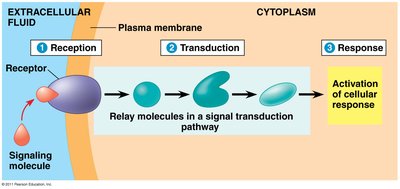
Cell communication is essential for coordinating cellular activities and responses to environmental signals. Cells use signaling pathways to detect and respond to external and internal cues, ensuring proper function and survival.
Signal Transduction Pathway: A series of steps by which a signal on a cell's surface is converted into a specific cellular response.
Three Main Steps:
Reception: The cell detects a signaling molecule from the outside of the cell.
Transduction: The binding of the signaling molecule changes the receptor protein in some way, initiating a cascade of events inside the cell.
Response: The transduced signal triggers a specific cellular activity, such as gene expression or enzyme activation.
Types of Cell Receptors
Transmembrane Receptors
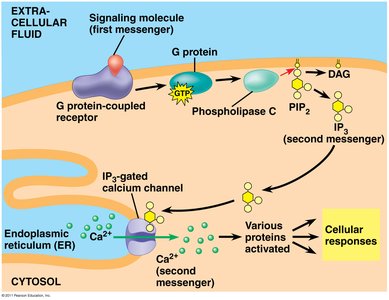
Transmembrane receptors are proteins that span the cell membrane and transmit signals from the extracellular environment to the cell's interior. They are crucial for detecting a wide variety of signals.
G Protein-Coupled Receptors (GPCRs): Involved in senses such as vision and smell. They activate G proteins, which then trigger various intracellular pathways.
Receptor Tyrosine Kinases (RTKs): Often associated with growth factors and can play a role in cancer when mutated or overactive.
Ligand-Gated Ion Channels: Open or close in response to the binding of a signaling molecule (ligand), allowing ions to flow across the membrane. Important in neurotransmitter release and nerve impulse transmission.
Intracellular Receptors
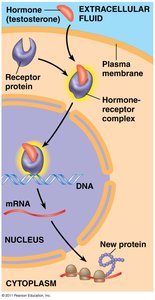
Intracellular receptors are found inside the cell, typically in the cytoplasm or nucleus. They bind to signaling molecules that can cross the cell membrane, such as steroid hormones and nitric oxide (NO).
Hormone-Receptor Complex: The hormone binds to its receptor, forming a complex that can act as a transcription factor to regulate gene expression.
Example: Testosterone enters the cell, binds to its receptor, and the complex influences the transcription of specific genes, leading to protein synthesis.
Signal Transduction Mechanisms
Phosphorylation and Dephosphorylation
Many signal transduction pathways involve the addition or removal of phosphate groups to proteins, which can activate or deactivate enzymes and other proteins.
Protein Kinases: Enzymes that transfer phosphate groups from ATP to proteins (phosphorylation).
Protein Phosphatases: Enzymes that remove phosphate groups from proteins (dephosphorylation).
Second Messengers
Second messengers are small molecules that relay signals received by receptors on the cell surface to target molecules inside the cell.
Common Second Messengers: cAMP (cyclic AMP), DAG (diacylglycerol), IP3 (inositol trisphosphate), Ca2+ (calcium ions).
Function: Amplify the signal and help coordinate the cell's response.
Cellular Responses to Signals
Types of Cellular Responses
Cells can respond to signals in various ways, depending on the pathway activated and the cell type.
Changes in Gene Expression: Activation or repression of specific genes, leading to changes in protein synthesis.
Alteration of Enzyme Activity: Activation or inhibition of enzymes, affecting metabolic pathways.
Modification of the Cytoskeleton: Changes in cell shape, movement, or division.
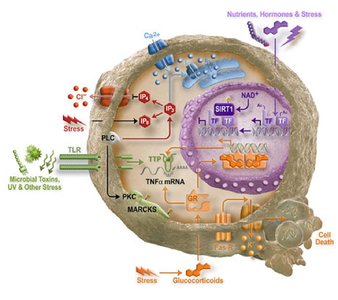
Cell Death (Apoptosis): Programmed cell death can be triggered by certain signals, especially in response to stress or damage.
Summary Table: Major Types of Cell Receptors and Their Functions
Receptor Type | Location | Ligand Example | Main Function |
|---|---|---|---|
G Protein-Coupled Receptor (GPCR) | Plasma membrane | Adrenaline, light (vision) | Activates G proteins, triggers second messengers |
Receptor Tyrosine Kinase (RTK) | Plasma membrane | Growth factors | Phosphorylates proteins, regulates cell growth/division |
Ligand-Gated Ion Channel | Plasma membrane | Neurotransmitters | Allows ion flow, changes membrane potential |
Intracellular Receptor | Cytoplasm or nucleus | Steroid hormones, NO | Regulates gene expression |
Key Equations
Phosphorylation Reaction:
cAMP Formation:
Additional info: The diagrams provided illustrate key concepts in cell signaling, including the three-step model of signal transduction, the role of second messengers, and the impact of signaling on gene expression and cellular responses to stress.
