 Indietro
Cell Communication and Signaling: Mechanisms and Examples
Guida di studio - Note intelligenti
 Appunti personalizzati basati sui tuoi materiali, ampliati con definizioni chiave, esempi e contesto.
Cell Communication
Introduction to Cell Signaling
Cell signaling is a fundamental process that allows cells to detect, send, and respond to external and internal signals. This communication is essential for coordinating cellular activities, especially in multicellular organisms. Signals can be chemical, electrical, or mechanical, and their reception and processing lead to specific cellular responses.
Types of Cell Signaling
Local Signaling
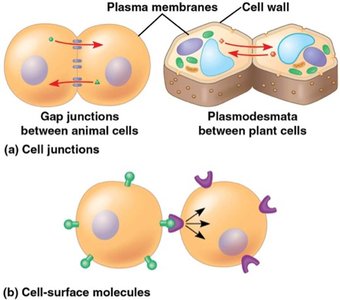
Local signaling occurs between cells that are in close proximity. Animal and plant cells can communicate directly through cell junctions or indirectly via secreted molecules.
Cell Junctions: Gap junctions in animal cells and plasmodesmata in plant cells allow direct cytoplasmic exchange of ions and molecules.
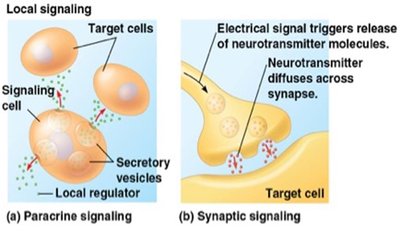
Paracrine Signaling: Cells release local regulators (e.g., growth factors) that affect nearby target cells.
Synaptic Signaling: In the nervous system, neurotransmitters are released in response to electrical signals and diffuse across synapses to target cells.
Long-Distance Signaling
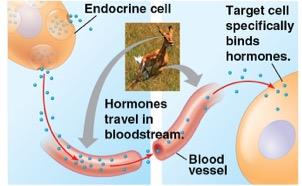
Long-distance signaling involves hormones that travel through the bloodstream to reach target cells far from their origin. This is known as endocrine signaling.
Hormones: Chemical messengers released by specialized cells, affecting distant target cells.
Specificity: Only cells with the appropriate receptor can respond to a given hormone.
The Three Stages of Cell Signaling
Signal Reception, Transduction, and Response
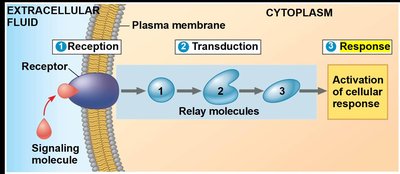
Cell signaling typically involves three main stages:
Signal Reception: The target cell detects a signaling molecule (ligand) via a receptor protein.
Signal Transduction: The receptor undergoes a conformational change, initiating a cascade of intracellular events.
Cellular Response: The cell executes a specific response, such as gene expression or metabolic changes.
Signal Reception: Types of Receptors
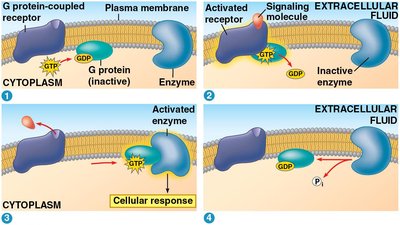
G Protein-Coupled Receptors (GPCRs)
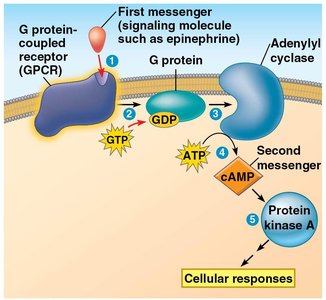
GPCRs are the largest family of cell-surface receptors. They interact with G proteins, which bind GTP and transmit signals from the extracellular environment to the cell's interior.
Structure: Transmembrane proteins with extracellular ligand-binding sites.
Function: Activate G proteins, which then regulate various enzymes and ion channels.
Receptor Tyrosine Kinases (RTKs)
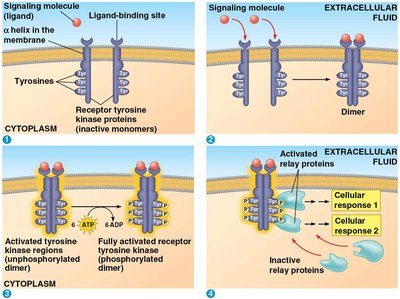
RTKs are membrane receptors that catalyze the transfer of phosphate groups from ATP to tyrosine residues on target proteins. They can trigger multiple signaling pathways simultaneously.
Role: Often involved in growth factor signaling.
Clinical relevance: Abnormal RTK function is linked to various cancers.
Ion Channel Receptors
Ligand-gated ion channel receptors open or close in response to ligand binding, allowing specific ions to flow across the membrane and alter cellular activity.
Example: Sodium ion channels in nerve cells.
Intracellular Receptors
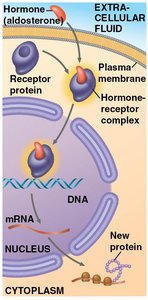
Some receptors are located inside the cell, in the cytoplasm or nucleus. These typically bind small or hydrophobic molecules, such as steroid hormones.
Example: Aldosterone, a steroid hormone, crosses the membrane and binds to intracellular receptors, influencing gene expression.
Signal Transduction Pathways
Phosphorylation Cascades
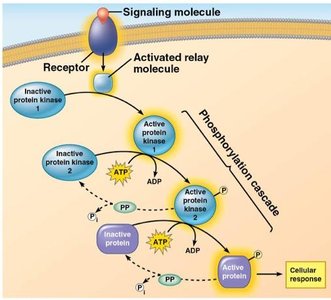
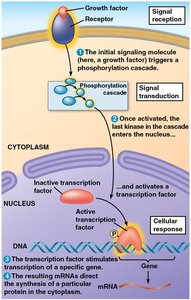
Signal transduction often involves cascades of protein kinases, which phosphorylate (add phosphate groups to) other proteins, acting as molecular switches to regulate activity.
Phosphorylation: Addition of a phosphate group, usually activating proteins.
Dephosphorylation: Removal of a phosphate group, often inactivating proteins.
Second Messengers
Second messengers are small, nonprotein molecules or ions that amplify and propagate signals within the cell. Common examples include cyclic AMP (cAMP) and calcium ions.
cAMP: Produced from ATP by adenylyl cyclase; activates protein kinase A.
Calcium ions: Regulate various cellular processes.

Cellular Responses to Signals
Nuclear Responses
Cell signaling can regulate gene expression by activating transcription factors, leading to the synthesis of specific proteins.
Example: Growth factors trigger phosphorylation cascades that activate transcription factors in the nucleus.
Cytoplasmic Responses
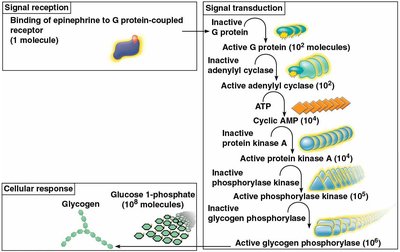
Signaling pathways can also regulate metabolic activities in the cytoplasm, such as the breakdown of glycogen to glucose in response to epinephrine.
Example: Glycogen phosphorylase is activated, breaking down glycogen into glucose for energy.
Hormonal Regulation: Insulin and Diabetes
Insulin Signaling and Glucose Regulation
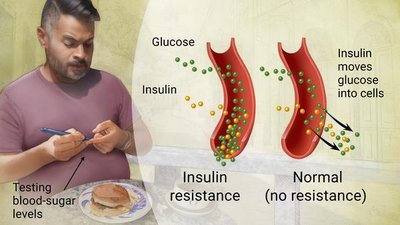
Insulin is a hormone produced by the pancreas that facilitates the uptake of glucose into cells, where it is stored as glycogen. Diabetes occurs when the body does not produce enough insulin or cannot use it effectively.
Normal Function: Insulin binds to its receptor, triggering pathways that promote glucose uptake and storage.
Diabetes: Characterized by insulin resistance or insufficient insulin production, leading to elevated blood glucose levels.
Summary Table: Types of Cell Signaling
Type | Mechanism | Example |
|---|---|---|
Direct Contact | Cell junctions (gap junctions, plasmodesmata) | Heart muscle cells |
Local Signaling | Paracrine, synaptic | Growth factors, neurotransmitters |
Long-Distance Signaling | Endocrine (hormones via bloodstream) | Insulin, epinephrine |
Key Equations
cAMP Formation:
Phosphorylation:
Dephosphorylation:
Application Example: The Impala's Flight Response
Cell Signaling in Action
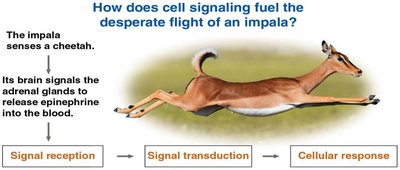
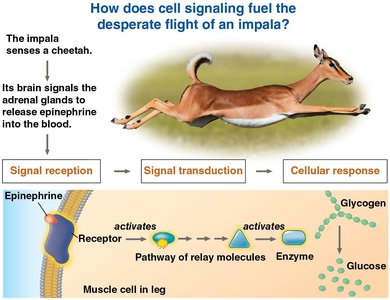
When an impala senses a predator, its brain signals the adrenal glands to release epinephrine. This hormone binds to receptors on muscle cells, triggering a cascade that results in the breakdown of glycogen to glucose, providing energy for rapid movement.
Signal Reception: Epinephrine binds to GPCR on muscle cells.
Signal Transduction: Activation of relay molecules and enzymes.
Cellular Response: Glycogen breakdown and glucose release.
Additional info: These notes expand on the original lecture content by providing definitions, examples, and key equations for cell signaling mechanisms, making them suitable for exam preparation in General Biology.
