 Indietro
Cell Communication and Signaling: Study Notes for General Biology
Guida di studio - Note intelligenti
 Appunti personalizzati basati sui tuoi materiali, ampliati con definizioni chiave, esempi e contesto.
Cell Communication
Cellular Messaging
Cells communicate with each other and interpret signals from their environment, primarily through chemical signals. These mechanisms are conserved across diverse species and biological processes.
Cell signaling is essential for coordination in multicellular organisms and among microorganisms.
Signals are often chemical messengers that trigger specific cellular responses.
The same signaling mechanisms are found in many organisms, indicating evolutionary conservation.

Cell Signaling in Microorganisms
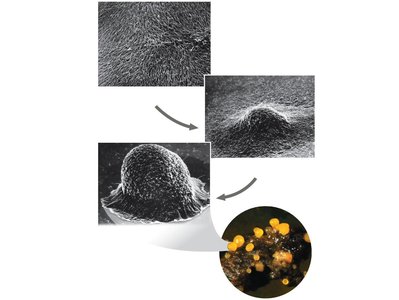
Microorganisms, such as yeast and bacteria, provide insight into cell signaling. Yeast cells use secreted factors to locate and mate with cells of the opposite type, initiating a signal transduction pathway.
Saccharomyces cerevisiae (yeast) has two mating types: a and α.
Cells secrete mating factors specific to their type, which bind to receptors on the opposite type.
Binding initiates a signal transduction pathway, leading to mating and formation of a new cell.
Cell signaling is also critical among prokaryotes, such as bacteria.
Quorum sensing allows bacteria to sense population density via signaling molecules.
Biofilm formation and toxin secretion are examples of quorum sensing in bacteria.
Local and Long-Distance Signaling
Local Signaling
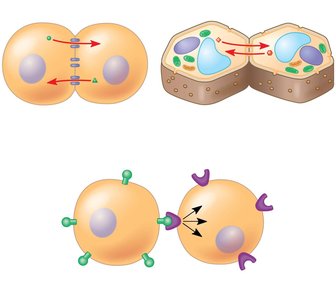
Cells communicate locally through direct contact or by releasing signaling molecules that affect nearby cells.
Cell junctions (gap junctions in animals, plasmodesmata in plants) allow direct cytoplasmic exchange.
Paracrine signaling: Growth factors stimulate nearby cells to grow and divide.
Synaptic signaling: Neurotransmitters are released in response to electrical signals in the nervous system.
Long-Distance Signaling
Hormones are used for long-distance signaling in plants and animals. In animals, this is called endocrine signaling.
Hormones travel through the circulatory system to reach target cells.
A cell's ability to respond depends on the presence of specific receptors.
The Three Stages of Cell Signaling
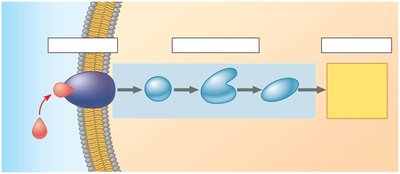
Reception
The target cell detects a signaling molecule (ligand) that binds to a receptor protein on the cell surface.
Binding is highly specific.
Shape change in the receptor initiates signal transduction.
Most receptors are plasma membrane proteins.
Transduction
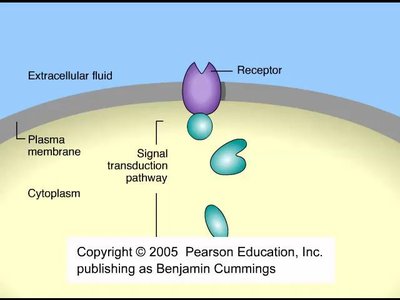
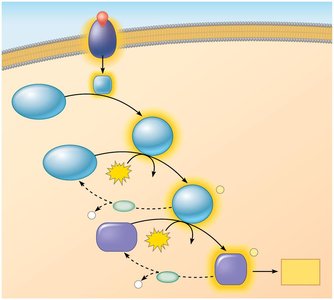
The binding of the signaling molecule alters the receptor and initiates a signal transduction pathway, often involving multiple steps and relay molecules.
Multistep pathways amplify signals and allow regulation.
Protein phosphorylation and dephosphorylation are key regulatory mechanisms.
Protein kinases transfer phosphate groups from ATP to proteins (phosphorylation).
Protein phosphatases remove phosphates (dephosphorylation).
Response
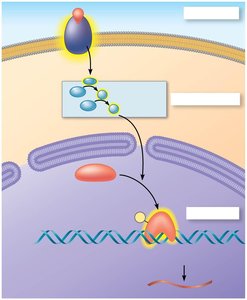
The transduced signal triggers a specific cellular response, such as regulation of gene expression or enzyme activity.
Responses may occur in the nucleus (gene expression) or cytoplasm (enzyme activity).
Signaling pathways can affect cell division, movement, or metabolism.
Types of Cell Surface Receptors
G Protein-Coupled Receptors (GPCRs)
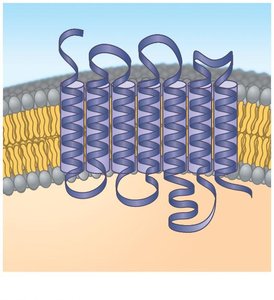
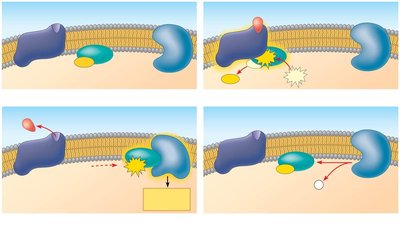
GPCRs are the largest family of cell-surface receptors and work with the help of G proteins, which bind GTP.
GPCRs are involved in diverse functions.
Most water-soluble signals bind to GPCRs.
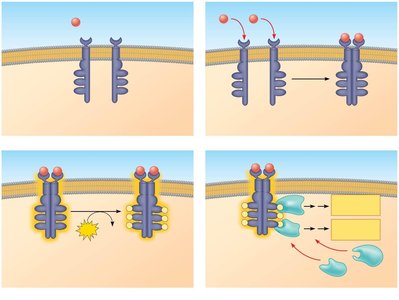
Receptor Tyrosine Kinases (RTKs)
RTKs are membrane receptors that transfer phosphate groups from ATP to tyrosine residues on proteins, triggering multiple signal transduction pathways.
RTKs can activate several pathways simultaneously.
Abnormal RTK function is linked to cancer.
Ligand-Gated Ion Channel Receptors
These receptors act as gates that open or close in response to ligand binding, allowing specific ions to pass through.
Important in nervous system signaling.
Examples include GABA receptors affected by tranquilizers.
Intracellular Receptors
Mechanism and Examples
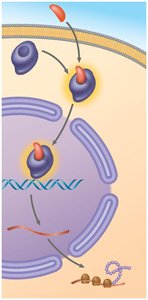
Intracellular receptors are found in the cytoplasm or nucleus. Small or hydrophobic messengers, such as steroid and thyroid hormones, can cross the membrane and activate these receptors.
Activated hormone-receptor complexes act as transcription factors.
Regulate gene expression directly.
Second Messengers in Signal Transduction
Cyclic AMP (cAMP)
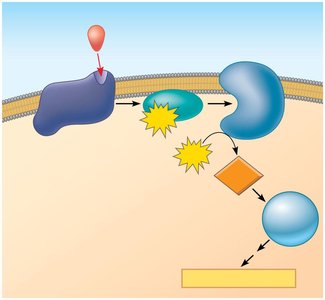
cAMP is a common second messenger produced by adenylyl cyclase in response to extracellular signals.
Participates in pathways initiated by GPCRs and RTKs.
Amplifies cellular responses.
Cholera toxin disrupts cAMP regulation, causing severe dehydration.
Calcium Ions and Inositol Triphosphate (IP3)
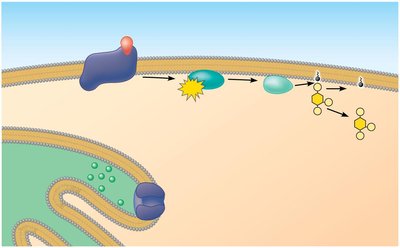
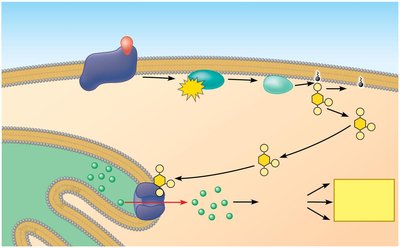
Calcium ions (Ca2+) are widely used as second messengers. Their concentration is tightly regulated, and small changes can have significant effects.
IP3 and DAG are produced by cleavage of membrane phospholipids and help release Ca2+ from internal stores.
Ca2+ signaling is involved in muscle contraction, neurotransmitter release, and other processes.
Regulation and Specificity of Cell Signaling
Signal Amplification
Enzyme cascades amplify the cell's response, with each step activating more molecules than the previous one.
Allows a small signal to produce a large response.
Specificity and Coordination
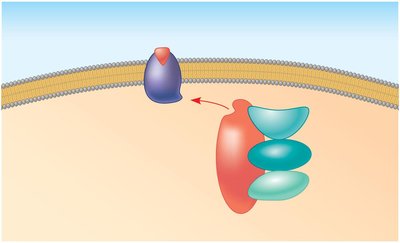
Different cells have different proteins, allowing them to respond uniquely to the same signal. Pathway branching and cross-talk help coordinate responses.
Scaffolding proteins enhance signaling efficiency by grouping relay proteins.
Termination of the Signal
Inactivation mechanisms ensure that signals are not perpetually active. Unbound receptors revert to an inactive state when signaling molecules decrease.
Apoptosis: Programmed Cell Death
Mechanism and Importance
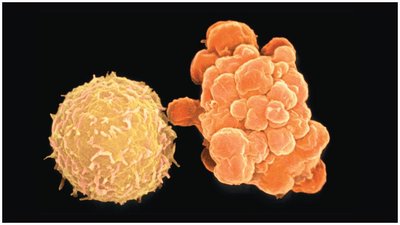
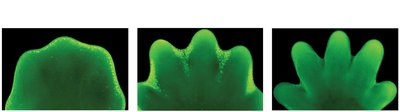
Apoptosis is a controlled process of cell death, preventing damage to neighboring cells. It is triggered by internal or external signals and involves a cascade of proteases called caspases.
Apoptosis is essential for development and disease prevention.
Interference with apoptosis can lead to cancer or degenerative diseases.
Summary Table: Types of Cell Signaling
Type | Distance | Example |
|---|---|---|
Direct Contact | Local | Gap junctions, plasmodesmata |
Paracrine | Local | Growth factors |
Synaptic | Local | Neurotransmitters |
Endocrine | Long-distance | Hormones |
Key Equations
Protein phosphorylation:
cAMP formation:
