 Indietro
Cell Communication and Signaling: Study Notes for General Biology
Guida di studio - Note intelligenti
 Appunti personalizzati basati sui tuoi materiali, ampliati con definizioni chiave, esempi e contesto.
Cell Communication
Cellular Messaging
Cells communicate with each other and interpret signals from their environment, primarily through chemical signals. These mechanisms are conserved across diverse species and processes, highlighting their fundamental importance in biology.
Cell signaling enables cells to coordinate activities and respond to environmental changes.
Signals are often chemical molecules, such as hormones or neurotransmitters.
Similar cell-signaling mechanisms are found in both simple and complex organisms.
Cell Signaling in Microorganisms
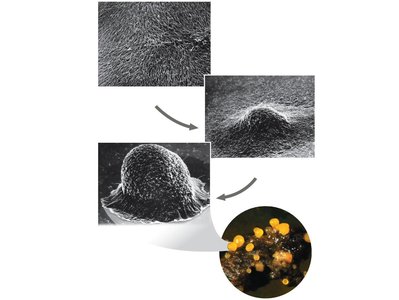
Microorganisms, such as yeast and bacteria, provide insight into cell signaling. Yeast cells use secreted factors to locate and mate with cells of the opposite type, initiating a signal transduction pathway. Bacteria use quorum sensing to detect population density and coordinate behaviors like biofilm formation.
Yeast mating types: a and α cells secrete specific factors to find each other.
Quorum sensing: Bacteria release signaling molecules to sense population density, leading to coordinated actions such as toxin secretion or biofilm formation.
Local and Long-Distance Signaling
Local Signaling
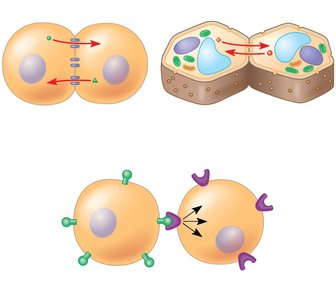
Cells in multicellular organisms communicate via signaling molecules. Local signaling includes direct contact through cell junctions and short-distance communication via secreted molecules.
Cell junctions: Gap junctions in animals and plasmodesmata in plants allow direct cytoplasmic exchange.
Paracrine signaling: Growth factors stimulate nearby cells to grow and divide.
Synaptic signaling: Neurotransmitters are released in response to electrical signals in the nervous system.
Long-Distance Signaling
Long-distance signaling involves hormones, which are released by specialized cells and travel through the circulatory system to target cells. This is known as endocrine signaling.
Hormones: Chemical messengers that regulate physiological processes.
Cells respond to hormones only if they have specific receptors for them.
The Three Stages of Cell Signaling
Overview
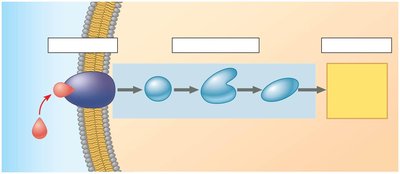
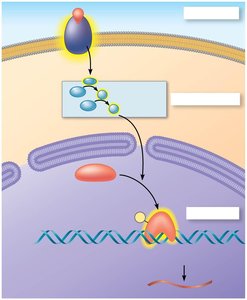
Cell signaling typically involves three stages: Reception, Transduction, and Response.
Reception: The cell detects a signaling molecule via a receptor protein.
Transduction: The signal is relayed and amplified through a series of molecular changes.
Response: The cell produces a specific response, such as gene expression or enzyme activation.
Reception: Signal Detection
Membrane Receptors
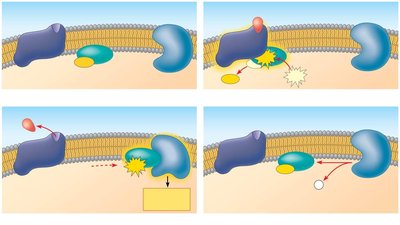
Signal molecules (ligands) bind to highly specific receptor proteins, often located in the plasma membrane. This binding causes a shape change in the receptor, initiating signal transduction.
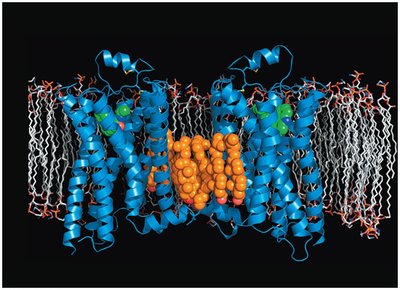
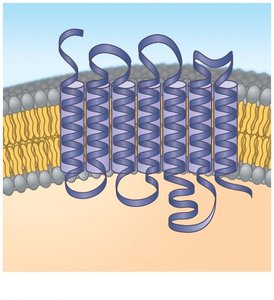
Three main types of membrane receptors: G protein-coupled receptors (GPCRs), Receptor tyrosine kinases (RTKs), and Ion channel receptors.
GPCRs are the largest family of cell-surface receptors and are involved in diverse functions.
Receptor Tyrosine Kinases (RTKs)
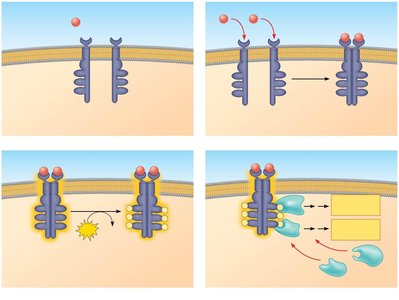
RTKs are membrane receptors that transfer phosphate groups from ATP to proteins, triggering multiple signal transduction pathways. Abnormal RTK function is linked to cancer.
Ion Channel Receptors
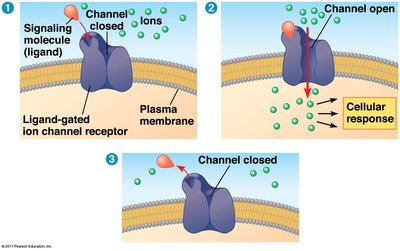
Ligand-gated ion channels open or close in response to ligand binding, allowing specific ions to pass through the membrane and alter cell activity.
Intracellular Receptors
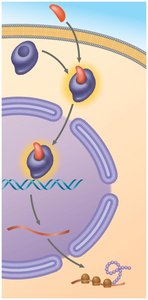
Intracellular receptors are located in the cytoplasm or nucleus. Small or hydrophobic messengers, such as steroid and thyroid hormones, can cross the membrane and activate these receptors, often acting as transcription factors.
Transduction: Signal Relay and Amplification
Signal Transduction Pathways
Signal transduction involves a cascade of molecular interactions, often resulting in amplification and regulation of the signal.
Each step in the pathway typically involves a shape change in a protein.
Multistep pathways allow for greater control and coordination.
Protein Phosphorylation and Dephosphorylation
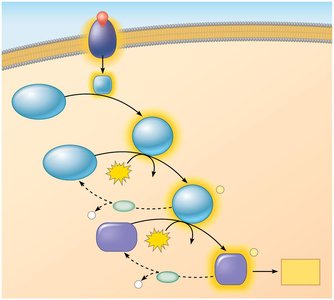
Phosphorylation (by protein kinases) and dephosphorylation (by protein phosphatases) regulate protein activity, acting as a molecular switch.
Phosphorylation cascade: Sequential activation of kinases amplifies the signal.
Dephosphorylation turns off the signal.
Second Messengers
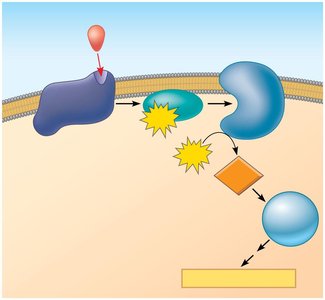
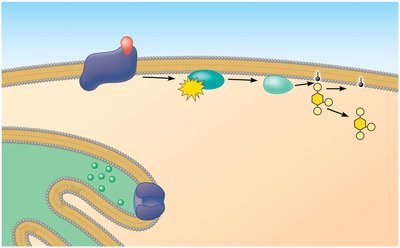
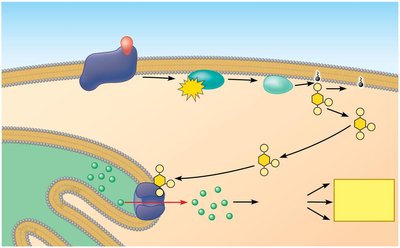
Second messengers are small, nonprotein molecules or ions that spread throughout the cell and participate in signaling pathways. Common examples include cyclic AMP (cAMP) and calcium ions (Ca2+).
cAMP: Produced by adenylyl cyclase in response to extracellular signals.
Calcium ions: Concentration changes act as signals, often regulated by IP3 and DAG.
Response: Cellular Outcomes
Nuclear and Cytoplasmic Responses
The final outcome of cell signaling is regulation of cellular activities, which may occur in the nucleus (gene expression) or cytoplasm (enzyme activity, ion channel regulation).
Signaling pathways can activate transcription factors, leading to gene expression.
Other pathways regulate enzyme activity or cell behavior (e.g., division, movement).
Regulation of the Response
Cell signaling is regulated in several ways to ensure appropriate responses:
Amplification: Enzyme cascades increase the magnitude of the response.
Specificity: Different cells respond differently to the same signal due to unique protein collections.
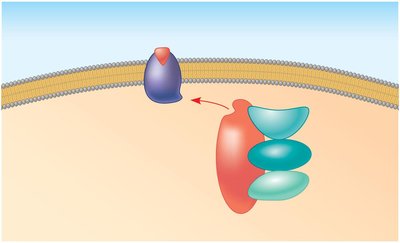
Efficiency: Scaffolding proteins organize signaling components for rapid and coordinated responses.
Termination: Inactivation mechanisms ensure signals are not perpetuated unnecessarily.
Apoptosis: Programmed Cell Death
Mechanisms and Importance
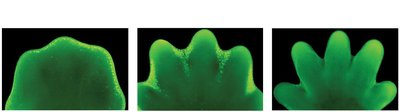
Apoptosis is a form of programmed cell death, crucial for development and maintaining tissue health. It involves the orderly dismantling of cellular components, preventing damage to neighboring cells.
Triggered by internal or external signals, activating a cascade of proteases called caspases.
Essential for normal development (e.g., removal of interdigital tissue in embryos) and prevention of disease.
Type of Receptor | Function | Example |
|---|---|---|
GPCR | Activates G protein, triggers signaling cascade | Adrenaline receptor |
RTK | Phosphorylates proteins, triggers multiple pathways | Insulin receptor |
Ion Channel | Opens/closes to allow ion flow | GABA receptor |
Key Equations:
Phosphorylation:
cAMP formation:
Additional info: Signal transduction pathways are highly regulated and can involve feedback mechanisms, cross-talk between pathways, and integration of multiple signals to produce complex cellular responses.
