 Indietro
Cell Communication and Signaling: Study Notes for General Biology
Guida di studio - Note intelligenti
 Appunti personalizzati basati sui tuoi materiali, ampliati con definizioni chiave, esempi e contesto.
Cell Communication
Overview of Cell Communication
Cell communication is essential for the regulation and coordination of biological processes in both unicellular and multicellular organisms. Cells use signaling molecules to transmit information, enabling responses to environmental changes and internal cues.
Signaling molecules are used for communication between cells.
Communication can be local (between adjacent cells) or long-distance (using hormones).
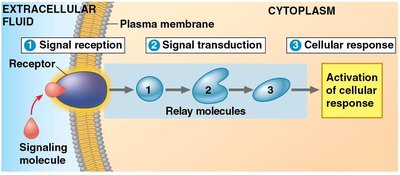
Cell signaling involves three main stages: reception, transduction, and response.
Communication Between Prokaryotes
Conjugation and Quorum Sensing
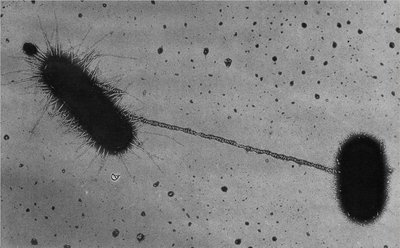
Prokaryotes, such as bacteria, communicate using direct contact and chemical signals.
Conjugation: Direct cell contact via pili allows exchange of genetic material.
Quorum sensing: Bacteria secrete signaling molecules that are sensed by nearby cells, regulating population density, biofilm formation, virulence, and bioluminescence.
Example: Vibrio fischeri bacteria produce bioluminescence in the light organ of the Hawaiian bobtail squid (Euprymna scolopes).
Communication Between Unicellular Eukaryotes
Yeast Mating and Signal Transduction
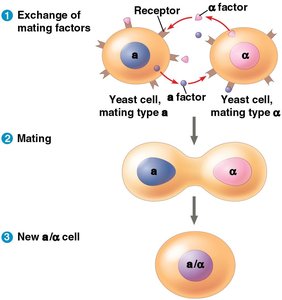
Unicellular eukaryotes, such as yeast, use chemical signals to locate and mate with cells of opposite mating types.
Saccharomyces cerevisiae (yeast) has two mating types: a and α.
Cells secrete mating factors specific to their type, which are recognized by receptors on the opposite type.
Binding of a mating factor initiates a signal transduction pathway leading to mating and formation of a new cell.
Communication in Multicellular Eukaryotes
Local and Long-Distance Signaling
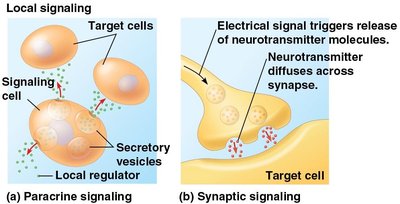
Multicellular organisms use a variety of mechanisms for cell communication, including local and long-distance signaling.
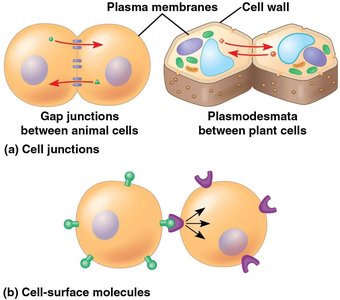
Local signaling occurs via cell junctions (gap junctions in animals, plasmodesmata in plants) and cell-cell recognition using surface molecules.
Paracrine signaling: Local regulators affect nearby cells.
Synaptic signaling: Neurotransmitters are released across synapses in the nervous system.
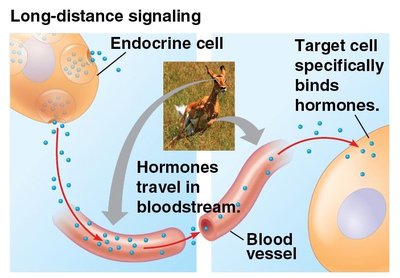
Endocrine signaling: Hormones are released by specialized cells and travel through the bloodstream to distant target cells.
Plant hormones may travel in vessels, cell-to-cell, or diffuse through air.
The Three Stages of Cell Signaling
Reception, Transduction, and Response
Cell signaling involves three sequential stages:
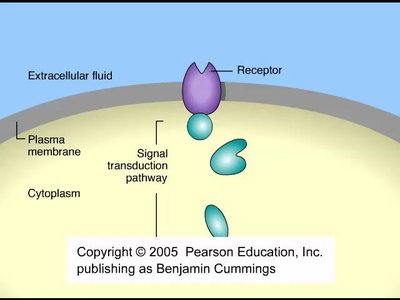
Reception: The cell detects a signaling molecule (ligand) from outside the cell.
Transduction: The signal is relayed and amplified through a series of molecular changes, often involving relay proteins.
Response: The cell responds by altering its activity, such as gene expression or enzyme activity.
Reception: Signal Detection
Types of Receptors
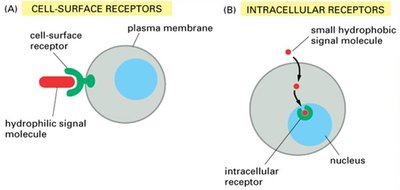
Signal reception is highly specific and involves receptors located on the cell surface or inside the cell.
Most signal receptors are plasma membrane proteins.
Some receptors are located inside the cell (intracellular receptors).
Binding of a ligand causes a shape change in the receptor, initiating signal transduction.
Membrane Receptors
There are three main types of membrane receptors:
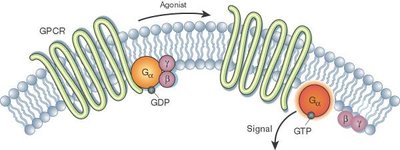
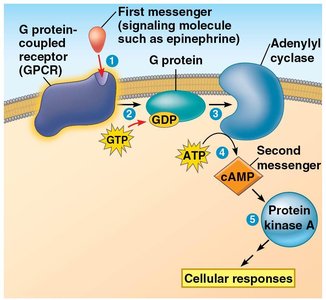
G protein-coupled receptors (GPCRs): Associated with G proteins; ligand binding activates G protein by exchanging GDP for GTP, which then activates downstream enzymes.
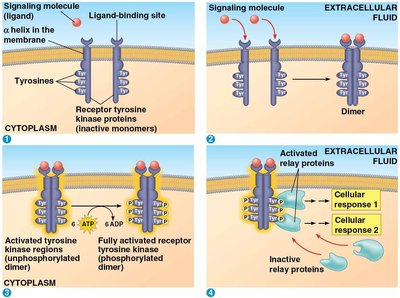
Receptor tyrosine kinases (RTKs): Trigger multiple signal transduction pathways; ligand binding causes dimerization and phosphorylation of tyrosine residues.
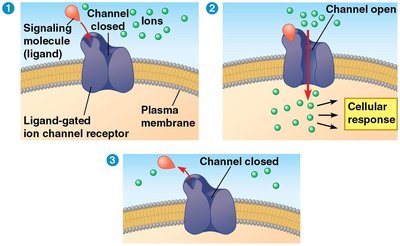
Ion channel receptors: Act as gates that open or close to allow specific ions (e.g., Na+, Ca2+) through the membrane.
Intracellular Receptors
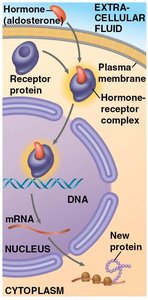
Intracellular receptors are found in the cytoplasm or nucleus and are activated by small or hydrophobic molecules.
Examples: steroid and thyroid hormones.
An activated hormone-receptor complex can act as a transcription factor, regulating gene expression.
Transduction: Signal Relay and Amplification
Signal Transduction Pathways
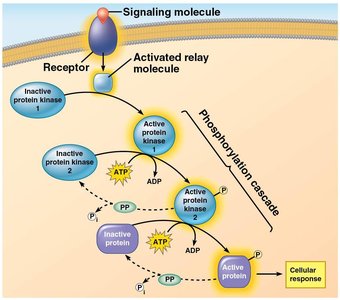
Signal transduction is a multistep process that amplifies the signal and allows for regulation.
The activated receptor triggers a chain of molecular interactions, often involving protein phosphorylation.
Each step transduces the signal into a different form, usually a shape change in a protein.
The original signal molecule is not passed along the pathway.
Second Messengers
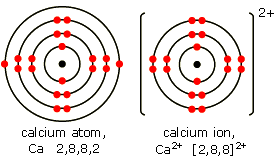
Many signaling pathways involve second messengers, which are small, non-protein, water-soluble molecules or ions.
Common second messengers: cyclic AMP (cAMP), calcium ions (Ca2+).
Second messengers participate in pathways initiated by GPCRs and RTKs.
Cyclic AMP (cAMP)
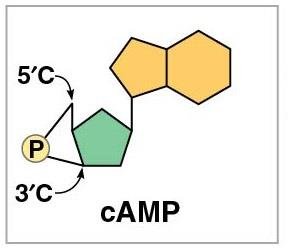
cAMP is produced from ATP by the enzyme adenylyl cyclase in response to extracellular signals.
cAMP activates protein kinase A, which phosphorylates target proteins.
cAMP diffuses through the cell to propagate the signal.

Calcium Ions and Inositol Triphosphate (IP3)
Calcium ions are important second messengers, and their concentration is tightly regulated.
Signal transduction pathways often trigger release of Ca2+ from the endoplasmic reticulum.
IP3 and diacylglycerol (DAG) are additional second messengers involved in these pathways.
Cellular Response
Types of Cellular Responses
A signal transduction pathway leads to regulation of one or more cellular activities, known as the output response.
Responses may occur in the nucleus (regulation of gene expression) or cytoplasm (regulation of protein activity).
Examples: cell division, growth, differentiation, cell death, enzyme activation, inhibition of cell activity.
Regulation of the Response
Signal Amplification
Enzyme cascades amplify the cell's response to a single signal.
Each step increases the number of activated products.
Specificity of Cell Signaling
The same signal can have different effects in cells with different proteins and pathways.
Pathway branching and cross-talk help coordinate incoming signals.
Signaling Efficiency
Scaffolding proteins increase signal transduction efficiency by grouping together different proteins involved in the same pathway.
Termination of the Signal
Inactivation mechanisms are essential for cell signaling.
Cellular response only occurs when the concentration of receptors with bound signaling molecules is above a threshold.
Binding of signal molecules to receptors must be reversible.
Unbound receptors revert to an inactive state.
Cell Death: Apoptosis
Programmed Cell Death
Cells that are infected, damaged, or at the end of their functional lives undergo programmed cell death (apoptosis).
Apoptosis involves fragmentation and packaging of cellular components into vesicles for digestion by scavenger cells.
Prevents damage to neighboring cells.
Essential for development and maintenance in animals (e.g., formation of fingers and toes).
Type of Signaling | Distance | Example |
|---|---|---|
Paracrine | Local | Growth factors |
Synaptic | Local | Neurotransmitters |
Endocrine | Long-distance | Hormones |
Cell junctions | Direct contact | Gap junctions, plasmodesmata |
Cell-cell recognition | Direct contact | Immune response |
Receptor Type | Location | Ligand Type | Example |
|---|---|---|---|
GPCR | Plasma membrane | Water-soluble | Epinephrine |
RTK | Plasma membrane | Water-soluble | Growth factors |
Ion channel | Plasma membrane | Ion | Neurotransmitters |
Intracellular | Cytoplasm/Nucleus | Hydrophobic | Steroid hormones |
Additional info: Signal transduction pathways often involve feedback mechanisms (positive or negative) and can be regulated by pathway crosstalk, ensuring precise control of cellular responses.
