 Indietro
Cell Communication: Mechanisms and Pathways
Guida di studio - Note intelligenti
 Appunti personalizzati basati sui tuoi materiali, ampliati con definizioni chiave, esempi e contesto.
Cell Communication
Overview of Cell Signaling
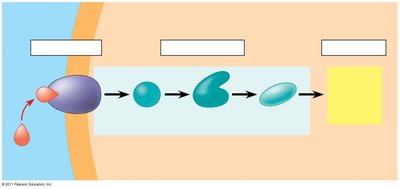
Cell communication is essential for multicellular organisms to coordinate activities and respond to environmental cues. External signals are converted to cellular responses through a series of steps: reception, transduction, and response. - Reception: The cell detects a signaling molecule from the outside. - Transduction: The signal is relayed and amplified inside the cell, often through a cascade of molecular events. - Response: The cell reacts, which may involve changes in gene expression, metabolism, or cell behavior. 
Types of Cell Signaling
Cells communicate through various mechanisms, which can be classified based on the distance the signal travels.
Local Signaling
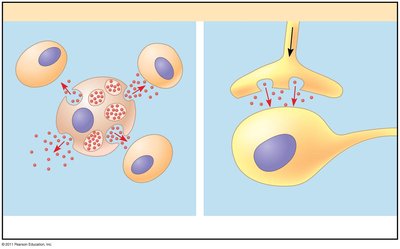
- Direct contact: Cells can communicate via specialized junctions (gap junctions in animals, plasmodesmata in plants) or cell-cell recognition. - Paracrine signaling: Local regulators are released and affect nearby cells. - Synaptic signaling: Neurotransmitters are released at synapses between nerve cells. 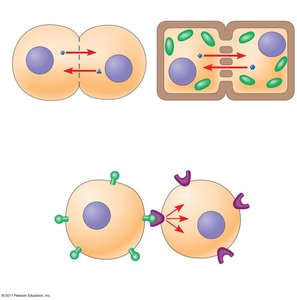
Long-Distance Signaling
- Endocrine signaling: Hormones are released into the bloodstream and act on distant target cells. 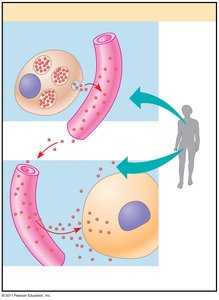
Stages of Cell Signaling
The three stages of cell signaling are:
Reception: A signaling molecule binds to a receptor protein, causing it to change shape.
Transduction: Cascades of molecular interactions relay signals from receptors to target molecules in the cell.
Response: Cell signaling leads to regulation of transcription or cytoplasmic activities.
Signal Transduction Pathways
Signal transduction pathways involve a sequence of changes in a series of molecules, resulting in a cellular response. Key Point: The most complete description is "a sequence of changes in a series of molecules resulting in a response."
Cell-Surface Receptors
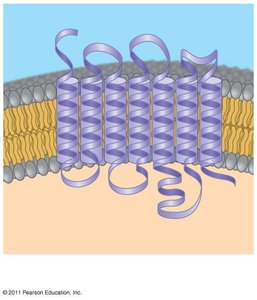
Cell-surface transmembrane receptors are proteins embedded in the plasma membrane that bind signaling molecules.
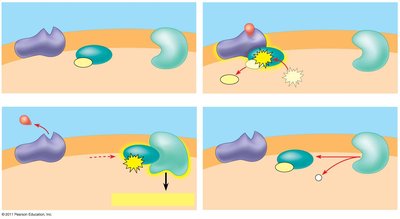
G protein-coupled receptors (GPCRs): Activate G proteins, which relay signals to other molecules.
Receptor tyrosine kinases (RTKs): Dimerize and autophosphorylate, activating relay proteins.
Ion channel receptors: Ligand binding opens or closes ion channels, altering cell activity.
Intracellular Receptors
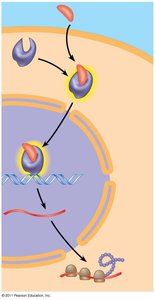
Some signaling molecules, such as steroid hormones, pass through the plasma membrane and bind to intracellular receptors. The hormone-receptor complex then acts as a transcription factor, regulating gene expression. 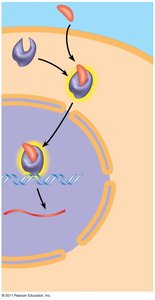
Transduction: Cascades and Second Messengers
Protein Phosphorylation and Dephosphorylation
- Protein kinases: Enzymes that transfer phosphate groups from ATP to proteins, activating them. - Protein phosphatases: Remove phosphate groups, deactivating proteins. - Phosphorylation cascade: Amplifies the signal and allows fine-tuning. 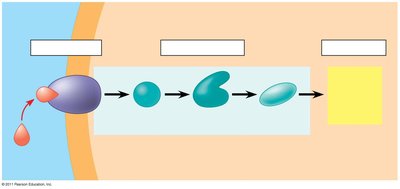
Second Messengers
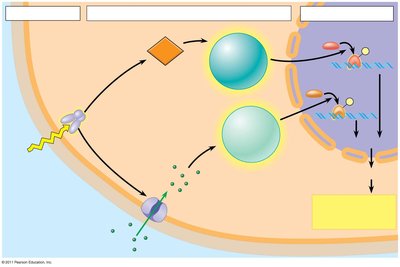
Second messengers are small molecules or ions that relay signals inside the cell. - Cyclic AMP (cAMP): Produced by adenylyl cyclase; activates protein kinase A. - Calcium ions (Ca2+): Released from intracellular stores; activate various proteins. - Inositol triphosphate (IP3): Triggers Ca2+ release from the endoplasmic reticulum. 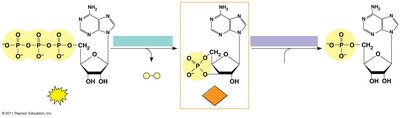
Cellular Responses to Signaling
Cell signaling can regulate transcription (gene expression) or cytoplasmic activities (such as metabolism or cell movement). 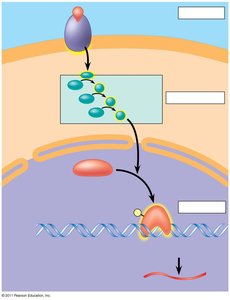
Apoptosis: Programmed Cell Death
Apoptosis is a controlled process of cell death, essential for development and homeostasis. It integrates multiple signaling pathways, including intrinsic (internal) and extrinsic (external) signals. - Intrinsic pathway: Triggered by internal cell damage (e.g., DNA damage, ER stress). - Extrinsic pathway: Triggered by external signals (e.g., death ligands binding to cell surface receptors). - Caspases: Proteases that execute apoptosis by cleaving cellular components. 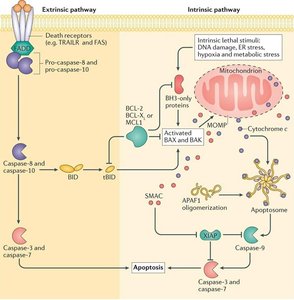
Summary Table: Types of Cell Signaling
Type | Distance | Example |
|---|---|---|
Direct contact | Local | Gap junctions, plasmodesmata |
Paracrine | Local | Growth factors |
Synaptic | Local | Neurotransmitters |
Endocrine | Long-distance | Hormones |
Key Terms
- Signal transduction pathway: Series of steps by which a signal is converted to a cellular response. - Ligand: A molecule that binds to a receptor. - Second messenger: Small molecule or ion that relays a signal inside the cell. - Apoptosis: Programmed cell death. Example: Apoptosis is crucial for removing damaged or unnecessary cells during development. Additional info: The notes expand on brief points by providing definitions, examples, and context for each signaling mechanism.
