 Indietro
Cell Communication: Mechanisms and Pathways
Guida di studio - Note intelligenti
 Appunti personalizzati basati sui tuoi materiali, ampliati con definizioni chiave, esempi e contesto.
Cell Communication
Overview of Cell Signaling
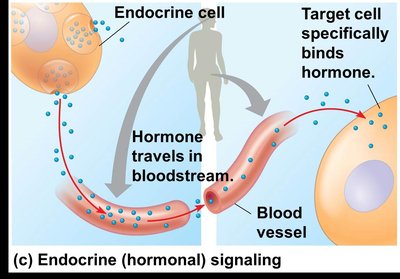
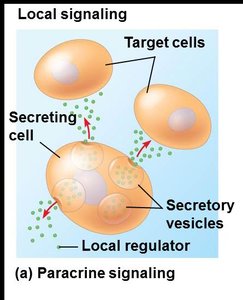
Cell communication is essential for the coordination of cellular activities in multicellular organisms. Cells communicate through chemical signals that can act locally or at a distance, triggering specific responses in target cells. The main types of signaling include endocrine, paracrine, and synaptic signaling.
Endocrine signaling: Involves hormones released by specialized cells that travel through the bloodstream to reach distant target cells. This type of signaling is typically slow but has long-lasting effects.
Paracrine signaling: Involves local regulators, such as growth factors, that affect nearby cells. This signaling is fast and short-lived.
Synaptic signaling: Occurs in the nervous system, where neurotransmitters are released in response to electrical signals and act on adjacent cells.
Epinephrine (Adrenaline) and the Fight-or-Flight Response
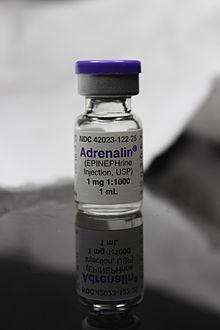
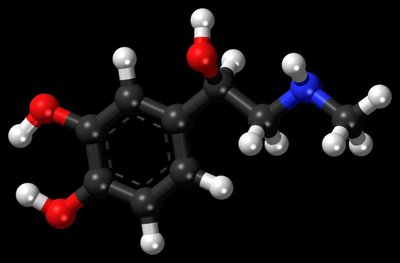
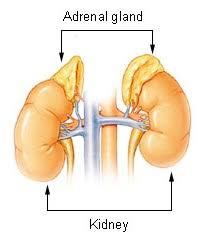
Epinephrine (also known as adrenaline) is a hormone and neurotransmitter involved in the body's acute stress response. It is released from the adrenal glands during the 'fight-or-flight' response, leading to physiological changes such as increased heart rate, blood pressure, and energy availability.
Discovery: First extracted by Napoleon Cybulski and purified by Jokichi Takamine.
Pathway elucidation: Earl Sutherland discovered how epinephrine stimulates the breakdown of glycogen in cells.
Effects: Epinephrine can lead to phenomena such as 'hysterical strength' due to rapid mobilization of energy stores.
The Three Stages of Cell Signaling
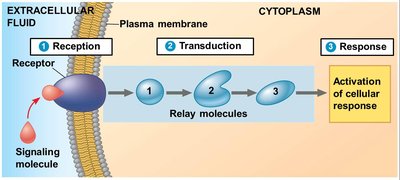
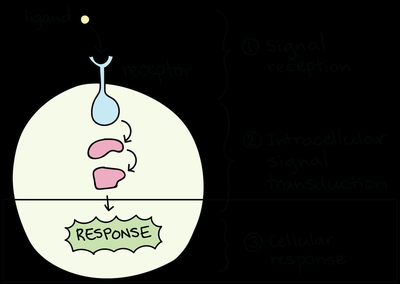
Cell signaling typically involves three main stages: reception, transduction, and response. Earl W. Sutherland's work demonstrated that intact cells are required for hormone action and that signaling involves intermediate steps.
Reception: The target cell detects a signaling molecule (ligand) that binds to a receptor protein on the cell surface or inside the cell.
Transduction: The binding of the ligand changes the receptor, initiating a cascade of intracellular events (signal transduction pathway).
Response: The transduced signal triggers a specific cellular response, such as gene expression, enzyme activation, or cell division.
Reception: Types of Cell Surface Receptors
Membrane Receptors
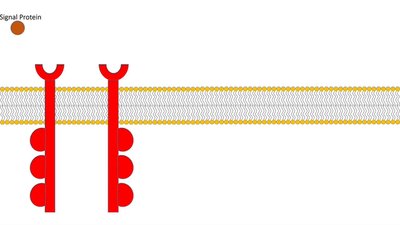
Most signal receptors are plasma membrane proteins. There are three main types:
G protein-coupled receptors (GPCRs): The largest family of cell surface receptors. They work with the help of G proteins, which bind GTP and act as molecular switches.
Receptor tyrosine kinases (RTKs): Enzymatic receptors that attach phosphates to tyrosine residues on themselves and other proteins, triggering multiple signaling pathways.
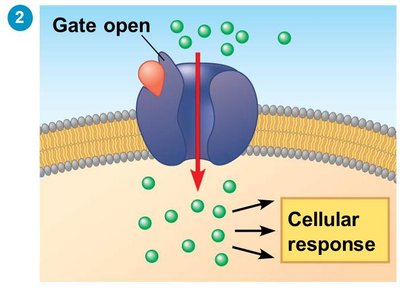
Ion channel receptors: Ligand-gated channels that open or close in response to binding of a signaling molecule, allowing specific ions to flow across the membrane and rapidly change cell activity.
G Protein-Coupled Receptors (GPCRs)
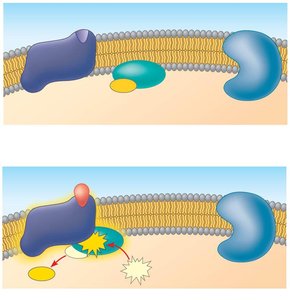
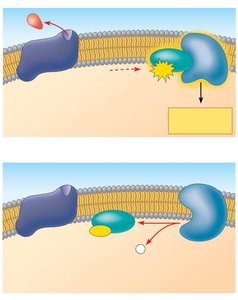
GPCRs are integral membrane proteins that transmit signals inside the cell via G proteins. The G protein acts as an on/off switch, activated by GTP binding and inactivated when GTP is hydrolyzed to GDP.
When a ligand binds to the GPCR, the receptor activates the G protein by facilitating the exchange of GDP for GTP.
The activated G protein then interacts with other membrane proteins, such as enzymes, to propagate the signal.
Rapid inactivation occurs when the ligand dissociates and the G protein hydrolyzes GTP to GDP.
Receptor Tyrosine Kinases (RTKs)
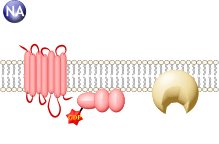
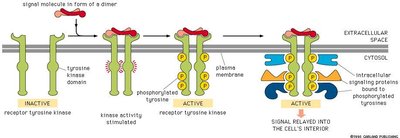
RTKs are membrane receptors that catalyze the transfer of phosphate groups from ATP to tyrosine residues on proteins. They can trigger multiple signaling pathways simultaneously.
RTKs exist as monomers until ligand binding induces dimerization.
Dimerization activates the kinase domains, leading to autophosphorylation of tyrosines.
Relay proteins bind to phosphorylated tyrosines, initiating various transduction pathways.
Intracellular Receptors
Some hormones and signaling molecules are lipid-soluble and can cross the plasma membrane to bind intracellular receptors. The hormone-receptor complex often acts as a transcription factor, regulating gene expression in the nucleus.
Examples include steroid hormones like aldosterone.
The complex binds DNA and stimulates transcription of specific genes, leading to protein synthesis.
Transduction: Signal Cascades and Second Messengers
Protein Phosphorylation Cascades
Many signal transduction pathways involve a series of protein kinases that sequentially phosphorylate each other, amplifying the signal. Protein phosphatases remove phosphates, turning off the signal.
Phosphorylation: Addition of phosphate groups by kinases activates proteins.
Dephosphorylation: Removal of phosphate groups by phosphatases deactivates proteins.
Second Messengers
Second messengers are small, non-protein, water-soluble molecules or ions that relay signals from receptors to target molecules inside the cell. Common examples include cyclic AMP (cAMP) and calcium ions (Ca2+).
cAMP: Generated from ATP by adenylyl cyclase, often in response to GPCR activation. cAMP activates protein kinase A, leading to a cascade of cellular responses.
Calcium ions: Released from intracellular stores or enter through channels, triggering various cellular processes.
Response: Cellular Outcomes of Signaling
Types of Cellular Responses
The final outcome of cell signaling can vary widely, including changes in gene expression, enzyme activity, cell division, secretion, or programmed cell death (apoptosis).
Regulation of transcription (gene expression) or cytoplasmic activities.
Opening or closing of ion channels, changes in metabolism, or vesicle exocytosis.
Amplification of the signal through enzyme cascades.
Regulation of the Response
Cell signaling is tightly regulated to ensure appropriate responses. Key aspects include:
Amplification: Enzyme cascades increase the magnitude of the response.
Specificity: Different cells may respond differently to the same signal due to variations in receptor types and intracellular machinery.
Efficiency: Scaffolding proteins enhance the speed and accuracy of signaling.
Termination: Inactivation mechanisms ensure that signals are not perpetuated unnecessarily. Defective termination can lead to diseases such as cancer.
Apoptosis: Programmed Cell Death
Mechanisms and Importance
Apoptosis is a form of programmed cell death that is essential for development, maintenance, and defense against disease. It involves the orderly dismantling of cellular components, preventing damage to neighboring cells.
Triggered by internal signals (e.g., DNA damage) or external signals (e.g., developmental cues).
Critical for processes such as the development of fingers and toes, and for removing damaged or potentially cancerous cells.
Dysregulation of apoptosis is implicated in diseases such as cancer, Parkinson's, and Alzheimer's.
Summary Table: Types of Cell Signaling
Type | Distance | Signal Molecule | Example |
|---|---|---|---|
Endocrine | Long | Hormone | Adrenaline (Epinephrine) |
Paracrine | Short | Growth factor | Local tissue repair |
Synaptic | Very short | Neurotransmitter | Acetylcholine in neurons |
Key Concepts to Know
Types of signaling: endocrine, paracrine, synaptic
Reception: GPCRs and RTKs activate second messengers by phosphorylating enzymes
Transduction cascade: Each step amplifies the signal
Response: Can include cell division, apoptosis, gene expression, secretion, or metabolic changes
