 Indietro
Cell Communication: Mechanisms and Signaling Pathways
Guida di studio - Note intelligenti
 Appunti personalizzati basati sui tuoi materiali, ampliati con definizioni chiave, esempi e contesto.
Cell Communication
Overview of Cellular Communication
Cells must constantly receive and respond to signals to regulate their activities, including growth, division, and death. Communication is essential for multicellular organisms to coordinate functions and adapt to environmental changes.
Control Mechanisms: Nervous and endocrine systems rely on cellular communication.
Cellular Functions: Cells are instructed when to produce proteins, contract, secrete products, or respond to environmental changes (e.g., glucose levels).
Types of Cell Communication
Cells communicate through various mechanisms, depending on their proximity and the nature of the signal.
Direct Contact: Cells can communicate via junctions or recognition molecules on their surfaces.
Local Signaling: Includes paracrine and synaptic signaling, where signals affect nearby cells.
Long-Distance Signaling: Endocrine signaling involves hormones traveling through the bloodstream to distant target cells.
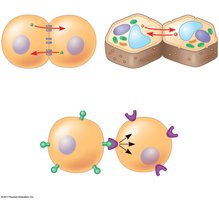
Local and Long-Distance Signaling
Paracrine Signaling: A signaling cell releases local regulators that affect nearby target cells.
Synaptic Signaling: In the nervous system, neurotransmitters are released across synapses to target cells.
Endocrine Signaling: Hormones are secreted by endocrine cells and travel through the bloodstream to distant targets.
The Three Stages of Cell Signaling
Stages of Cell Signaling
Cell signaling involves three main stages:
Reception: The cell detects a signaling molecule (ligand) from outside.
Transduction: The signal is converted into a form that can bring about a specific cellular response, often through a series of steps.
Response: The cell responds to the signal, such as activating an enzyme or gene expression.
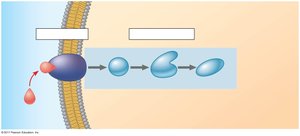
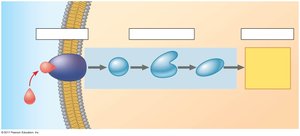
Signal Reception
Types of Membrane Receptors
Membrane receptors are specialized proteins that bind signaling molecules and initiate cellular responses.
Ligand-Gated Ion Channels: Open or close in response to ligand binding, allowing ions to flow across the membrane. Important in nerve conduction.
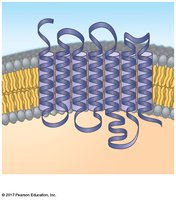
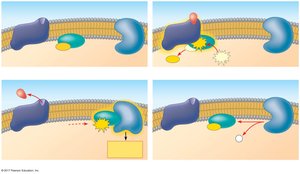
G Protein-Coupled Receptors (GPCRs): Activate intracellular G proteins, which then trigger various signaling pathways.
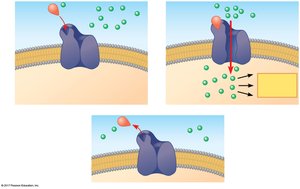
Signal Transduction
Transduction Pathways
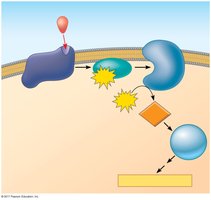
Transduction converts the signal from one form to another, often involving a cascade of molecular events.
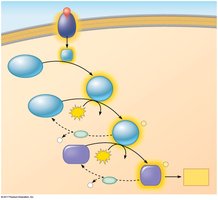
Phosphorylation Cascade: Series of protein kinases activate each other by adding phosphate groups, amplifying the signal.
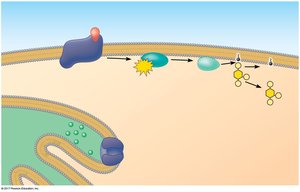
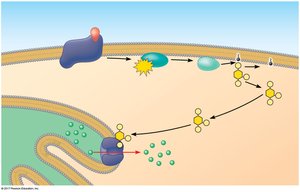
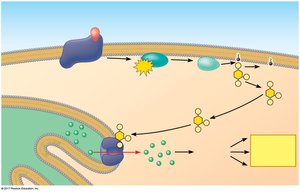
Second Messengers: Small, nonprotein molecules (e.g., cAMP, Ca2+, IP3) relay signals inside the cell.

Cellular Responses
Types of Cellular Responses
The final outcome of cell signaling can vary widely, depending on the cell type and the signal received.
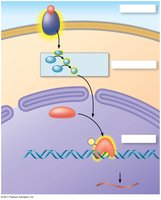
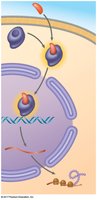
Gene Expression: Activation of transcription factors can lead to changes in gene expression.
Enzyme Activation: Metabolic pathways may be turned on or off.
Cell Movement or Secretion: Cells may contract, move, or secrete substances.
Regulation of the Response
Signal Regulation and Amplification
Cellular responses are not simply "on" or "off"; they can be regulated in several ways.
Amplification: A single signaling molecule can trigger a large response through cascades.
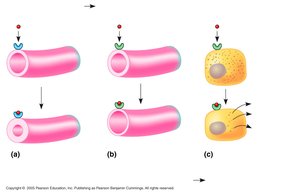
Specificity: Different cells may respond differently to the same signal, depending on their receptors and internal machinery.
Cross-Talk: Pathways can interact, leading to complex responses.
Signal Amplification Example
Binding of one epinephrine molecule to a receptor can result in the release of millions of glucose molecules from glycogen.
Specificity and Cross-Talk
Cells with different receptors or internal proteins can respond differently to the same signaling molecule.
Summary Table: Types of Cell Signaling
Type | Distance | Example | Key Feature |
|---|---|---|---|
Direct Contact | Adjacent cells | Gap junctions, plasmodesmata | Physical connection |
Paracrine | Local | Growth factors | Local regulator diffusion |
Synaptic | Local | Neurotransmitters | Electrical signal triggers release |
Endocrine | Long-distance | Hormones | Bloodstream transport |
Key Terms and Concepts
Ligand: A molecule that binds to a receptor.
Receptor: Protein that detects a signal molecule.
Transduction: Conversion of a signal to a cellular response.
Second Messenger: Small molecules that relay signals inside the cell (e.g., cAMP, Ca2+).
Phosphorylation Cascade: Series of events where kinases activate each other.
Amplification: Increase in the magnitude of the cellular response.
Important Equations
cAMP Formation
ATP is converted to cAMP by adenylyl cyclase:
Phosphorylation
Protein kinases transfer phosphate groups from ATP to proteins:
Example: Epinephrine Signaling
Epinephrine binds to different receptors in various cell types, leading to distinct responses such as vasoconstriction, vasodilation, or glucose release.
Additional info: Some details and explanations were expanded for clarity and completeness, including definitions and context for signaling pathways and second messengers.
