 Indietro
Cell Communication: Mechanisms and Significance in Biology
Guida di studio - Note intelligenti
 Appunti personalizzati basati sui tuoi materiali, ampliati con definizioni chiave, esempi e contesto.
Cell Communication
Overview of Cell Communication
Cell communication is essential for the coordination of biological processes within and between cells. It enables cells to sense their environment, respond to external signals, and interact with other cells, which is fundamental for multicellular life and microbial communities.
Cell signaling involves the transmission of information from one cell to another through chemical signals.
Cells use both local signaling and long-distance signaling to communicate.
Signal transduction is the process by which a cell converts an external signal into a functional response.
Bacterial Communication and Quorum Sensing
Bacteria communicate with each other using chemical signals, a process known as quorum sensing. This allows them to coordinate behaviors based on population density.
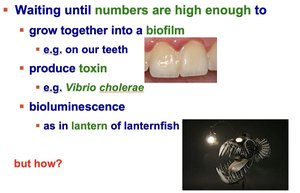
Quorum sensing enables bacteria to regulate gene expression collectively, leading to group behaviors such as biofilm formation, toxin production, and bioluminescence.
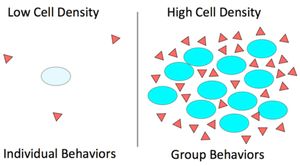
When cell density is low, bacteria act individually; at high density, they act as a group.
Example: Vibrio cholerae produces toxins only when enough bacteria are present. Bioluminescent bacteria in lanternfish light up only when they reach a critical population. 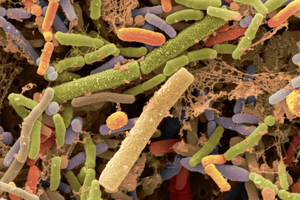
Types of Cell Signaling
Local Signaling
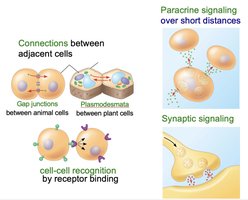
Local signaling occurs between cells that are close to each other. It includes direct contact and the release of signaling molecules that affect nearby cells.
Paracrine signaling: Cells release signals that affect nearby cells.
Synaptic signaling: Neurons release neurotransmitters across synapses.
Cell-cell recognition: Cells interact directly via membrane-bound molecules.
Gap junctions (animals) and plasmodesmata (plants): Channels that allow molecules to pass directly between adjacent cells.
Long-Distance (Endocrine) Signaling
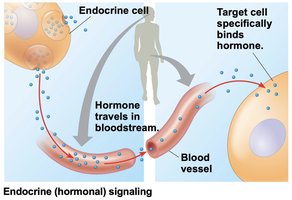
Long-distance signaling involves hormones that travel through the bloodstream (in animals) or vascular tissue (in plants) to reach target cells far from their origin.
Endocrine signaling: Hormones are released by endocrine cells and transported via the circulatory system to distant target cells.
Hormonal signaling is crucial for regulating growth, metabolism, and development.
Signal Transduction Pathway
Main Steps of Signal Transduction
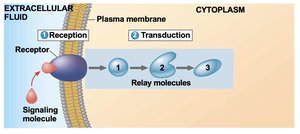
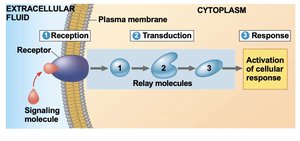
Signal transduction consists of three main stages:
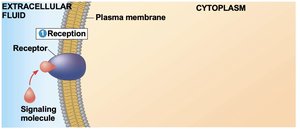
Reception: A signaling molecule (ligand) binds to a receptor protein on the cell surface.
Transduction: The signal is relayed and amplified inside the cell through a series of molecular events.
Response: The cell triggers a specific response, such as a change in gene expression or enzyme activation.
Reception
Reception is the first step in cell signaling, where a signaling molecule binds to a receptor protein, usually located on the cell membrane.
Binding is highly specific; only certain ligands can bind to their corresponding receptors.
Most signal receptors are plasma membrane proteins.
Types of Membrane Receptors
There are three main types of membrane receptors:
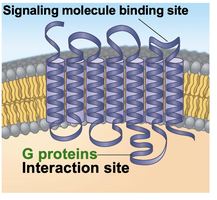
G protein-coupled receptors (GPCRs): Transmembrane proteins that interact with G proteins to transmit signals.
Receptor tyrosine kinases: Enzymatic receptors that phosphorylate target proteins.
Ion channel receptors: Channels that open or close in response to ligand binding, allowing ions to flow across the membrane.
G Protein-Coupled Receptors (GPCRs)
GPCRs are the most widespread membrane receptors in eukaryotes. They transmit signals from outside the cell to the inside by interacting with G proteins.
GPCRs have seven transmembrane domains.
They are involved in many physiological processes, including sensory perception, immune response, and neurotransmission.
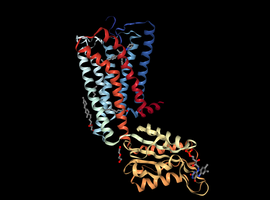
Human Cannabinoid Receptor CB1
The CB1 receptor is a GPCR found in neurons. It binds endocannabinoids and regulates processes such as memory, pain, mood, and appetite.
CB1 also binds THC, the psychoactive compound in Cannabis sativa.

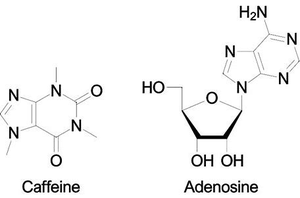
Caffeine Receptor
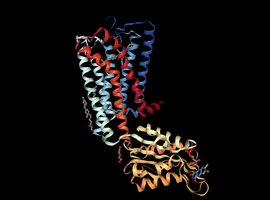
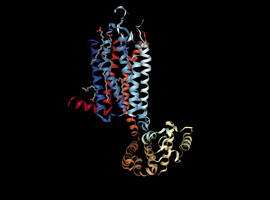
The so-called "caffeine receptor" is an adenosine receptor. Adenosine binding causes drowsiness, but caffeine blocks this receptor, preventing the effect.
Caffeine is a stimulant that competes with adenosine for binding to its receptor.
Summary Table: Types of Cell Signaling
Type | Distance | Example | Mechanism |
|---|---|---|---|
Paracrine | Short | Growth factors | Signal diffuses to nearby cells |
Synaptic | Short | Neurotransmitters | Released at synapse |
Endocrine | Long | Hormones | Transported via bloodstream |
Cell-cell recognition | Direct | Immune cells | Membrane-bound molecules interact |
Gap junctions/Plasmodesmata | Direct | Heart muscle cells | Channels connect cytoplasm |
Key Terms
Ligand: A molecule that binds specifically to a receptor.
Receptor: A protein that detects a signaling molecule and initiates a response.
Signal transduction: The process of converting a signal from outside the cell into a functional response inside the cell.
GPCR: G protein-coupled receptor, a major class of membrane receptors.
Quorum sensing: Bacterial communication based on population density.
Equations and Formulas
Signal amplification in transduction can be represented as:
Conclusion
Cell communication is fundamental to biological systems, enabling cells to coordinate activities, respond to environmental changes, and maintain homeostasis. Understanding the mechanisms of signaling, including local and long-distance communication, is essential for comprehending processes such as development, immunity, and behavior. Additional info: Academic context was added to clarify the steps of signal transduction, the types of membrane receptors, and the significance of GPCRs in human physiology.
