 Indietro
Cell Communication: Signal Reception, Transduction, and Response
Guida di studio - Note intelligenti
 Appunti personalizzati basati sui tuoi materiali, ampliati con definizioni chiave, esempi e contesto.
Cell Communication
Introduction to Cell Signaling
Cell communication is essential for the coordination of activities in multicellular organisms. Cells use signaling molecules to convey information, allowing them to respond to environmental changes and interact with other cells.
Cell signaling involves the transmission of signals from the environment or other cells to a target cell.
Signaling can occur locally (between nearby cells) or over long distances (using hormones).
Examples include communication among bacteria, yeast mating, and animal nervous and endocrine systems.
Signal transduction pathway: A series of steps by which a signal is converted into a specific cellular response.
Types of Cell Signaling
Direct contact: Cells communicate via molecules on their surfaces.
Paracrine signaling: Local signaling where cells release growth factors affecting nearby cells.
Synaptic signaling: Involves neurotransmitters released in response to electrical signals in the nervous system.
Endocrine (hormonal) signaling: Hormones travel through the circulatory system to distant target cells.
The Three Stages of Cell Signaling
Cell signaling typically involves three main stages:
Reception: The target cell detects a signaling molecule (ligand) that binds to a receptor protein.
Transduction: The receptor changes shape and initiates a signal transduction pathway, often involving multiple steps.
Response: The transduced signal triggers a specific cellular response, such as gene expression or metabolic changes.
Signal Reception
Receptors in the Plasma Membrane
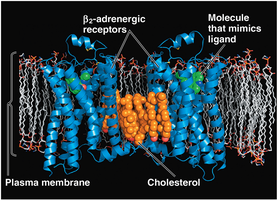
Most signal receptors are proteins located in the plasma membrane, but some are found inside the cell. The binding between a ligand and its receptor is highly specific and usually causes a shape change in the receptor, initiating signal transduction.
G protein-coupled receptors (GPCRs): The largest family of cell-surface receptors. They transmit information from the extracellular environment to the cell interior and work with the help of G proteins, which bind GTP.
Receptor tyrosine kinases (RTKs): Membrane receptors that catalyze the transfer of phosphate groups from ATP to proteins. RTKs can trigger multiple pathways and are associated with cancer when malfunctioning.
Ligand-gated ion channel receptors: Act as gates that open or close in response to ligand binding, allowing specific ions to pass through.
Intracellular Receptors
Intracellular receptors are found in the cytoplasm or nucleus. Small or hydrophobic molecules, such as steroid and thyroid hormones, can cross the membrane and activate these receptors. The hormone-receptor complex often acts as a transcription factor, regulating gene expression.
Signal Transduction
Signal Transduction Pathways
Signal transduction involves cascades of molecular interactions that transmit signals from receptors to relay molecules inside the cell. These multistep pathways amplify signals and provide opportunities for regulation.
Protein phosphorylation: Protein kinases transfer phosphates from ATP to proteins, creating a phosphorylation cascade.
Protein dephosphorylation: Protein phosphatases remove phosphates, acting as a molecular switch.
Second Messengers
Second messengers are small, nonprotein, water-soluble molecules or ions that spread throughout the cell by diffusion. They participate in pathways initiated by GPCRs and RTKs.
Cyclic AMP (cAMP): Produced from ATP by adenylyl cyclase. Activates protein kinase A, which phosphorylates other proteins.
Calcium ions (Ca2+): Used widely as second messengers. Their concentration in the cytosol is much lower than outside the cell, so small changes have large effects.
Inositol trisphosphate (IP3) and diacylglycerol (DAG): Produced by cleavage of phospholipids and help release calcium from intracellular stores.
Cellular Response
Regulation of Transcription and Cytoplasmic Activities
The cell’s response to a signal is called the output response. This can involve regulation of gene expression or changes in cytoplasmic activities.
Signal amplification: Enzyme cascades amplify the response.
Specificity: Different cells respond differently to the same signal due to unique protein collections.
Efficiency: Scaffolding proteins group relay proteins, increasing efficiency.
Termination: Inactivation mechanisms ensure signals are not perpetuated indefinitely.
Apoptosis: Programmed Cell Death
Mechanisms and Importance
Apoptosis is a form of programmed cell death that prevents damage to neighboring cells. It involves the integration of multiple signaling pathways and is essential for development and maintenance in animals.
Cell components are packaged into vesicles and digested by scavenger cells.
Apoptosis can be triggered by internal or external signals, such as DNA damage or protein misfolding.
It is involved in normal development (e.g., formation of fingers and toes) and diseases (e.g., Parkinson’s, Alzheimer’s, cancer).
Summary Table: Types of Cell Surface Receptors
Receptor Type | Main Function | Example |
|---|---|---|
G protein-coupled receptor (GPCR) | Transmits signals via G proteins | β2-adrenergic receptor |
Receptor tyrosine kinase (RTK) | Phosphorylates proteins, triggers multiple pathways | Insulin receptor |
Ligand-gated ion channel | Allows ion flow in response to ligand | Acetylcholine receptor |
Key Equations
Phosphorylation:
cAMP formation:
