 Indietro
Cell Cycle and Mitosis Study Guide – BIO 1305
Guida di studio - Note intelligenti
 Appunti personalizzati basati sui tuoi materiali, ampliati con definizioni chiave, esempi e contesto.
Q1. Given a micrograph or drawing of a cell, label the chromosomes, chromatids, sister chromatids, and homologous chromosomes, if present, and determine the haploid number and ploidy.
Background
Topic: Chromosome Structure and Cell Cycle
This question tests your understanding of chromosome terminology and how to identify key features in cell images, including chromosomes, chromatids, sister chromatids, homologous chromosomes, haploid number (n), and ploidy (number of sets).
Key Terms:
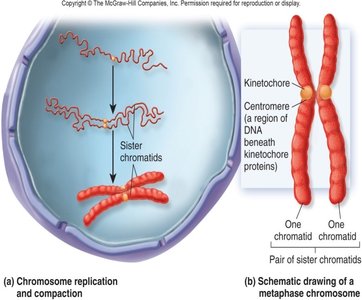
Chromosome: A single DNA molecule with associated proteins, counted by centromeres.
Chromatid: One of the two identical copies in a replicated chromosome.
Sister Chromatids: Two identical chromatids joined at the centromere.
Homologous Chromosomes: Matching pairs from each parent, same size and genes, possibly different alleles.
Haploid Number (n): Number of different chromosome types.
Ploidy: Number of sets of chromosomes (haploid = n, diploid = 2n).
Step-by-Step Guidance
Examine the cell image and locate the centromeres to count the number of chromosomes.
Identify chromatids: If chromosomes are replicated, each will have two chromatids joined at the centromere.
Label sister chromatids: These are the two identical chromatids joined together.
Look for homologous pairs: Match chromosomes by size and shape to identify pairs from each parent.
Determine haploid number (n): Count the different types of chromosomes present.
Assess ploidy: Decide if the cell is haploid (n) or diploid (2n) based on the number of sets.
Try solving on your own before revealing the answer!
Final Answer:
Labeling: Chromosomes are counted by centromeres; chromatids are the individual DNA strands; sister chromatids are joined pairs; homologous chromosomes are matched pairs. Haploid number (n) is the number of different types, and ploidy is the number of sets (e.g., diploid = 2n).
For example, in a diploid cell with two homologous pairs, n = 2 and ploidy = 2n = 4.
Q2. Explain why chromosome replication has to occur before mitosis, in interphase.
Background
Topic: DNA Replication and Cell Division
This question tests your understanding of the timing and necessity of DNA replication in the cell cycle, specifically why it must happen before mitosis.
Key Terms:
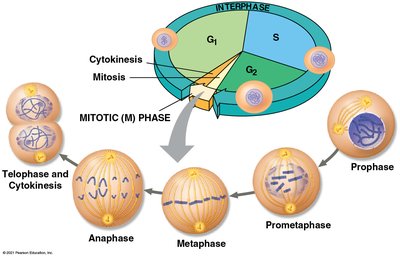
Interphase: The phase where the cell grows and DNA is replicated (includes G1, S, G2).
S Phase: The specific stage where DNA replication occurs.
Mitosis: The process of nuclear division.
Step-by-Step Guidance
Recall that mitosis separates the replicated DNA into two daughter cells.
Understand that DNA must be doubled before mitosis so each daughter cell receives a complete set.
Replication occurs in S phase, when chromatin is accessible.
If DNA is not replicated first, daughter cells would lack some genetic material.
The G2 checkpoint ensures DNA is fully copied before mitosis begins.
Try solving on your own before revealing the answer!
Final Answer:
Chromosome replication must occur before mitosis so that each daughter cell receives a complete, identical set of genetic material. Replication happens in S phase of interphase, and the G2 checkpoint ensures this is complete before mitosis starts.
Q3. Given a labeled drawing showing the phases of mitosis, explain what is happening to the chromosomes and how it helps ensure that each daughter cell gets a complete and identical set.
Background
Topic: Mitosis Phases and Chromosome Movement
This question tests your ability to describe the events of mitosis and how chromosome behavior ensures genetic fidelity in daughter cells.
Key Terms:
Prophase, Prometaphase, Metaphase, Anaphase, Telophase: The five phases of mitosis.
Mitotic Spindle: Structure that separates chromosomes.
Metaphase Plate: Imaginary line where chromosomes align.
Cytokinesis: Division of cytoplasm.
Step-by-Step Guidance
In prophase, chromosomes condense and spindle begins to form.
During prometaphase, nuclear envelope breaks down and spindle fibers attach to kinetochores.
In metaphase, chromosomes align at the metaphase plate, ensuring each sister chromatid is attached to opposite poles.
In anaphase, sister chromatids separate and move to opposite poles, guaranteeing each daughter cell receives one copy of each chromosome.
In telophase, chromosomes decondense and nuclear envelopes reform, followed by cytokinesis.
Try solving on your own before revealing the answer!
Final Answer:
During mitosis, chromosomes are duplicated and then separated so that each daughter cell receives a complete and identical set. The alignment and separation of sister chromatids ensure genetic fidelity.
Q4. Diagram the sequence of stages in the eukaryotic cell cycle (M, G1, S, and G2) and label the major events or checkpoints that occur in each. Predict the consequences of altering a given stage (M, G1, S, G2) in the cell cycle in terms of the cell's structure or fate.
Background
Topic: Cell Cycle Regulation and Checkpoints
This question tests your understanding of the cell cycle stages, checkpoints, and the effects of disruptions in these stages.
Key Terms and Formulas:
Cell Cycle Stages: G1 (growth), S (DNA synthesis), G2 (preparation), M (mitosis).
Checkpoints: G1, G2, M (spindle).
MPF (Maturation Promoting Factor): Cyclin-Cdk complex that triggers mitosis.
Step-by-Step Guidance
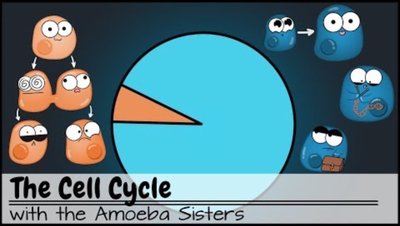
Draw or visualize the cell cycle as a circle with G1, S, G2, and M phases.
Label the checkpoints: G1 (cell size, nutrients, DNA damage), G2 (DNA replication, MPF), M (spindle attachment).
Describe what happens at each checkpoint and what signals are required to proceed.
Predict consequences: For example, if G1 checkpoint is ignored, cells may divide uncontrollably (cancer).
If S phase is blocked, DNA is not fully copied and cell cannot proceed to mitosis.
Try solving on your own before revealing the answer!
Final Answer:
The cell cycle includes G1, S, G2, and M phases, with checkpoints at G1, G2, and M. Altering these stages can lead to cell cycle arrest, incomplete DNA, or uncontrolled division (cancer).
