 Indietro
Exam 3
Guida di studio - Note intelligenti
 Appunti personalizzati basati sui tuoi materiali, ampliati con definizioni chiave, esempi e contesto.
Cell Cycle and Chromosome Structure
Centromere and Chromatid
The centromere is the region of a chromosome where the two sister chromatids are joined and where spindle fibers attach during cell division. A chromatid is one of two identical halves of a replicated chromosome.
Centromere: Essential for proper chromosome segregation during mitosis and meiosis.
Chromatid: Each chromosome consists of two chromatids after DNA replication.
Number of chromatids and centromeres: Before cell division, each chromosome has two chromatids and one centromere.
Spindle Apparatus and Chromosome Movement
The spindle apparatus is a structure made of microtubules that segregates chromosomes during cell division. Chromosomes move toward opposite poles during anaphase as spindle fibers shorten.
Origin of microtubules: Microtubules originate from the centrosomes during mitosis.
Arrangement at metaphase: Chromosomes align at the metaphase plate.
Phases of the Cell Cycle
The cell cycle consists of interphase (G1, S, G2) and mitotic phase (M). Each phase has distinct events:
G1 phase: Cell grows and prepares for DNA replication.
G0 phase: Cells exit the cycle and do not divide.
S phase: DNA is replicated.
G2 phase: Cell prepares for mitosis.
G1 checkpoint: Ensures cell is ready for DNA synthesis.
DNA Content During Cell Cycle
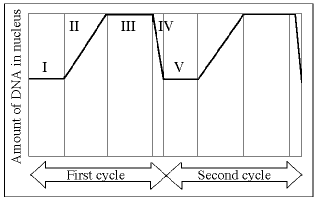
The amount of DNA in the nucleus changes during the cell cycle, as shown in the diagram below. Phases I-V correspond to different stages:
Phase I: G1 phase (normal DNA content)
Phase II: S phase (DNA synthesis, content increases)
Phase III: G2 phase (doubled DNA content)
Phase IV: Mitosis (DNA content decreases as cell divides)
Phase V: G1 phase of next cycle (normal DNA content)
Arrangement of chromosomes at metaphase: Chromosomes are aligned at the metaphase plate, each attached to spindle fibers.
Meiosis and Chromosome Numbers
Chromosome and Chromatid Numbers in Meiosis
Meiosis consists of two divisions: Meiosis I and II. Chromosome and chromatid numbers change as follows:
Metaphase I: Chromosomes are paired as homologs; each consists of two chromatids.
Anaphase I: Homologous chromosomes separate; chromatids remain together.
Metaphase II: Chromosomes (now unpaired) align; each still has two chromatids.
Anaphase II: Sister chromatids separate.
Telophase I and II: Chromosome number is halved after Telophase II.
End of cytokinesis: Four haploid cells, each with one chromatid per chromosome.
Genetic Variation and Inheritance
Crossing Over and Genetic Variation
Crossing over occurs during Prophase I of meiosis, where homologous chromosomes exchange genetic material. This increases genetic variation.
Scientific terms: Synapsis, chiasma, tetrad, recombination.
Causes of genetic variation: Crossing over, independent assortment, random fertilization.
Dihybridism and Independent Assortment
Dihybrid crosses involve two traits. Independent assortment refers to the random distribution of homologous chromosomes during meiosis, leading to varied gametes.
Type of gametes: Four possible combinations for two traits.
Homozygous vs. heterozygous: Homozygous individuals have identical alleles; heterozygous have different alleles.
Patterns of Inheritance
Different inheritance patterns include:
Complete dominance: One allele masks the effect of another.
Incomplete dominance: Heterozygote shows intermediate phenotype.
Multiple alleles: More than two alleles for a gene (e.g., blood types).
Polygenic inheritance: Multiple genes affect a trait.
Pleiotropy: One gene affects multiple traits.
DNA Structure and Replication
DNA Structure and Chemical Bonds
DNA is a double helix held together by hydrogen bonds between complementary bases (A-T, C-G).
Relative percentage of bases: Chargaff's rule: %A = %T, %C = %G.
Key bonds: Phosphodiester bonds (backbone), hydrogen bonds (between bases).
Enzymes in DNA Replication
Several enzymes are involved in DNA replication:
Helicase: Unwinds DNA.
DNA polymerase: Synthesizes new DNA strands.
Ligase: Joins Okazaki fragments on the lagging strand.
Okazaki fragments: Short DNA segments synthesized on the lagging strand.
Gene Expression and Regulation
Splicing, Introns, Exons, and Spliceosome
During gene expression, introns (non-coding regions) are removed and exons (coding regions) are joined by the spliceosome in a process called splicing.
Ribozyme: RNA molecule with enzymatic activity, sometimes involved in splicing.
Chromosome Abnormalities and Mutations
Types of Mutations
Mutations can alter chromosome structure or number:
Disjunction: Failure of chromosomes to separate properly.
Inversion: Segment of chromosome is reversed.
Deletion: Loss of chromosome segment.
Translocation: Segment moves to another chromosome.
Special Chromosome Features
Telomere and Telomerase
Telomeres are repetitive DNA sequences at chromosome ends, protecting them from degradation. Telomerase is an enzyme that extends telomeres.
Karyotype, Somatic Cells, and Gametes
A karyotype is the complete set of chromosomes in a cell. Somatic cells are body cells (diploid), while gametes are reproductive cells (haploid).
Linked Genes and SRY Gene
Linked Genes and Crossing Over Frequency
Linked genes are located close together on the same chromosome and tend to be inherited together. The frequency of crossing over between linked genes is proportional to their distance apart.
SRY Gene
The SRY gene is responsible for male sex determination in humans.
Inheritance Pattern | Description | Example |
|---|---|---|
Complete dominance | One allele masks another | Purple vs. white flower color |
Incomplete dominance | Intermediate phenotype | Red and white snapdragons produce pink |
Multiple alleles | More than two alleles | ABO blood types |
Polygenic inheritance | Multiple genes affect trait | Skin color |
Pleiotropy | One gene affects multiple traits | Sickle cell anemia |
Formula for DNA replication:
Formula for base pairing:
Formula for chromosome number after meiosis:
Additional info: Some explanations and table entries were inferred for completeness and clarity based on standard General Biology content.
----------------------------------------
