 Indietro
Cell Cycle Control, Meiosis, and Sexual Life Cycles: Study Notes for General Biology
Guida di studio - Note intelligenti
 Appunti personalizzati basati sui tuoi materiali, ampliati con definizioni chiave, esempi e contesto.
Cell Cycle Control
Overview of the Cell Cycle
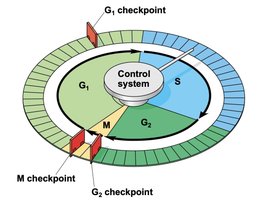
The cell cycle is a series of events that cells undergo to grow and divide. It consists of interphase (G1, S, G2) and the mitotic (M) phase. Regulation of the cell cycle is essential for normal growth and development, and is controlled by checkpoints and signaling pathways. 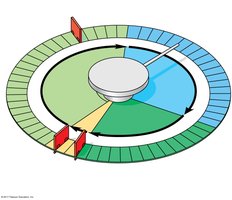
Cell Cycle Checkpoints
Checkpoints are control mechanisms that ensure the integrity of the cell's DNA and proper progression through the cell cycle. There are three main checkpoints:
G1 checkpoint: The most important checkpoint; checks for DNA damage and cell size. If DNA is damaged, the cell may enter a resting state (G0).
G2 checkpoint: Ensures all DNA is replicated and checks for DNA damage before mitosis.
M checkpoint: Ensures all chromosomes are properly attached to the spindle before proceeding with cell division.
Role of p53 in Cell Cycle Control
The p53 gene is a crucial tumor suppressor that responds to DNA damage by halting the cell cycle or inducing apoptosis (programmed cell death). Loss or mutation of p53 is associated with many cancers. 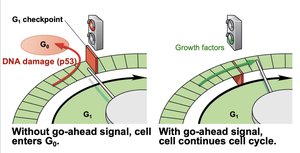
Cell Cycle Regulation in Elephants vs. Humans
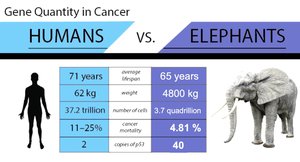
Elephants have a much lower cancer rate than humans, partly because they possess 40 copies of the p53 gene, compared to only 2 in humans. This allows elephants to efficiently remove damaged cells via apoptosis.
Characteristic | Humans | Elephants |
|---|---|---|
Average Lifespan | 71 years | 65 years |
Average Weight | 62 kg | 4800 kg |
Number of Cells | 37.2 trillion | 3.7 quadrillion |
Cancer Mortality | 11–25% | 4.81% |
Copies of p53 | 2 | 40 |
G2 Checkpoint and MPF
The G2 checkpoint is regulated by the Maturation-Promoting Factor (MPF), a complex of cyclin and cyclin-dependent kinase (cdk). MPF activity fluctuates during the cell cycle, peaking at the onset of mitosis. 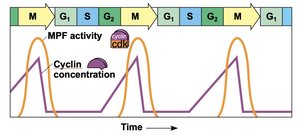
M Checkpoint
The M checkpoint ensures that all chromosomes are properly attached to the spindle before the cell proceeds with division. If attachment is incomplete, the cell cycle is halted. 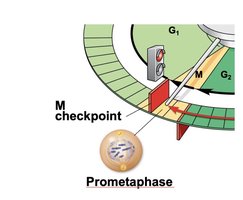
Growth Factors and Cell Division
Growth factors are signaling molecules that stimulate cells to divide. Density-dependent inhibition occurs when crowded cells stop dividing, while anchorage dependence requires cells to be attached to a surface to divide. 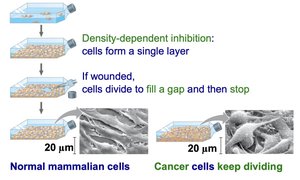
Cancer Cells and Cell Cycle Regulation
Cancer cells bypass normal regulatory mechanisms, allowing them to divide uncontrollably. This can result from aberrant signaling, production of their own growth factors, or defects in cell cycle control systems. 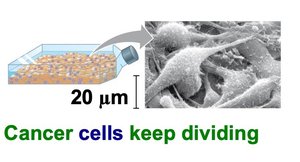
Meiosis and the Sexual Life Cycle
Genetics and Heredity
Genes are segments of DNA that encode information for RNA and proteins, and are passed to the next generation via gametes. Genetics is the study of heredity and variation. Heredity is the transmission of traits from one generation to the next, while variation refers to differences in appearance among individuals.
Asexual vs. Sexual Reproduction
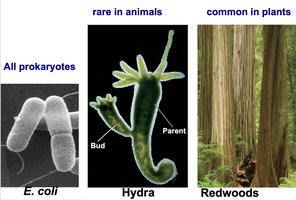
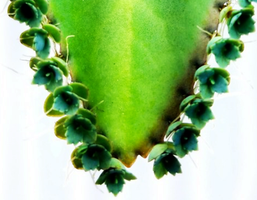
Asexual reproduction: A single individual passes all its genes to offspring, producing clones. Common in prokaryotes and some plants.
Sexual reproduction: Two parents contribute genes, resulting in offspring with unique genetic combinations.
Reproduction Type | Advantages | Disadvantages |
|---|---|---|
Asexual | High offspring numbers; no fertilization needed | Low genetic variation; less adaptable to changing environments |
Sexual | High genetic variation; adaptability | Requires fertilization; fewer offspring |
Variety of Sexual Life Cycles
Sexual life cycles involve alternation between meiosis and fertilization, maintaining chromosome number across generations. The timing and nature of haploid and diploid stages differ among animals, plants, and fungi.
Animal Life Cycle
In animals, only gametes are haploid; the multicellular organism is diploid. 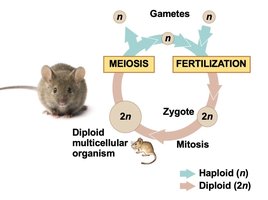
Plant Life Cycle
Plants alternate between multicellular haploid (gametophyte) and multicellular diploid (sporophyte) generations, known as "alternation of generations." 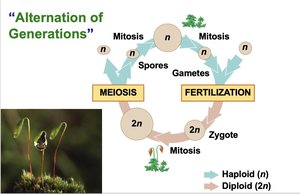
Fungal Life Cycle
In fungi, the only diploid stage is the zygote; most of the life cycle is haploid. 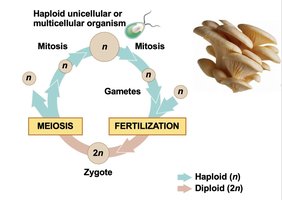
Meiosis: Chromosome Reduction
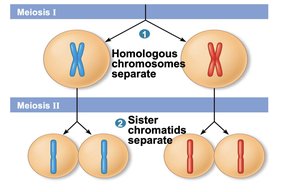
Meiosis is a two-part cell division process that reduces chromosome number by half, producing haploid gametes.
Meiosis I: Homologous chromosomes separate.
Meiosis II: Sister chromatids separate.
Genetic Variation in Sexual Reproduction
Sexual reproduction increases genetic variation through three main mechanisms:
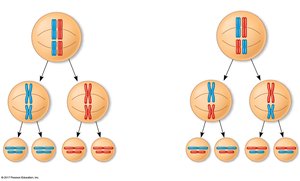
Independent assortment: Homologous chromosomes are randomly distributed during meiosis, creating diverse gametes.
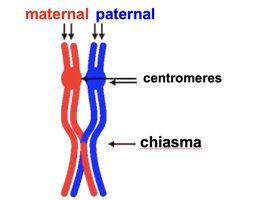
Crossing over: Homologous chromosomes exchange genetic material during meiosis, further increasing variation.
Random fertilization: Any sperm can fuse with any ovum, resulting in numerous possible genetic combinations.
Quantifying Genetic Variation
The combination of independent assortment, crossing over, and random fertilization can produce a zygote with approximately 70 trillion possible genetic combinations. Formula: possible combinations, where is the haploid number of chromosomes. *Additional info: For humans, , so million combinations from independent assortment alone.*
Summary Table: Factors Supporting Genetic Variation
Factor | Description |
|---|---|
Independent Assortment | Random distribution of homologous chromosomes during meiosis |
Crossing Over | Exchange of genetic material between homologous chromosomes |
Random Fertilization | Any sperm can fuse with any ovum |
