 Indietro
Cell Cycle, DNA Replication, and Mitosis: Study Notes for General Biology
Guida di studio - Note intelligenti
 Appunti personalizzati basati sui tuoi materiali, ampliati con definizioni chiave, esempi e contesto.
Cell Cycle Overview
Phases of the Cell Cycle
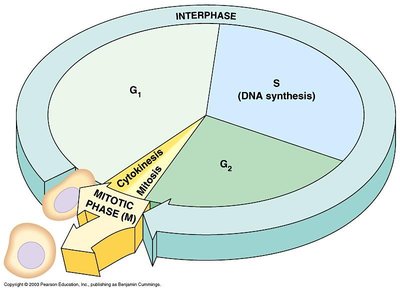
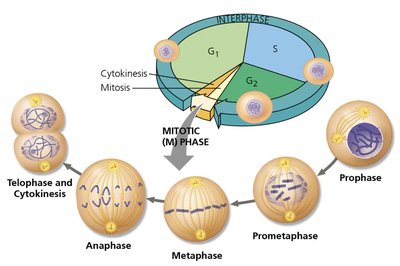
The cell cycle is the series of events that cells undergo to grow and divide. It consists of interphase (G1, S, G2) and the mitotic (M) phase, which includes mitosis and cytokinesis.
G1 phase: Cell growth and preparation for DNA replication.
S phase: DNA synthesis (replication) occurs, resulting in duplicated chromosomes.
G2 phase: Further growth and preparation for cell division.
M phase: Mitosis (division of the nucleus) and cytokinesis (division of the cytoplasm).
Cell Cycle Checkpoints
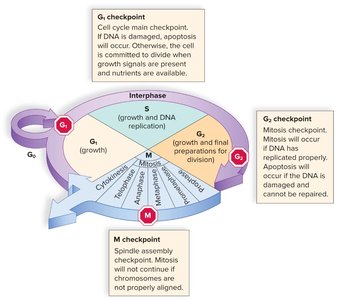
Checkpoints are regulatory mechanisms that ensure the cell cycle progresses only when conditions are favorable and previous steps are completed correctly.
G1 checkpoint: Checks for DNA damage and sufficient growth signals. If DNA is damaged, apoptosis may occur.
G2 checkpoint: Ensures DNA replication is complete and undamaged before mitosis.
M checkpoint: Ensures chromosomes are properly aligned before cell division proceeds.
DNA Replication
Mechanism of DNA Replication
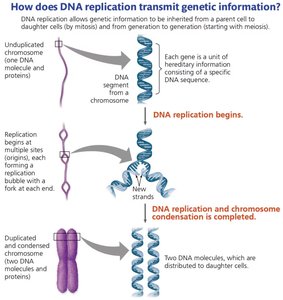
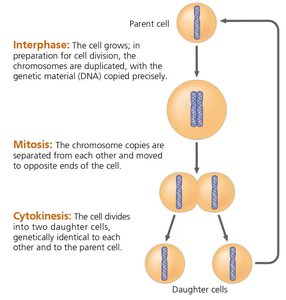
DNA replication is the process by which a cell copies its DNA before cell division. It is essential for growth, repair, and reproduction.
Origins of replication: Multiple sites where replication begins in eukaryotic chromosomes.
Replication bubbles: Regions where DNA is unwound and replication occurs.
Replication fork: The area where new DNA strands are synthesized.
Semiconservative replication: Each new DNA molecule consists of one old (parental) strand and one new (daughter) strand.


Transmission of Genetic Information
DNA replication ensures that genetic information is accurately passed from parent cells to daughter cells during cell division.
Genes: Units of hereditary information located on chromosomes.
Chromosome condensation: Occurs after replication, preparing chromosomes for segregation during mitosis.
Chromosome Structure and Organization
Chromosomes and Chromatids
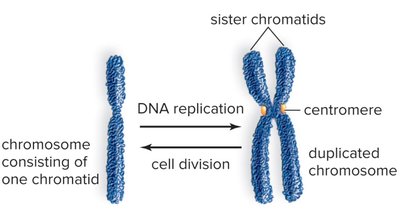
Chromosomes are long, linear DNA molecules wrapped around proteins. After DNA replication, each chromosome consists of two sister chromatids joined at the centromere.
Chromatid: One of two identical halves of a replicated chromosome.
Sister chromatids: Genetically identical copies formed during DNA replication.
Centromere: The region where sister chromatids are joined.
Genome and Ploidy
The genome is the complete set of genetic information in a cell. Ploidy refers to the number of unique sets of chromosomes.
Diploid (2n): Two sets of chromosomes, one from each parent (most somatic cells).
Haploid (n): One set of chromosomes (gametes).
Mitosis: Process and Significance
Stages of Mitosis
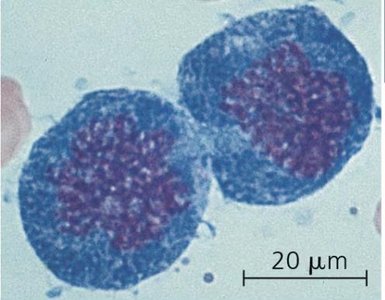
Mitosis is the process by which a cell divides its nucleus, ensuring each daughter cell receives an identical set of chromosomes. It is followed by cytokinesis, which divides the cytoplasm.
Prophase: Chromosomes condense, spindle apparatus forms.
Prometaphase: Nuclear envelope breaks down, spindle fibers attach to chromosomes.
Metaphase: Chromosomes align at the metaphase plate.
Anaphase: Sister chromatids separate and move to opposite poles.
Telophase: Nuclear envelope reforms, chromosomes decondense.
Cytokinesis: Division of the cytoplasm, forming two daughter cells.
Significance of Mitosis
Mitosis is essential for asexual reproduction, growth, cell replacement, and healing in multicellular organisms.
Genetically identical daughter cells: Ensures tissue integrity and function.
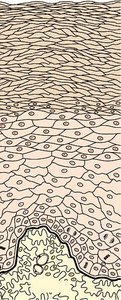
Cell replacement: Replaces dead or damaged cells, especially in tissues like skin.
Summary Table: Cell Cycle Phases and Key Events
Phase | Main Event | Checkpoint |
|---|---|---|
G1 | Cell growth | Checks for DNA damage, growth signals |
S | DNA replication | Ensures complete and accurate replication |
G2 | Growth, preparation for mitosis | Checks for DNA damage, readiness for mitosis |
M | Mitosis and cytokinesis | Checks chromosome alignment |
Additional info:
DNA replication is semiconservative, meaning each daughter DNA molecule contains one parental strand and one new strand.
Cell cycle checkpoints are critical for preventing uncontrolled cell division, which can lead to cancer.
