 Indietro
Cell Cycle, Mitosis, Meiosis, and Chromosome Disorders Study Guide
Guida di studio - Note intelligenti
 Appunti personalizzati basati sui tuoi materiali, ampliati con definizioni chiave, esempi e contesto.
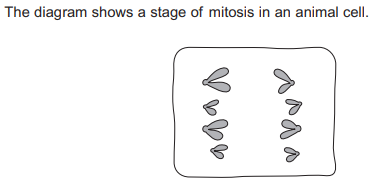
Q31. The diagram shows a stage of mitosis in an animal cell.
Background
Topic: Mitosis and Cell Division
This question tests your understanding of the stages of mitosis, the events that occur during each stage, and how genetic material is distributed to daughter cells.
Key Terms and Concepts:
Mitosis: The process by which a cell divides its nucleus and genetic material to produce two identical daughter cells.
Chromosomes: Structures made of DNA and proteins that carry genetic information.
Metaphase: The stage of mitosis where chromosomes align at the cell's equator.
Spindle fibers: Structures that help separate chromosomes during mitosis.
Step-by-Step Guidance
Observe the diagram and note the arrangement of chromosomes. They are lined up in the center of the cell, which is characteristic of a specific stage of mitosis.
Recall the stages of mitosis: prophase, metaphase, anaphase, telophase. Identify which stage involves chromosomes aligning at the cell's equator.
Describe the main event of this stage: spindle fibers attach to the centromeres of each chromosome, preparing for separation.
Consider what happens next: chromosomes will be pulled apart toward opposite poles, resulting in two genetically identical cells.
Think about the DNA content: if the original cell has 9.6 units of DNA, how much will each daughter cell have after mitosis? Set up the calculation but do not solve yet.
For meiosis, recall that gametes have half the DNA content of the original diploid cell. Set up the calculation for gamete DNA content.
Try solving on your own before revealing the answer!
Final Answer:
a) The stage shown is metaphase.
b) During metaphase, chromosomes align at the cell's equator, and spindle fibers attach to their centromeres. This ensures that, when the cell divides, each daughter cell receives an identical set of chromosomes.
c) If the cell had 9.6 units of DNA, each daughter cell would have 9.6 units after mitosis, since mitosis produces genetically identical cells.
d) If this cell were to undergo meiosis, the gametes would have 4.8 units of DNA, which is half the original amount, reflecting the reduction from diploid to haploid.
Metaphase is critical for ensuring equal distribution of genetic material. Mitosis maintains chromosome number, while meiosis halves it for gamete formation.
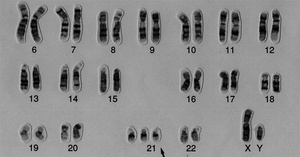
Q32. Down’s syndrome is a disorder caused by a child being born with an extra 21st chromosome, as shown in the picture below.
Background
Topic: Chromosome Disorders and Genetic Variation
This question tests your understanding of nondisjunction, chromosomal abnormalities, and how these can lead to genetic disorders such as Down's syndrome.
Key Terms and Concepts:
Nondisjunction: The failure of homologous chromosomes or sister chromatids to separate properly during meiosis.
Trisomy: The presence of an extra chromosome (three instead of two) in a particular pair.
Fertilization: The union of gametes to form a zygote.
Karyotype: An image showing the number and appearance of chromosomes in a cell.
Step-by-Step Guidance
Examine the karyotype image and note the presence of three chromosomes at position 21, indicating trisomy 21.
Recall how chromosomes are supposed to separate during meiosis. Identify the process (nondisjunction) that can cause an extra chromosome to be present in a gamete.
Explain how, if a gamete with an extra chromosome (n+1) fuses with a normal gamete (n), the resulting zygote will have three copies of chromosome 21.
Consider how this chromosomal abnormality leads to Down's syndrome, affecting the phenotype and development of the child.
Try solving on your own before revealing the answer!
Final Answer:
A) During gamete formation, nondisjunction can occur, causing homologous chromosomes (or sister chromatids) to fail to separate. This results in a gamete with an extra chromosome (n+1).
B) When this gamete fuses with a normal gamete during fertilization, the zygote ends up with three copies of chromosome 21 (trisomy 21), which causes Down's syndrome.
The extra chromosome disrupts normal development, leading to the characteristic features and symptoms of the disorder.
