 Indietro
Cell Division and Mitosis: Structure, Function, and Mechanisms
Guida di studio - Note intelligenti
 Appunti personalizzati basati sui tuoi materiali, ampliati con definizioni chiave, esempi e contesto.
Cell Division and Mitosis
Overview of Cell Division
Cell division is a fundamental process in biology, enabling organisms to grow, develop, and reproduce. It involves the duplication and separation of genetic material to produce new cells. - Cell division is essential for reproduction, tissue growth, and repair. - There are two main types of reproduction: sexual (mixing genes from two parents) and asexual (producing genetically identical offspring). 
Cell Structure and the Nucleus
The nucleus is the control center of eukaryotic cells, housing most of the cell's genetic material. - The nucleus contains DNA, RNA, and chromosomes. - Chromosomes are structures that package DNA, making it manageable during cell division. 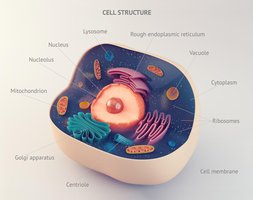
DNA Quantity and Organization
Cells contain a remarkable amount of DNA, which must be efficiently organized. - A single human cell contains about 2 meters of DNA. - The total DNA in the human body is approximately 74 billion kilometers. - DNA is condensed into chromatin and further organized into chromosomes for cell division. 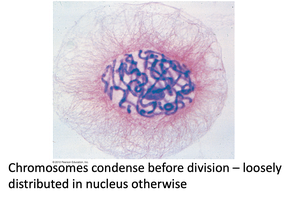
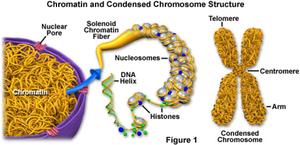
Chromatin and Chromosome Structure
Chromatin is the complex of DNA and proteins that forms chromosomes. - Chromatin condenses into visible chromosomes during cell division. - Chromosomes consist of DNA wrapped around histone proteins, forming nucleosomes. - Each chromosome has a centromere, telomeres, and arms. Condensed chromosomes are essential for accurate segregation during mitosis.
Cell Division in Different Organisms
Both prokaryotes and eukaryotes undergo cell division, but the mechanisms differ. - Prokaryotes reproduce asexually by binary fission, producing clones. - Eukaryotes divide using mitosis (for growth and repair) and meiosis (for sexual reproduction). 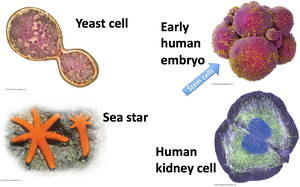
Prokaryotic Cell Division: Binary Fission
Binary fission is the process by which prokaryotic cells divide. - The chromosome is duplicated and separated. - The cell elongates and divides into two daughter cells, each genetically identical to the parent.
Eukaryotic Cell Cycle
The eukaryotic cell cycle consists of two main phases: interphase and mitosis. - Interphase: The cell grows, carries out normal functions, and prepares for division. - Mitosis: The cell separates its duplicated chromosomes and divides.
Subphases of Interphase
- G1 (First Gap): Cell growth and normal function. - S (Synthesis): DNA replication; chromosomes are duplicated. - G2 (Second Gap): Further growth and preparation for mitosis.
Chromosome Duplication
- Before S phase, chromosomes have a single chromatid. - After S phase, chromosomes consist of two identical sister chromatids. - During mitosis, sister chromatids are separated into two daughter cells.
Mitosis: Steps and Mechanisms
Mitosis is the process by which eukaryotic cells divide their nucleus and genetic material. It is organized into distinct phases:
Prophase
- Mitotic spindle forms from microtubules, originating at the centrosome. - Chromosomes condense and become visible.
Prometaphase
- Nuclear envelope breaks down. - Chromosomes attach to the mitotic spindle via kinetochores.
Metaphase
- Chromosomes align at the cell's center (metaphase plate). - Spindle fibers attach to each sister chromatid.
Anaphase
- Spindle fibers contract, separating sister chromatids. - Chromatids move to opposite cell poles. - Cell elongates in preparation for division.
Telophase
- Nuclear envelope reforms. - Chromosomes decondense. - Cell begins to divide, forming a cleavage furrow in animals or a cell plate in plants.
Cytokinesis
- Division of the cytoplasm completes cell division. - In animals, a cleavage furrow forms; in plants, a cell plate develops.
Summary Table: Cell Cycle Phases
Phase | Main Events |
|---|---|
Interphase (G1, S, G2) | Growth, DNA replication, preparation for division |
Prophase | Chromosome condensation, spindle formation |
Prometaphase | Nuclear envelope breakdown, spindle attachment |
Metaphase | Chromosome alignment at metaphase plate |
Anaphase | Sister chromatid separation, cell elongation |
Telophase | Nuclear envelope reformation, chromosome decondensation |
Cytokinesis | Cytoplasmic division, formation of two daughter cells |
Key Terms and Concepts
- Chromatin: DNA-protein complex forming chromosomes. - Chromosome: Condensed DNA structure for cell division. - Sister chromatids: Identical copies of a chromosome joined at the centromere. - Mitotic spindle: Microtubule structure guiding chromosome separation. - Binary fission: Prokaryotic cell division mechanism. - Cleavage furrow: Indentation in animal cells during cytokinesis. - Cell plate: Structure forming in plant cells during cytokinesis.
Example: Cell Division in Various Organisms
- Yeast cells divide by budding (asexual). - Sea stars can regenerate by cell division. - Human embryos and kidney cells undergo mitosis for growth and repair.
Equations and Formulas
- DNA Length Calculation: - Cell Cycle Duration:
Additional info:
- The cell cycle is tightly regulated; misregulation can lead to diseases such as cancer. - Chromosome condensation is critical for accurate segregation during mitosis. - Mitosis ensures genetic continuity, while meiosis introduces genetic variation. ----------------------------------------
