 Indietro
Cell Division, Cancer, and Chemotherapy: Step-by-Step Study Guidance
Guida di studio - Note intelligenti
 Appunti personalizzati basati sui tuoi materiali, ampliati con definizioni chiave, esempi e contesto.
Q1. Why is cell division necessary? Describe three situations in which cell division occurs.
Background
Topic: Cell Division and Its Importance
This question tests your understanding of why cells divide and the biological contexts in which cell division is essential.
Key Terms:
Cell division: The process by which a parent cell divides into two or more daughter cells.
Mitosis: Division of somatic cells for growth, repair, and maintenance.
Meiosis: Division that produces gametes for sexual reproduction.
Step-by-Step Guidance
Think about why multicellular organisms need to produce new cells. Consider growth, repair, and reproduction.
Identify three distinct biological situations where cell division is required (e.g., organismal growth, tissue repair, reproduction).
For each situation, briefly describe how cell division contributes to the process.
Try solving on your own before revealing the answer!
Final Answer:
Cell division is necessary for:
Growth: Increasing the number of cells in an organism.
Repair: Replacing damaged or dead cells (e.g., healing wounds).
Reproduction: Producing gametes (meiosis) or new organisms (asexual reproduction).
These processes ensure the survival, maintenance, and propagation of life.
Q2. Describe the organization of the genetic material by defining the following terms: Genome, Chromosomes, Chromatin, Somatic cells, Gametes.
Background
Topic: Genetic Material Organization
This question tests your knowledge of how genetic material is structured and classified in cells.
Key Terms:
Genome: The complete set of genetic material in an organism.
Chromosomes: Structures that organize and carry DNA.
Chromatin: DNA and protein complex that forms chromosomes.
Somatic cells: Body cells (non-reproductive).
Gametes: Reproductive cells (sperm and egg).
Step-by-Step Guidance
Define each term clearly, focusing on its role in the cell.
Explain how these terms relate to each other (e.g., chromatin forms chromosomes, chromosomes make up the genome).
Distinguish between somatic cells and gametes in terms of chromosome number and function.
Try solving on your own before revealing the answer!
Final Answer:
Genome: All the genetic material in a cell or organism.
Chromosomes: Thread-like structures made of DNA and proteins, carrying genetic information.
Chromatin: The material (DNA + proteins) that makes up chromosomes.
Somatic cells: Non-reproductive cells with a full set of chromosomes (diploid).
Gametes: Reproductive cells with half the chromosome number (haploid).
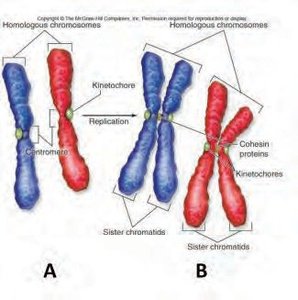
Q3. Use the figures to describe: Homologous Chromosomes and Sister Chromatids.
Background
Topic: Chromosome Structure
This question tests your ability to distinguish between homologous chromosomes and sister chromatids using visual aids.
Key Terms:
Homologous chromosomes: Chromosome pairs, one from each parent, with similar genes.
Sister chromatids: Identical copies of a chromosome, joined at the centromere after DNA replication.
Step-by-Step Guidance
Examine the provided figure and identify the homologous chromosomes (pairs of similar chromosomes, one maternal and one paternal).
Locate the sister chromatids (identical copies joined together after replication).
Describe the differences in structure and genetic content between homologous chromosomes and sister chromatids.
Try solving on your own before revealing the answer!
Final Answer:
Homologous chromosomes are pairs (one from each parent) with similar genes but possibly different alleles. Sister chromatids are identical copies of a single chromosome, joined at the centromere, formed after DNA replication.
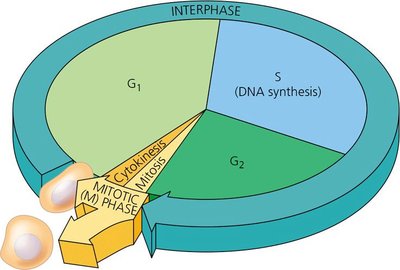
Q4. Describe the overall process of the cell cycle. Describe the general function of each phase. Which is the longest part?
Background
Topic: Cell Cycle Phases
This question tests your understanding of the cell cycle and the function of each phase.
Key Terms and Formula:
Cell cycle: The series of events that cells go through as they grow and divide.
Phases: G1 (growth), S (DNA synthesis), G2 (preparation), M (mitosis/cytokinesis).
Step-by-Step Guidance
List the main phases of the cell cycle: G1, S, G2, and M.
Describe the function of each phase (e.g., G1: cell growth, S: DNA replication).
Identify which phase is typically the longest and explain why.
Try solving on your own before revealing the answer!
Final Answer:
The cell cycle consists of G1 (growth), S (DNA synthesis), G2 (preparation for division), and M (mitosis/cytokinesis). Interphase (G1, S, G2) is the longest part, as cells spend most of their time growing and preparing for division.
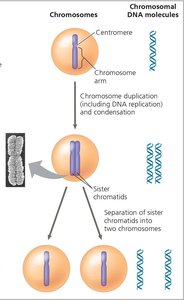
Q5. Cell division occurs in multiple steps. Describe major features of each step: Interphase (G1, S phase, G2), Mitosis (Prophase, Metaphase, Anaphase, Telophase), Cytokinesis.
Background
Topic: Steps of Cell Division
This question tests your knowledge of the sequence and features of cell division.
Key Terms:
Interphase: G1 (growth), S (DNA replication), G2 (preparation).
Mitosis: Prophase, Metaphase, Anaphase, Telophase.
Cytokinesis: Division of cytoplasm.
Step-by-Step Guidance
Describe what happens in each sub-phase of interphase (G1, S, G2).
Explain the sequence of mitosis steps and their main features.
Describe cytokinesis and how it completes cell division.
Try solving on your own before revealing the answer!
Final Answer:
Interphase: G1 (cell grows), S (DNA replicates), G2 (cell prepares for division).
Mitosis: Prophase (chromosomes condense), Metaphase (chromosomes align), Anaphase (sister chromatids separate), Telophase (nuclear envelope reforms).
Cytokinesis: Cytoplasm divides, forming two daughter cells.
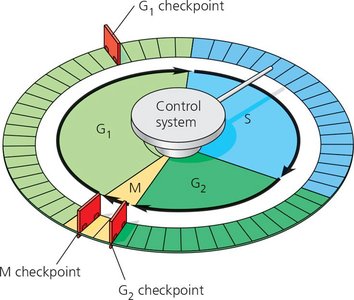
Q6. Cells can continue to grow out of control when checkpoint processes fail. Describe the checkpoints that regulate the cell cycle.
Background
Topic: Cell Cycle Checkpoints
This question tests your understanding of cell cycle regulation and the importance of checkpoints.
Key Terms:
Checkpoints: Control mechanisms that ensure proper cell cycle progression.
G1, G2, M checkpoints: Specific points where the cell checks for errors or readiness.
Step-by-Step Guidance
Identify the main checkpoints: G1, G2, and M.
Describe what each checkpoint checks for (e.g., DNA damage, proper chromosome alignment).
Explain what happens if a checkpoint fails.
Try solving on your own before revealing the answer!
Final Answer:
G1 checkpoint: Checks for DNA damage and cell size.
G2 checkpoint: Ensures DNA is fully replicated and undamaged.
M checkpoint: Verifies proper chromosome attachment to spindle.
If checkpoints fail, cells may divide uncontrollably, leading to cancer.
Q7. Cancer results from out of control cell growth. There are two classes of genes that can result in cancer. Describe the difference between each and how they cause cancer.
Background
Topic: Cancer Genetics
This question tests your understanding of oncogenes and tumor suppressor genes.
Key Terms:
Oncogenes: Genes that promote cell division; mutations can lead to uncontrolled growth.
Tumor suppressor genes: Genes that inhibit cell division; mutations can remove growth inhibition.
Step-by-Step Guidance
Define oncogenes and tumor suppressor genes.
Explain how mutations in each gene type contribute to cancer.
Describe the normal function of each gene class and what happens when they malfunction.
Try solving on your own before revealing the answer!
Final Answer:
Oncogenes are mutated forms of genes that normally promote cell division; when overactive, they cause excessive growth. Tumor suppressor genes normally inhibit cell division; when inactivated, cells lose growth control, leading to cancer.
Q8. How many copies need to be mutated in a tumor suppressor gene to cause cancer? In a proto-oncogene?
Background
Topic: Gene Mutation and Cancer
This question tests your understanding of the genetic requirements for cancer development.
Key Terms:
Tumor suppressor gene: Both copies must be mutated for loss of function.
Proto-oncogene: Only one copy needs to be mutated to become an oncogene.
Step-by-Step Guidance
Recall the difference between dominant and recessive mutations.
Explain why both copies of a tumor suppressor gene must be mutated.
Describe why a single mutation in a proto-oncogene can cause cancer.
Try solving on your own before revealing the answer!
Final Answer:
Both copies of a tumor suppressor gene must be mutated to cause cancer, while only one copy of a proto-oncogene needs to be mutated to promote cancer.
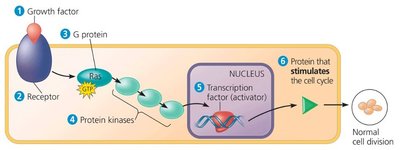
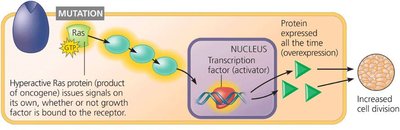
Q9. Describe the role of ras in the cell. How does a malfunctional ras result in cancer?
Background
Topic: Ras Protein and Cell Signaling
This question tests your understanding of the ras protein's function and its impact on cell division.
Key Terms:
Ras: A signaling protein that helps regulate cell division.
Oncogene: Mutated ras can become an oncogene, causing uncontrolled division.
Step-by-Step Guidance
Describe the normal role of ras in transmitting growth signals.
Explain how ras activation leads to cell division.
Discuss what happens when ras is mutated and cannot be inactivated.
Try solving on your own before revealing the answer!
Final Answer:
Ras normally transmits signals from growth factors to stimulate cell division. A malfunctional (mutated) ras is always active, causing continuous cell division and contributing to cancer.
Q10. Describe how the role of ras in the cell. How does a malfunctional ras result in cancer?
Background
Topic: Ras Protein and Cancer
This question is similar to Q9 and reinforces your understanding of ras's role in cell division and cancer.
Key Terms:
Ras: Signaling protein for cell division.
Oncogene: Mutated ras leads to uncontrolled growth.
Step-by-Step Guidance
Review the normal function of ras in cell signaling.
Explain how a mutation in ras can lead to constant activation.
Discuss the consequences of continuous cell division.
Try solving on your own before revealing the answer!
Final Answer:
Malfunctional ras is always active, leading to overexpression of proteins that stimulate cell division, resulting in cancer.
Q11. Describe how estrogen, progesterone, and HER2 receptor signaling is involved in the development of breast cancer.
Background
Topic: Hormone and Receptor Signaling in Cancer
This question tests your understanding of how hormone and receptor signaling contribute to breast cancer.
Key Terms:
Estrogen and progesterone receptors: Proteins that bind hormones and promote cell growth.
HER2: Growth factor receptor; overexpression leads to increased cell division.
Step-by-Step Guidance
Describe how estrogen and progesterone receptors stimulate cell division in breast tissue.
Explain the role of HER2 in cell signaling and division.
Discuss how abnormal signaling can lead to cancer.

Try solving on your own before revealing the answer!
Final Answer:
Estrogen and progesterone receptors promote cell division when activated by hormones. HER2 overexpression leads to excessive growth signals, contributing to breast cancer development.
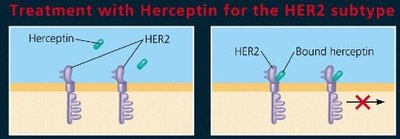
Q12. How does Herceptin work as a therapeutic?
Background
Topic: Targeted Cancer Therapy
This question tests your understanding of how Herceptin targets HER2-positive breast cancer.
Key Terms:
Herceptin: Monoclonal antibody therapy for HER2-positive cancer.
HER2: Growth factor receptor.
Step-by-Step Guidance
Describe how Herceptin binds to HER2 receptors.
Explain how this binding blocks growth signals.
Discuss the effect on cancer cell division.
Try solving on your own before revealing the answer!
Final Answer:
Herceptin binds to HER2 receptors, blocking their activity and preventing excessive cell division in HER2-positive breast cancer cells.
