 Indietro
Cell Division, Cancer, and the Cell Cycle: Guided Study Notes
Guida di studio - Note intelligenti
 Appunti personalizzati basati sui tuoi materiali, ampliati con definizioni chiave, esempi e contesto.
Q1. Why is cell division necessary? Describe three situations in which cell division occurs.
Background
Topic: Cell Division and Its Importance
This question tests your understanding of why cells divide and the biological contexts in which cell division is essential.
Key Terms:
Cell division: The process by which a parent cell divides into two or more daughter cells.
Growth, repair, reproduction: Common reasons for cell division in multicellular and unicellular organisms.
Step-by-Step Guidance
Think about why a single cell would need to divide in the first place. Consider both unicellular and multicellular organisms.
Identify at least three biological scenarios where cell division is required (e.g., organismal growth, tissue repair, reproduction).
For each scenario, briefly describe how cell division contributes to that process.
Try solving on your own before revealing the answer!
Final Answer:
Cell division is necessary for: (1) growth of an organism (increasing cell number), (2) repair and replacement of damaged or dead cells (such as healing a wound), and (3) reproduction (asexual reproduction in unicellular organisms, or production of gametes in multicellular organisms). These processes ensure survival, maintenance, and propagation of life.
Q2. Describe the organization of the genetic material by defining the following terms: Genome, Chromosomes, Chromatin, Somatic cells, Gametes.
Background
Topic: Genetic Material Organization
This question tests your understanding of how genetic information is structured and organized within cells.
Key Terms:
Genome: The complete set of genetic material in an organism.
Chromosomes: Structures made of DNA and proteins that contain genetic information.
Chromatin: The complex of DNA and proteins that forms chromosomes within the nucleus.
Somatic cells: All body cells except gametes; diploid.
Gametes: Reproductive cells (sperm and egg); haploid.
Step-by-Step Guidance
Define each term in your own words, focusing on its role in the cell.
Explain how these terms are related (e.g., chromatin makes up chromosomes, which are part of the genome).
Distinguish between somatic cells and gametes in terms of chromosome number and function.
Try solving on your own before revealing the answer!
Final Answer:
Genome: All the genetic material in an organism. Chromosomes: Threadlike structures of DNA and protein that carry genetic information. Chromatin: The material (DNA + proteins) that makes up chromosomes. Somatic cells: Body cells with two sets of chromosomes (diploid). Gametes: Reproductive cells with one set of chromosomes (haploid).
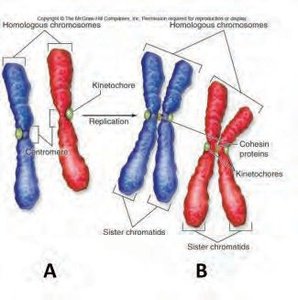
Q3. Use the figures to the right to describe the following: Homologous Chromosomes, Sister chromatids.
Background
Topic: Chromosome Structure
This question asks you to distinguish between homologous chromosomes and sister chromatids, which are key concepts in genetics and cell division.
Key Terms:
Homologous chromosomes: Chromosome pairs, one from each parent, that are similar in shape, size, and genetic content.
Sister chromatids: Identical copies of a chromosome, connected by a centromere, formed during DNA replication.
Step-by-Step Guidance
Examine the image and identify the homologous chromosomes (chromosomes of the same type, but from different parents).
Locate the sister chromatids (identical copies joined at the centromere after DNA replication).
Describe how homologous chromosomes differ from sister chromatids in terms of genetic similarity and origin.
Try solving on your own before revealing the answer!
Final Answer:
Homologous chromosomes are pairs of chromosomes (one from each parent) that carry the same genes but may have different alleles. Sister chromatids are identical copies of a single chromosome, created during DNA replication, and are joined together at the centromere.
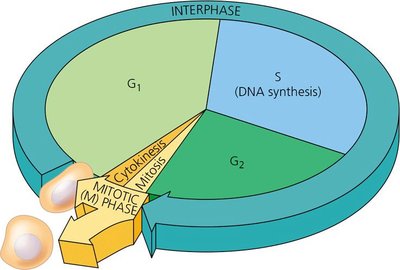
Q4. Describe the overall process of the cell cycle. Describe the general function of each phase. Which is the longest part?
Background
Topic: The Cell Cycle
This question tests your understanding of the stages of the cell cycle and the function of each phase.
Key Terms and Diagram:
Cell cycle: The series of events that cells go through as they grow and divide.
G1 phase: Cell growth and normal functions.
S phase: DNA synthesis (replication).
G2 phase: Preparation for mitosis.
M phase: Mitosis and cytokinesis (cell division).
Step-by-Step Guidance
List the main phases of the cell cycle in order: G1, S, G2, and M.
Describe the primary function of each phase (e.g., growth, DNA replication, preparation for division, division).
Identify which phase is typically the longest and explain why.
Try solving on your own before revealing the answer!
Final Answer:
The cell cycle consists of G1 (growth), S (DNA synthesis), G2 (preparation for mitosis), and M (mitosis and cytokinesis). Interphase (G1, S, G2) is the longest part, with G1 often being the longest individual phase.
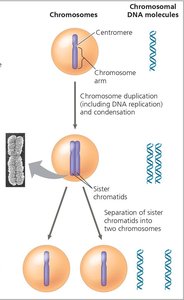
Q5. Cell division occurs in multiple steps. Describe major features of each step below: Interphase (G1, S phase, G2), Mitosis (Prophase, Metaphase, Anaphase, Telophase), Cytokinesis.
Background
Topic: Steps of Cell Division
This question asks you to break down the cell cycle and mitosis into their component steps and describe what happens in each.
Key Terms:
Interphase: G1 (growth), S (DNA replication), G2 (preparation for mitosis).
Mitosis: Prophase, Metaphase, Anaphase, Telophase (steps of nuclear division).
Cytokinesis: Division of the cytoplasm.
Step-by-Step Guidance
For Interphase, describe what happens in G1, S, and G2 phases.
For Mitosis, outline the key events in Prophase, Metaphase, Anaphase, and Telophase.
Explain what occurs during Cytokinesis and how it differs from mitosis.
Try solving on your own before revealing the answer!
Final Answer:
Interphase: G1 (cell grows), S (DNA is replicated), G2 (cell prepares for division). Mitosis: Prophase (chromosomes condense), Metaphase (chromosomes align), Anaphase (sister chromatids separate), Telophase (nuclei reform). Cytokinesis: Cytoplasm divides, resulting in two daughter cells.
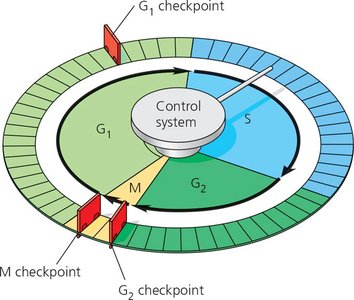
Q6. Cells can continue to grow out of control when checkpoint processes fail. Describe the checkpoints that regulate the cell cycle.
Background
Topic: Cell Cycle Checkpoints
This question tests your knowledge of the regulatory mechanisms that ensure proper cell division.
Key Terms and Diagram:
Checkpoints: Control points where the cell cycle can be stopped if conditions are not favorable.
G1 checkpoint: Checks for DNA damage and adequate cell size.
G2 checkpoint: Ensures DNA replication is complete and checks for DNA damage.
M checkpoint: Ensures all chromosomes are properly attached to the spindle before division.
Step-by-Step Guidance
Identify the three main checkpoints in the cell cycle (G1, G2, M).
Describe what each checkpoint monitors (e.g., DNA damage, chromosome attachment).
Explain what happens if a cell fails a checkpoint.
Try solving on your own before revealing the answer!
Final Answer:
The cell cycle is regulated by G1, G2, and M checkpoints. Each checkpoint ensures the cell is ready to proceed to the next phase; if not, the cycle is halted for repair or the cell undergoes apoptosis.
