 Indietro
Cell Division, Meiosis, and Genetic Variation: Study Notes for General Biology
Guida di studio - Note intelligenti
 Appunti personalizzati basati sui tuoi materiali, ampliati con definizioni chiave, esempi e contesto.
Cell Division and the Cell Cycle
Overview of Cell Division
Cell division is a fundamental process that enables organisms to grow, repair tissues, and reproduce. It distinguishes living things from nonliving matter by allowing the production of new cells and organisms.
Genome: The complete set of DNA in a cell. Prokaryotes typically have a single DNA molecule, while eukaryotes have multiple.
Somatic cells: Nonreproductive cells with two sets of chromosomes (diploid).
Gametes: Reproductive cells (sperm and eggs) with half as many chromosomes (haploid).
Before cell division, DNA is replicated and chromosomes condense.
The Cell Cycle
The cell cycle is the sequence of events in the life of a cell, including growth, DNA replication, and division.
Mitotic (M) phase: Includes mitosis (nuclear division) and cytokinesis (cytoplasmic division).
Interphase: Period of cell growth and chromosome copying, divided into G1 (first gap), S (synthesis), and G2 (second gap) phases.
Mitosis
Mitosis is conventionally divided into five stages:
Prophase
Prometaphase
Metaphase
Anaphase
Telophase
The cell cycle is regulated by a molecular control system to ensure proper division.
Meiosis and Sexual Life Cycles
Inheritance and Chromosomes
Inheritance, or heredity, is the transmission of traits from one generation to the next. Variation among offspring is due to genetic differences.
Genes: Units of heredity made up of DNA segments.
Genes are passed via gametes.
Most DNA is packaged into chromosomes.
Humans have 46 chromosomes in somatic cells (diploid).
Locus: Specific position of a gene on a chromosome.
Asexual vs. Sexual Reproduction
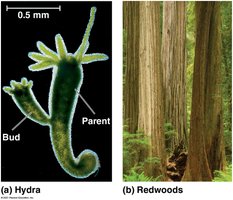
Asexual reproduction involves a single parent and produces genetically identical offspring. Sexual reproduction involves two parents and produces genetically unique offspring.
Asexual reproduction: Genes passed by mitosis, no fusion of gametes.
Sexual reproduction: Unique gene combinations from two parents.
Chromosome Sets and Karyotypes
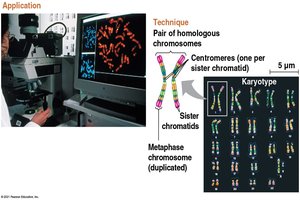
Human somatic cells have 23 pairs of chromosomes, including autosomes and sex chromosomes.
Homologous chromosomes: Chromosome pairs with the same length, centromere position, and staining pattern.
Karyotype: Ordered display of chromosome pairs from a cell.
Sex chromosomes: X and Y determine sex (XX for females, XY for males).
Autosomes: The remaining 22 pairs.
Diploid and Haploid Cells
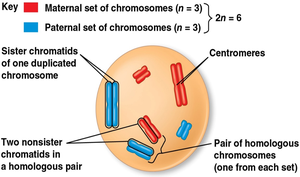
Each pair of homologous chromosomes includes one chromosome from each parent. The diploid number for humans is 46 (2n = 46), and the haploid number is 23 (n = 23).
Diploid (2n): Two sets of chromosomes.
Haploid (n): One set of chromosomes (gametes).
Each chromosome is replicated before division, forming sister chromatids.
Human Life Cycle: Fertilization and Meiosis
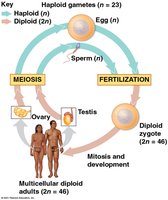
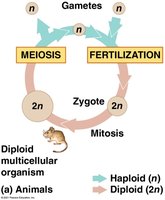
Fertilization is the union of gametes, producing a zygote with one set of chromosomes from each parent. The zygote divides by mitosis to form an adult. Meiosis produces gametes, maintaining chromosome number across generations.
Gametes are the only cells produced by meiosis.
Meiosis results in haploid gametes; fertilization restores diploid state.
Sexual Life Cycles in Animals
In most animals, gametes are the only haploid cells. They are produced by meiosis and fuse to form a diploid zygote, which develops into a multicellular organism.
Meiosis: Process and Stages
Overview of Meiosis
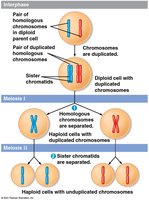
Meiosis reduces chromosome number from diploid to haploid and consists of two consecutive divisions: meiosis I and meiosis II. Four genetically distinct daughter cells are produced.
Chromosomes duplicate before meiosis.
Sister chromatids are held together by cohesins.
Meiosis I: Homologous chromosomes separate.
Meiosis II: Sister chromatids separate.
Meiosis I: Separating Homologous Chromosomes
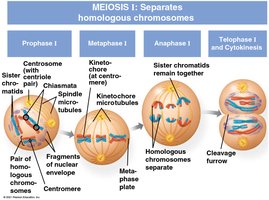
Meiosis I is divided into four phases:
Prophase I: Homologous chromosomes pair and crossing over occurs at chiasmata.
Metaphase I: Homologous pairs align at the metaphase plate.
Anaphase I: Homologous chromosomes separate, sister chromatids remain together.
Telophase I and Cytokinesis: Two haploid cells form, each with duplicated chromosomes.
Crossing Over and Synapsis
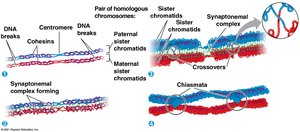
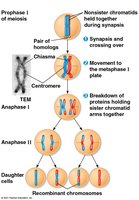
During prophase I, crossing over occurs between nonsister chromatids, producing recombinant chromosomes. The synaptonemal complex facilitates tight pairing of homologs.
DNA breaks are repaired, joining DNA from different chromatids.
Chiasmata are the sites of crossover.
Meiosis II: Separating Sister Chromatids
Meiosis II is similar to mitosis and consists of prophase II, metaphase II, anaphase II, and telophase II. Sister chromatids are separated, resulting in four haploid cells.
Chromosomes are no longer genetically identical due to crossing over.
Nuclei form and chromosomes decondense in telophase II.
Cytokinesis produces four genetically distinct haploid cells.
Comparison of Mitosis and Meiosis
Key Differences
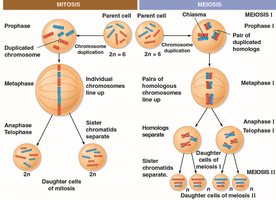
Mitosis produces two genetically identical diploid cells, while meiosis produces four genetically distinct haploid cells.
Mitosis: Conserves chromosome number, produces identical cells.
Meiosis: Reduces chromosome number, increases genetic diversity.
Unique Events in Meiosis I
Synapsis and crossing over in prophase I.
Alignment of homologous pairs at the metaphase plate.
Separation of homologs during anaphase I.
Genetic Variation in Sexual Life Cycles
Sources of Genetic Variation
Genetic variation is essential for evolution and arises from mutations, independent assortment, crossing over, and random fertilization.
Mutations: Create new alleles.
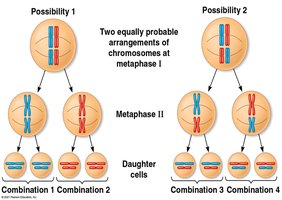
Independent assortment: Homologous pairs orient randomly at metaphase I, sorting maternal and paternal chromosomes independently.
Crossing over: Produces recombinant chromosomes, combining DNA from both parents.
Random fertilization: Any sperm can fuse with any egg, increasing variation.
Independent Assortment of Chromosomes
Each pair of chromosomes sorts independently, resulting in numerous possible combinations in gametes.
Crossing Over
Crossing over during prophase I produces recombinant chromosomes, further increasing genetic diversity.
Summary Table: Comparison of Mitosis and Meiosis
Feature | Mitosis | Meiosis |
|---|---|---|
Number of divisions | 1 | 2 |
Number of daughter cells | 2 | 4 |
Chromosome number | Diploid (2n) | Haploid (n) |
Genetic identity | Identical to parent | Genetically distinct |
Role | Growth, repair | Gamete production |
Key Equations
Diploid number:
Haploid number:
For humans: ,
Conclusion
Meiosis and sexual reproduction are central to genetic diversity and evolution. Understanding the mechanisms of cell division, chromosome behavior, and genetic variation is fundamental to biology.
