 Indietro
Cell Membrane Structure and Function: Mini-Textbook Study Guide
Guida di studio - Note intelligenti
 Appunti personalizzati basati sui tuoi materiali, ampliati con definizioni chiave, esempi e contesto.
The Membrane
Structure of the Plasma Membrane
The plasma membrane is a dynamic structure that regulates the movement of substances into and out of the cell. It is primarily composed of phospholipids, proteins, carbohydrates, and cholesterol, each contributing to its function and properties. - Phospholipids: Amphipathic molecules with hydrophilic heads and hydrophobic tails, forming a bilayer. - Proteins: Embedded or attached to the membrane, serving various functions. - Carbohydrates: Attached to lipids (glycolipids) or proteins (glycoproteins), important for cell recognition. - Cholesterol: Modulates membrane fluidity. Example: The phospholipid bilayer forms the basic structural framework of the membrane, with hydrophobic tails facing inward and hydrophilic heads facing outward. 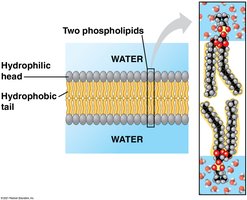
Fluid Mosaic Model
The fluid mosaic model describes the membrane as a mosaic of proteins floating in or attached to a fluid bilayer of phospholipids. - Proteins are not randomly distributed; they often form functional groups. - Membrane fluidity is maintained by weak hydrophobic interactions. - Lipids and some proteins can move laterally; flip-flop movement is rare. 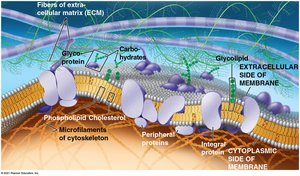
Membrane Fluidity and Temperature
Membrane fluidity is influenced by the types of fatty acids present and the presence of cholesterol. - Unsaturated fatty acids: Increase fluidity by preventing tight packing. - Saturated fatty acids: Decrease fluidity by allowing tight packing. - Cholesterol: Reduces fluidity at moderate temperatures, but prevents solidification at low temperatures. Example: In cold environments, membranes rich in unsaturated fatty acids remain fluid, while saturated fatty acids can cause membranes to solidify. 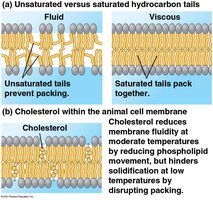
Membrane Proteins and Their Functions
Membrane proteins are essential for the diverse functions of the plasma membrane. - Peripheral proteins: Bound to the membrane surface. - Integral proteins: Penetrate the hydrophobic core; transmembrane proteins span the membrane. - Attachment: Some proteins are anchored to the cytoskeleton or extracellular matrix. - Functions: Transport, enzymatic activity, signal transduction, cell-cell recognition, intercellular joining, and attachment.
Role of Membrane Carbohydrates
Carbohydrates attached to proteins and lipids serve as cellular markers for recognition. - Glycolipids: Carbohydrates bonded to lipids. - Glycoproteins: Carbohydrates bonded to proteins. - Cell-cell recognition: Essential for immune response and tissue formation.
Synthesis and Sidedness of Membranes
Membranes have distinct inside and outside faces, with asymmetrical distribution of proteins, lipids, and carbohydrates. 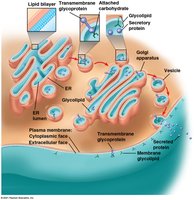
Selective Permeability
The plasma membrane exhibits selective permeability, allowing some substances to cross more easily than others. - Small, nonpolar molecules: Pass rapidly (e.g., O2, CO2). - Polar molecules and ions: Cross slowly or require transport proteins.
Transport Across the Membrane
Passive Transport
Passive transport involves the movement of substances across the membrane without energy input. - Diffusion: Movement of molecules from high to low concentration. - Dynamic equilibrium: Equal movement in both directions. Equation: 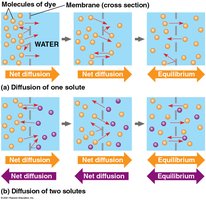
Osmosis
Osmosis is the diffusion of water across a selectively permeable membrane. - Water moves toward higher solute concentration. - Tonicity: Isotonic (equal solute), hypertonic (higher solute outside), hypotonic (lower solute outside). Example: Paramecium uses a contractile vacuole to expel excess water in a hypotonic environment. 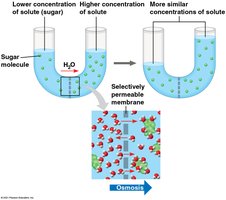
Facilitated Diffusion
Facilitated diffusion uses transport proteins to move substances down their concentration gradient. - Channel proteins: Provide hydrophilic tunnels. - Carrier proteins: Change shape to move molecules. 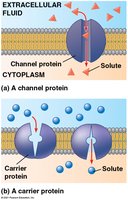
Active Transport
Active transport moves substances against their concentration gradient using energy, usually from ATP. - Carrier proteins: All active transport proteins are carriers. - Sodium-potassium pump: Maintains high K+ and low Na+ inside animal cells. Equation: (energy for transport) 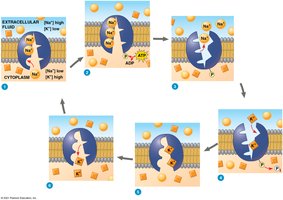
Membrane Potential and Ion Pumps
Membrane potential is the voltage across a membrane, created by ion distribution. - Electrochemical gradient: Combination of chemical and electrical forces. - Electrogenic pumps: Generate voltage (sodium-potassium pump in animals, proton pump in plants). 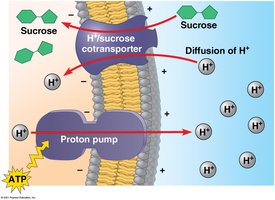
Bulk Transport: Exocytosis and Endocytosis
Large molecules cross the membrane via vesicles in processes called exocytosis and endocytosis. - Exocytosis: Vesicles fuse with the membrane to release contents outside. - Endocytosis: Membrane forms vesicles to bring substances inside.
Types of Endocytosis
- Phagocytosis: Cell engulfs particles. - Pinocytosis: Cell "gulps" extracellular fluid. - Receptor-mediated endocytosis: Specific molecules are taken in after binding to receptors. 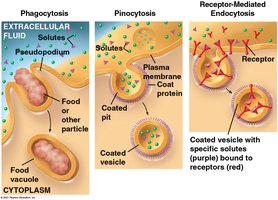
Summary Table: Membrane Transport Mechanisms
Transport Type | Energy Required | Direction | Example |
|---|---|---|---|
Passive (Diffusion) | No | Down gradient | O2, CO2 |
Facilitated Diffusion | No | Down gradient | Glucose via carrier protein |
Active Transport | Yes (ATP) | Against gradient | Sodium-potassium pump |
Osmosis | No | Water down gradient | Water movement in cells |
Bulk Transport | Yes (vesicles) | Varies | Exocytosis, endocytosis |
Practice Questions
If a cell is hypertonic to the solution, where is the water going? What happens to the cell?
If a solution is hypotonic to the cell, where is the water going? What happens to the cell?
Additional info: This guide covers the structure and function of the plasma membrane, including transport mechanisms, membrane fluidity, and bulk transport, as outlined in General Biology curriculum.
