 Indietro
Cell Membrane Structure and Function: Mini-Textbook Study Notes
Guida di studio - Note intelligenti
 Appunti personalizzati basati sui tuoi materiali, ampliati con definizioni chiave, esempi e contesto.
The Membrane
Structure and Composition of Cellular Membranes
Cellular membranes are essential barriers that regulate the movement of substances into and out of cells. They are primarily composed of amphipathic phospholipids, proteins, carbohydrates, and other lipids. - Phospholipids form a bilayer with hydrophobic tails facing inward and hydrophilic heads facing outward toward water. - Amphipathic means having both hydrophilic and hydrophobic regions; phospholipids exemplify this property. - Proteins are embedded within or attached to the membrane, contributing to its function and structure. - Carbohydrates are attached to lipids (glycolipids) or proteins (glycoproteins), playing roles in cell recognition. 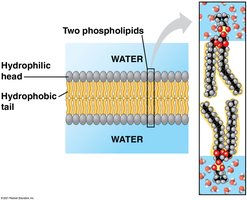
The Fluid Mosaic Model
The fluid mosaic model describes the membrane as a dynamic structure with proteins floating in or attached to a fluid phospholipid bilayer. - Proteins are not randomly distributed; they often form functional groups. - Membranes are held together by weak hydrophobic interactions, allowing lateral movement of lipids and some proteins. - Rarely, lipids may flip-flop between layers. 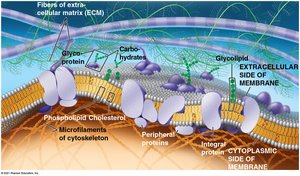
Membrane Fluidity and Temperature
Membrane fluidity is influenced by the types of fatty acids and the presence of cholesterol. - Unsaturated fatty acids increase fluidity by preventing tight packing. - Saturated fatty acids decrease fluidity by allowing tight packing. - Cholesterol acts as a fluidity buffer: it restrains movement at high temperatures and prevents tight packing at low temperatures. - Plants use related steroid lipids for similar purposes. 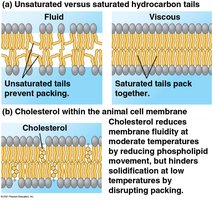
Membrane Proteins: Types and Functions
Membrane proteins are crucial for the diverse functions of the membrane. - Peripheral proteins are bound to the membrane surface. - Integral proteins penetrate the hydrophobic core; transmembrane proteins span the entire membrane. - Proteins may be anchored by the cytoskeleton or extracellular matrix. - Functions include transport, enzymatic activity, signal transduction, cell-cell recognition, and attachment.
Membrane Carbohydrates and Cell Recognition
Carbohydrates attached to lipids (glycolipids) or proteins (glycoproteins) serve as cell identification markers. - Cells recognize each other by binding to these surface molecules. - Membranes have distinct inside and outside faces, with asymmetrical distribution of components. 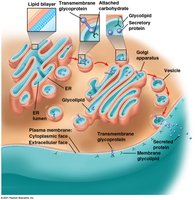
Selective Permeability of the Membrane
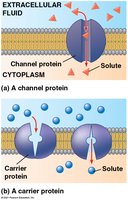
The plasma membrane is selectively permeable, allowing some substances to cross more easily than others. - Small, hydrophobic molecules (e.g., O2, CO2) pass rapidly. - Hydrophilic molecules (e.g., sugars, ions) cross slowly or require transport proteins. - Transport proteins include channel proteins (hydrophilic tunnels) and carrier proteins (change shape to move molecules).
Transport Across the Membrane
Passive Transport: Diffusion and Facilitated Diffusion
Passive transport involves the movement of substances down their concentration gradient without energy input. - Diffusion is the random movement of molecules toward equilibrium. - Facilitated diffusion uses transport proteins to speed up passive movement. - Channel proteins and carrier proteins are involved in facilitated diffusion. 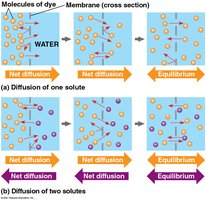
Osmosis and Water Balance
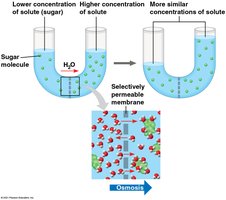
Osmosis is the diffusion of water across a selectively permeable membrane. - Water moves toward higher solute concentration until equilibrium is reached. - Tonicity describes the effect of solute concentration on cell volume:
Isotonic: Equal solute concentration inside and outside; no net water movement.
Hypertonic: Higher solute concentration outside; cell loses water.
Hypotonic: Lower solute concentration outside; cell gains water.
Active Transport and Membrane Potential
Active Transport
Active transport moves substances against their concentration gradients using energy, typically from ATP. - All active transport proteins are carrier proteins. - The sodium-potassium pump maintains high K+ and low Na+ inside animal cells. (energy for pump) 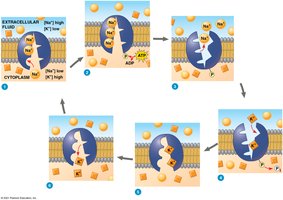
Membrane Potential and Ion Pumps
Membrane potential is the voltage across a membrane due to ion distribution. - The electrochemical gradient combines chemical and electrical forces driving ion movement. - Electrogenic pumps generate membrane potential: sodium-potassium pump in animals, proton pump in plants, fungi, and bacteria. 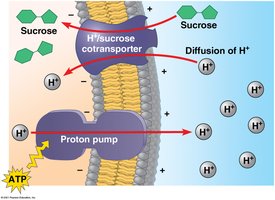
Cotransport
Cotransport occurs when the active transport of one solute indirectly drives the transport of another. - Example: H+/sucrose cotransporter in plants couples sucrose uptake to H+ diffusion.
Bulk Transport: Exocytosis and Endocytosis
Exocytosis
Exocytosis is the process by which cells export large molecules by vesicle fusion with the plasma membrane. - Secretory cells (e.g., pancreas) use exocytosis to release products like insulin.
Endocytosis
Endocytosis is the uptake of macromolecules by vesicle formation. - Phagocytosis: Cell engulfs particles, forming a food vacuole. - Pinocytosis: Cell "gulps" extracellular fluid into vesicles; nonspecific uptake. - Receptor-mediated endocytosis: Specific solutes bind to receptors, triggering vesicle formation. 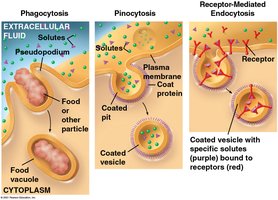
Examples and Applications
- Paramecium uses contractile vacuoles for osmoregulation in hypotonic environments. - Plant cells become turgid in hypotonic solutions, flaccid in isotonic, and undergo plasmolysis in hypertonic solutions. - Human cells use receptor-mediated endocytosis to take in cholesterol; defects can lead to disease. Additional info: These notes expand on the original content with definitions, examples, and context for General Biology students.
