 Indietro
Cell Membrane Structure and Function: Study Notes for General Biology
Guida di studio - Note intelligenti
 Appunti personalizzati basati sui tuoi materiali, ampliati con definizioni chiave, esempi e contesto.
Cell Membrane Structure and Function
Introduction to the Plasma Membrane
The plasma membrane is a dynamic structure that separates the interior of the cell from its external environment. It is primarily composed of a phospholipid bilayer with embedded proteins, cholesterol, and carbohydrates, which together regulate the movement of substances into and out of the cell.
Phospholipid Bilayer
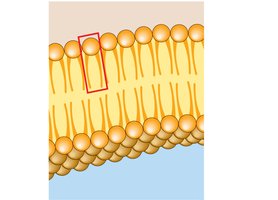
Phospholipids are amphipathic molecules with hydrophilic (water-attracting) heads and hydrophobic (water-repelling) tails.
The bilayer arrangement ensures that hydrophobic tails are shielded from water, while hydrophilic heads face the aqueous environments inside and outside the cell.
This structure creates a semi-permeable barrier, allowing selective passage of substances.
Membrane Fluidity
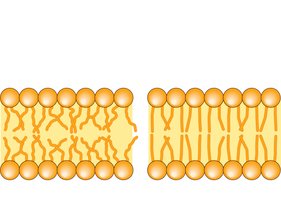
Membrane fluidity is essential for the proper functioning of the cell membrane, affecting the movement of proteins and lipids within the layer and the ability of the membrane to self-heal.
Unsaturated fatty acids (with double or triple bonds) introduce kinks in the tails, increasing fluidity.
Saturated fatty acids (with mostly single bonds) pack more tightly, decreasing fluidity.
Role of Cholesterol
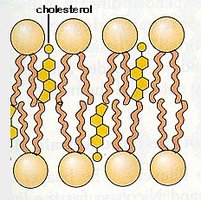
Cholesterol molecules are interspersed within the phospholipid bilayer and play a critical role in modulating membrane fluidity and stability.
At high temperatures, cholesterol stabilizes the membrane and raises its melting point.
At low temperatures, cholesterol prevents the membrane from becoming too rigid by disrupting the regular packing of phospholipids.
Cholesterol also reduces membrane permeability to small water-soluble molecules.
Membrane Proteins
Proteins embedded in the plasma membrane serve various functions, including transport, signal transduction, and cell recognition.
Integral proteins span the membrane and are involved in transport and communication.
Peripheral proteins are attached to the membrane surface and play roles in signaling and maintaining cell shape.
Transport Across the Membrane
The plasma membrane controls the movement of substances via passive and active transport mechanisms.
Passive transport (no energy required): includes simple diffusion, facilitated diffusion, and osmosis.
Active transport (energy required): moves substances against their concentration gradient using ATP.
Simple and Facilitated Diffusion
Simple diffusion: Small nonpolar molecules (e.g., O2, CO2) pass directly through the lipid bilayer.
Facilitated diffusion: Larger or polar molecules (e.g., glucose, ions) move through channel or carrier proteins.
Osmosis
Osmosis is the diffusion of water across a selectively permeable membrane from an area of low solute concentration to high solute concentration.
Isotonic solution: No net movement of water; cell volume remains stable.
Hypertonic solution: Water leaves the cell; cell shrinks.
Hypotonic solution: Water enters the cell; cell swells.
Summary Table: Factors Affecting Membrane Fluidity
Factor | Effect on Fluidity |
|---|---|
Unsaturated fatty acids | Increase fluidity |
Saturated fatty acids | Decrease fluidity |
Cholesterol (high temp) | Stabilizes, decreases fluidity |
Cholesterol (low temp) | Prevents rigidity, increases fluidity |
Additional info: Membrane fluidity is also influenced by temperature and the presence of other lipids. Cells can adjust the composition of their membranes in response to environmental changes to maintain optimal fluidity.
