 Indietro
Cell Membrane Structure and Transport Mechanisms
Guida di studio - Note intelligenti
 Appunti personalizzati basati sui tuoi materiali, ampliati con definizioni chiave, esempi e contesto.
Cell Membrane Structure
Phospholipid Bilayer
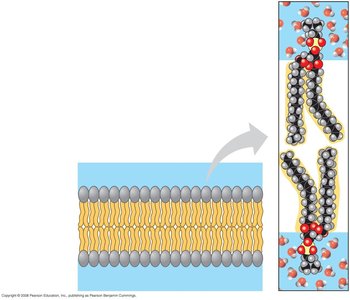
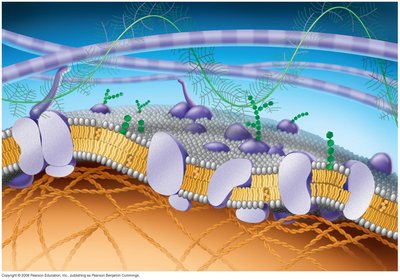
The cell membrane, also known as the plasma membrane, is primarily composed of a double layer of phospholipids. Each phospholipid molecule has a hydrophilic (water-loving) head and two hydrophobic (water-fearing) tails. This arrangement forms a bilayer, with the hydrophobic tails facing inward, shielded from water, and the hydrophilic heads facing outward toward the aqueous environment. - Phospholipids: Amphipathic molecules with a polar head and nonpolar tails. - Bilayer Formation: Hydrophobic tails are sequestered inside, while hydrophilic heads interact with water. - Function: Provides a semi-permeable barrier, allowing selective transport of substances. 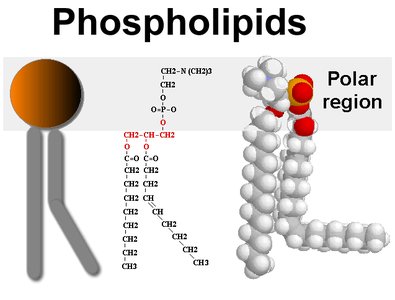
Fluid Mosaic Model
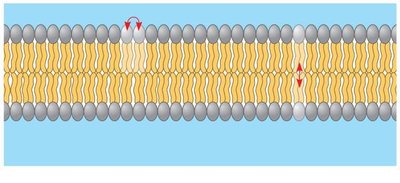
The cell membrane is described by the fluid mosaic model, which states that the membrane is a flexible, dynamic structure with proteins embedded within or attached to the phospholipid bilayer. - Membrane Proteins: Integral and peripheral proteins serve various functions, including transport, signaling, and structural support. - Lateral Movement: Phospholipids and proteins move laterally within the layer, contributing to membrane fluidity. - Flip-Flop Movement: Rare movement of phospholipids between layers. 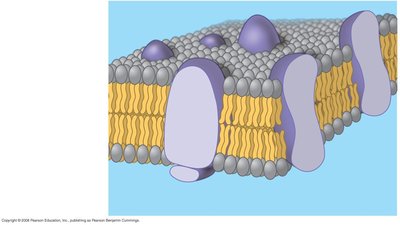
Membrane Fluidity
Membrane fluidity is influenced by the composition of phospholipid tails and the presence of cholesterol. - Unsaturated Tails: Increase fluidity due to kinks that prevent tight packing. - Saturated Tails: Decrease fluidity by allowing tight packing. - Cholesterol: Acts as a fluidity buffer, stabilizing the membrane in both hot and cold conditions. - Adaptation: Organisms adjust membrane composition based on environmental temperature. 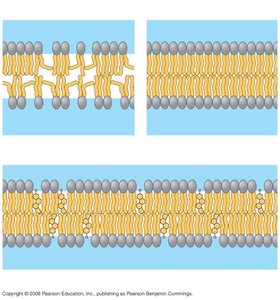
Membrane Proteins and Their Functions
Types of Membrane Proteins
Membrane proteins are classified as integral (spanning the membrane) or peripheral (attached to the surface). - Integral Proteins: Often span the membrane and are involved in transport. - Peripheral Proteins: Attach to the membrane surface and assist in signaling or structural support. 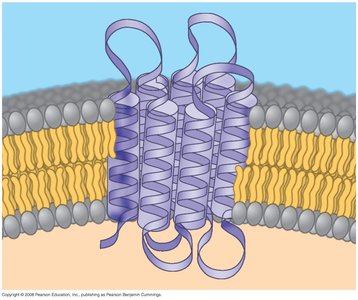
Functions of Membrane Proteins
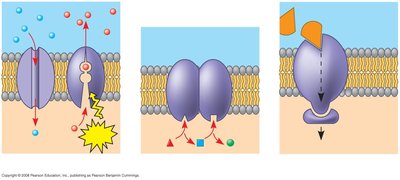
Membrane proteins perform several essential functions:
Transport: Move substances across the membrane.
Enzymatic Activity: Catalyze reactions at the membrane surface.
Signal Transduction: Act as receptors for signaling molecules.
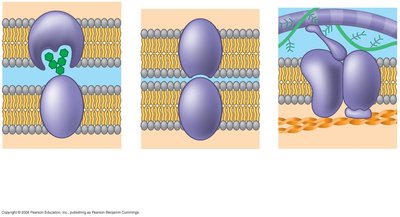
Cell-Cell Recognition: Allow cells to identify each other.
Intercellular Joining: Connect adjacent cells.
Attachment: Anchor the membrane to the cytoskeleton and extracellular matrix.
Membrane Transport Mechanisms
Passive Transport
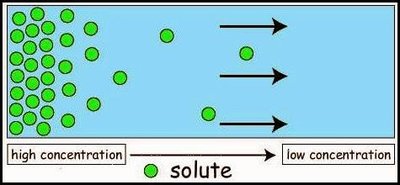
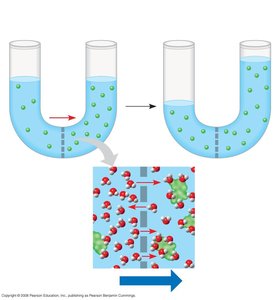
Passive transport involves the movement of molecules from areas of high concentration to low concentration without the use of energy.
Diffusion: Movement of solute particles down their concentration gradient.
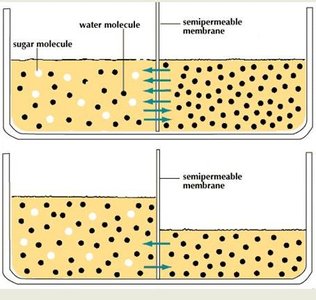
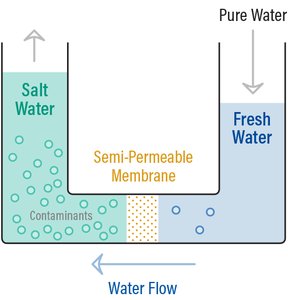
Osmosis: Movement of water across a semi-permeable membrane from low solute concentration to high solute concentration.
Tonicity and Osmoregulation
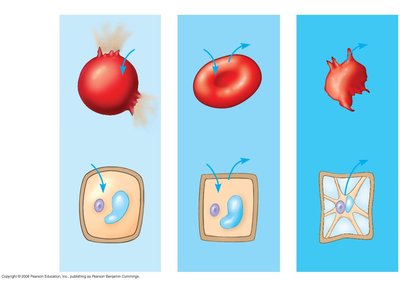
Tonicity describes the effect of a solution on cell volume.
Hypotonic: Lower solute concentration outside the cell; water enters the cell.
Hypertonic: Higher solute concentration outside the cell; water leaves the cell.
Isotonic: Equal solute concentration; no net water movement.
Water always moves from hypotonic to hypertonic solutions. 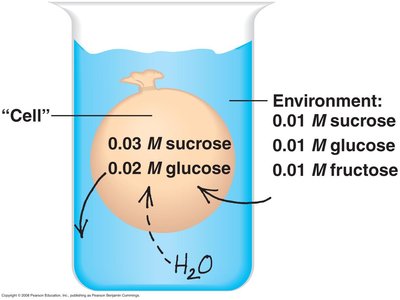
Facilitated Transport
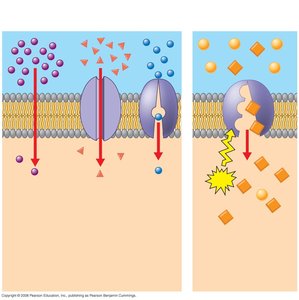
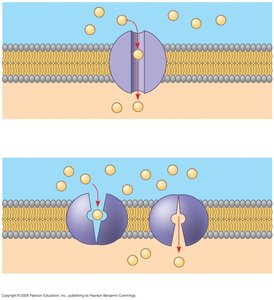
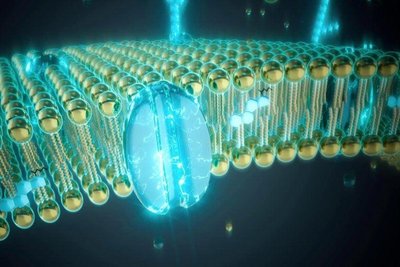
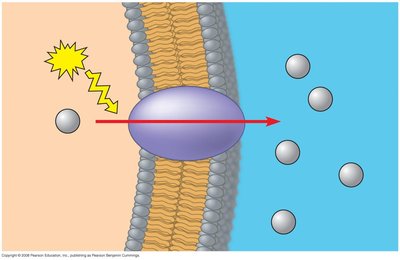
Facilitated transport uses membrane proteins to move molecules across the membrane.
Facilitated Diffusion: Movement down the concentration gradient with the help of channel or carrier proteins.
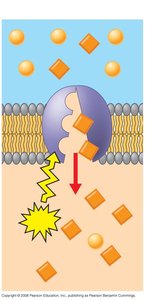
Facilitated Active Transport: Movement against the concentration gradient, requiring energy.
Active Transport
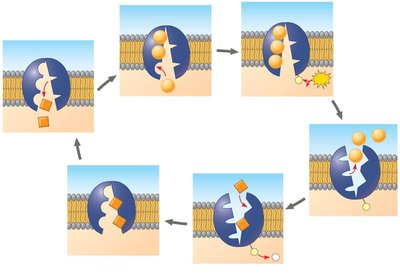
Active transport moves molecules against their concentration gradient using energy, typically from ATP.
Electrogenic Pumps: Generate voltage across the membrane.
Sodium-Potassium Pump: Pumps 3 Na+ out and 2 K+ in, maintaining membrane potential.
Proton Pump: Moves H+ ions, important in plants, fungi, and bacteria.
Cotransport
Cotransport occurs when the active transport of one solute indirectly drives the transport of another. Plants use the gradient of hydrogen ions generated by proton pumps to drive the active transport of nutrients.
Bulk Transport
Bulk transport moves large molecules via vesicles and requires energy.
Exocytosis: Release of substances from the cell.
Endocytosis: Uptake of substances into the cell, including phagocytosis (cellular eating), pinocytosis (cellular drinking), and receptor-mediated endocytosis.
Summary Table: Membrane Transport Mechanisms
Transport Type | Energy Required | Direction | Example |
|---|---|---|---|
Diffusion | No | High to Low | O2 movement |
Osmosis | No | High to Low (water) | Water movement |
Facilitated Diffusion | No | High to Low | Glucose transport |
Active Transport | Yes (ATP) | Low to High | Na+/K+ pump |
Bulk Transport | Yes | Varies | Phagocytosis |
Additional info: Recent research (Brown and Rana Ashkar, 2025) shows that membrane elasticity depends more on lipid packing density than on lipid type, which is a key principle for cell health and artificial cell engineering.
