 Indietro
Cell Membrane Structure, Transport, and Energy – Guided Study Notes
Guida di studio - Note intelligenti
 Appunti personalizzati basati sui tuoi materiali, ampliati con definizioni chiave, esempi e contesto.
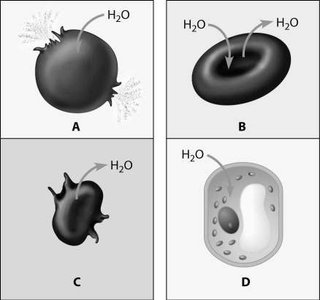
Q1. Which figure depicts an animal cell placed in a solution hypotonic to the cell?
Background
Topic: Osmosis and Tonicity in Animal Cells
This question tests your understanding of how animal cells respond to different external solute concentrations, specifically hypotonic solutions, and the resulting movement of water across the plasma membrane.
Key Terms and Concepts:
Hypotonic solution: A solution with a lower solute concentration compared to the inside of the cell, causing water to move into the cell.
Osmosis: The diffusion of water across a selectively permeable membrane.
Lysis: The bursting of an animal cell due to excessive water intake.
Step-by-Step Guidance
Recall that in a hypotonic solution, water moves into the cell because the external environment has a lower solute concentration than the cytoplasm.
Consider what happens to an animal cell when excess water enters: the cell swells and may burst (lyse) due to the lack of a rigid cell wall.
Examine each figure for signs of water entering the cell and the cell swelling or bursting.
Identify which figure shows an animal cell with water moving inward and the cell membrane stretching or rupturing.
Try solving on your own before revealing the answer!
Final Answer: A (cell A)
Cell A shows an animal cell swelling and bursting due to water entering, which is characteristic of a cell placed in a hypotonic solution.
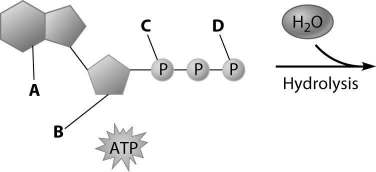
Q2. Which part of the ATP molecule breaks free of the rest when an ATP molecule is used for energy?
Background
Topic: ATP Structure and Energy Release
This question tests your knowledge of the structure of ATP (adenosine triphosphate) and how energy is released during its hydrolysis.
Key Terms and Concepts:
ATP: The primary energy carrier in cells, consisting of adenosine and three phosphate groups.
Hydrolysis: A chemical reaction that breaks bonds using water, often releasing energy.
Phosphate group: The part of ATP that is removed to release energy.
Step-by-Step Guidance
Recall that ATP consists of adenosine (adenine + ribose) and three phosphate groups labeled as C and D in the diagram.
When ATP is hydrolyzed, one phosphate group is removed, releasing energy for cellular work.
Identify which labeled part (A, B, C, or D) corresponds to the terminal (last) phosphate group in the ATP structure.
Consider which bond is broken during ATP hydrolysis and which group is released.
Try solving on your own before revealing the answer!
Final Answer: D (part D)
Part D is the terminal phosphate group that breaks free during ATP hydrolysis, releasing energy for the cell.
