 Indietro
Cell Membrane Transport, Energy, and Enzyme Function: Study Notes
Guida di studio - Note intelligenti
 Appunti personalizzati basati sui tuoi materiali, ampliati con definizioni chiave, esempi e contesto.
Cell Membrane Structure and Function
Overview of Membrane Structure
The cell membrane is a dynamic structure essential for maintaining cellular integrity and regulating the movement of substances. It is composed of a phospholipid bilayer with embedded proteins, cholesterol, and carbohydrates, forming a fluid mosaic model.
Phospholipid bilayer: Provides a semi-permeable barrier.
Proteins: Embedded within the bilayer, perform transport, signaling, and structural functions.
Cholesterol: Modulates membrane fluidity.
Transport Across Cell Membranes
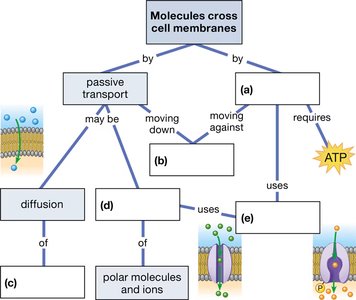
Cells regulate the movement of molecules across membranes through various mechanisms, classified as passive or active transport.
Passive transport: Movement of substances without energy input, down their concentration gradient.
Active transport: Movement of substances against their concentration gradient, requiring energy (usually ATP).
Types of Passive Transport
Diffusion: Movement of molecules from high to low concentration.
Facilitated diffusion: Uses transport proteins to move polar molecules and ions across the membrane.
Osmosis: Diffusion of water across a membrane.
Types of Active Transport
Primary active transport: Direct use of ATP to move molecules.
Secondary active transport: Uses energy from the movement of another molecule.
Bulk transport: Includes exocytosis and endocytosis for large molecules.
Example: Sodium-potassium pump moves Na+ and K+ ions against their gradients using ATP.
Energy and Metabolism in Cells
Forms of Energy
Energy is the capacity to do work. Cells utilize two main forms:
Kinetic energy: Energy of motion (e.g., thermal energy, light).
Potential energy: Stored energy due to position or structure (e.g., chemical energy in bonds).
Thermodynamics in Biology
First law: Energy cannot be created or destroyed, only transformed.
Second law: Energy transformations increase entropy (disorder); some energy is lost as heat.
Chemical Reactions: Exergonic vs. Endergonic
Exergonic reactions: Release energy (e.g., cellular respiration).
Endergonic reactions: Require energy input (e.g., photosynthesis).
Metabolism: The sum of all chemical reactions in a cell, organized into metabolic pathways.
ATP: The Energy Currency of the Cell
ATP (adenosine triphosphate) powers cellular work by coupling exergonic and endergonic reactions.
Structure: Adenosine + three phosphate groups.
Hydrolysis: ATP → ADP + phosphate + energy (exergonic reaction).
Phosphorylation: Transfer of phosphate group to another molecule, energizing it.
Types of cellular work: Chemical (building molecules), transport (moving substances), mechanical (muscle contraction).
Enzyme Function and Regulation
How Enzymes Work
Enzymes are biological catalysts that speed up reactions by lowering the activation energy barrier.
Activation energy: Energy required to start a reaction.
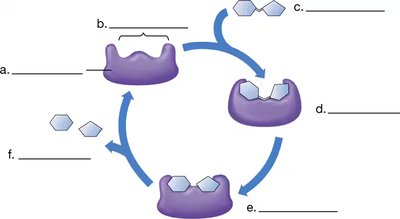
Enzyme specificity: Each enzyme acts on a specific substrate, fitting into the enzyme's active site.
The Catalytic Cycle
Substrate binds to enzyme's active site.
Induced fit: Enzyme changes shape to better fit substrate.
Reaction occurs: Substrate is converted to products.
Products released: Enzyme is unchanged and ready for another cycle.
Optimal Conditions for Enzyme Activity
Temperature: Most human enzymes work best at 35–40°C.
pH: Most enzymes function near neutral pH (6–8), but some (e.g., pepsin) work in acidic environments.
Cofactors: Nonprotein helpers (inorganic ions or organic coenzymes) required for enzyme function.
Enzyme Regulation: Inhibition
Competitive inhibitors: Resemble substrate and block active site.
Noncompetitive inhibitors: Bind elsewhere, changing enzyme shape and reducing activity.
Feedback inhibition: End product inhibits an early enzyme in a pathway, preventing overproduction.
Enzyme Inhibitors: Drugs, Pesticides, and Poisons
Reversible inhibition: Weak interactions; inhibition can be undone.
Irreversible inhibition: Covalent bonds; permanent loss of enzyme activity.
Examples: Ibuprofen, antibiotics, nerve gases, pesticides.
Summary Table: Types of Membrane Transport
Type | Energy Required | Direction | Example |
|---|---|---|---|
Diffusion | No | Down gradient | O2 across membrane |
Facilitated Diffusion | No | Down gradient | Glucose via transport protein |
Active Transport | Yes (ATP) | Against gradient | Na+/K+ pump |
Osmosis | No | Down gradient | Water via aquaporins |
Exocytosis/Endocytosis | Yes | Bulk movement | Secretion of hormones |
Key Equations
ATP Hydrolysis:
Activation Energy:
Additional info:
Enzyme activity can be graphed as a function of substrate or enzyme concentration, showing saturation kinetics.
Metabolic pathways are tightly regulated to conserve resources and maintain homeostasis.
