 Indietro
Cell Membranes: Structure, Function, and Permeability
Guida di studio - Note intelligenti
 Appunti personalizzati basati sui tuoi materiali, ampliati con definizioni chiave, esempi e contesto.
Cell Membranes
Introduction to Plasma Membranes
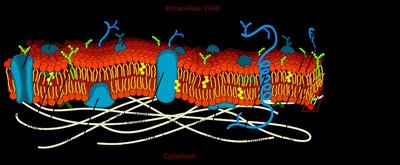
The plasma membrane is a fundamental structure that separates the interior of the cell from its external environment. It is primarily composed of lipids and proteins, and its selective permeability is essential for maintaining cellular homeostasis and facilitating necessary biochemical reactions.
Functions: Protects the cell, regulates entry and exit of substances, and supports cellular communication.
Composition: Mainly phospholipids, cholesterol, and embedded proteins.
Phospholipid Structure and Function
Amphipathic Nature of Phospholipids
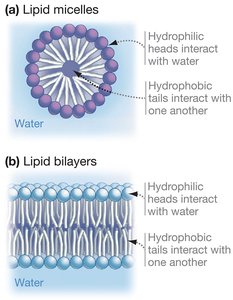
Phospholipids are amphipathic molecules, meaning they have both hydrophilic (water-loving) heads and hydrophobic (water-fearing) tails. This dual nature drives the formation of key membrane structures in aqueous environments.
Hydrophilic heads: Interact with water molecules.
Hydrophobic tails: Avoid water and interact with each other.
Micelles: Spherical structures formed by free fatty acids in water.
Lipid bilayers: Double-layered sheets formed by phospholipids, fundamental to biological membranes.
Formation of Lipid Bilayers
Spontaneous Assembly in Water
Phospholipid bilayers form spontaneously in aqueous environments due to the amphipathic nature of phospholipids. This process does not require energy input and results in a decrease in entropy at the molecular level, as hydrophobic tails aggregate to minimize water interaction.
Micelles: Small, spherical aggregates of lipids.
Lipid bilayers: Paired sheets of phospholipids with hydrophobic tails facing inward and hydrophilic heads facing outward.
Experimental Systems: Artificial Membranes
Vesicles and Planar Bilayers
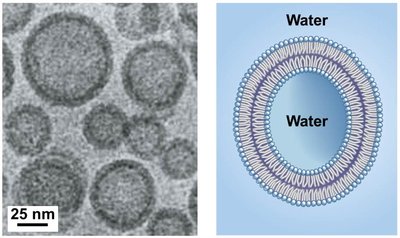
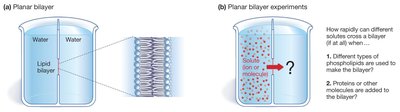
Artificial membranes, such as liposomes and planar bilayers, are used in laboratory settings to study membrane properties and permeability. Liposomes are spherical vesicles with a lipid bilayer, while planar bilayers are constructed across a small opening to separate two solutions.
Liposomes: Useful for studying encapsulation and transport of molecules.
Planar bilayers: Allow measurement of permeability and the effect of different lipid compositions.
Selective Permeability of Membranes
What Can Cross the Membrane?
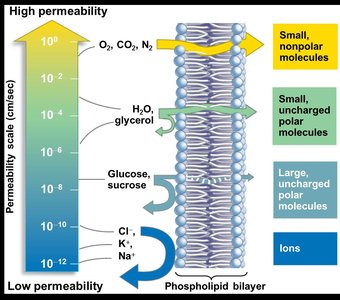
Phospholipid bilayers exhibit selective permeability, allowing certain molecules to pass more easily than others. Small, nonpolar molecules diffuse rapidly, while large or charged molecules cross slowly or not at all.
High permeability: Small, nonpolar molecules (e.g., O2, CO2).
Moderate permeability: Small, uncharged polar molecules (e.g., H2O, glycerol).
Low permeability: Large, uncharged polar molecules (e.g., glucose) and ions (e.g., Na+, Cl-).
Factors Affecting Membrane Permeability
Hydrocarbon Tail Length and Saturation
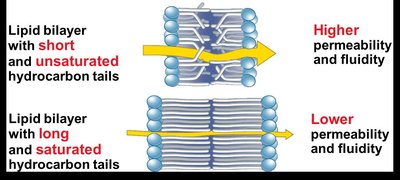
The physical properties of the membrane, including permeability and fluidity, are influenced by the length and saturation of the phospholipid hydrocarbon tails.
Short and unsaturated tails: Increase membrane fluidity and permeability due to kinks that prevent tight packing.
Long and saturated tails: Decrease fluidity and permeability by allowing tighter packing and stronger hydrophobic interactions.
Cholesterol Content
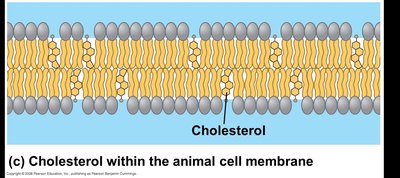
Cholesterol is an important component of animal cell membranes. It modulates membrane fluidity and permeability by fitting between phospholipid tails, increasing packing density and reducing permeability.
High cholesterol: Membrane becomes more rigid and less permeable.
Low cholesterol: Membrane is less rigid and more permeable.
Experimental Evidence: Cholesterol and Permeability
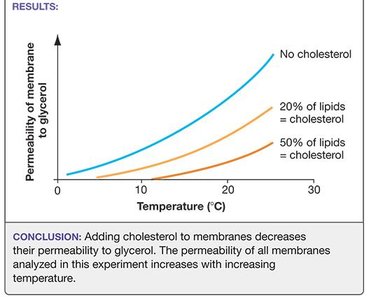
Experiments using artificial membranes show that increasing cholesterol content decreases membrane permeability to small molecules like glycerol. The effect is more pronounced at higher temperatures.
Cholesterol Content | Permeability to Glycerol |
|---|---|
0% | High |
20% | Moderate |
50% | Low |
Temperature and Membrane Fluidity
Effect of Temperature
Temperature significantly affects membrane fluidity and permeability. As temperature decreases, membranes become less fluid and may solidify, depending on lipid composition. Cholesterol acts as a buffer, maintaining fluidity at lower temperatures and restraining movement at higher temperatures.
High temperature: Increases fluidity; cholesterol restrains excessive movement.
Low temperature: Decreases fluidity; cholesterol prevents tight packing and solidification.

Movement of Phospholipids in the Membrane
Lateral and Transverse Movement
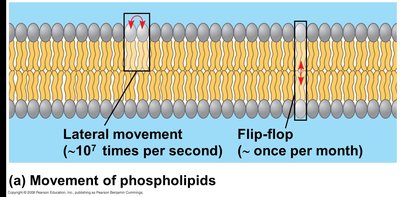
Phospholipids in the membrane are dynamic, moving laterally within the bilayer. However, they rarely flip-flop from one side of the bilayer to the other due to the energy barrier associated with moving the hydrophilic head through the hydrophobic core.
Lateral movement: Occurs frequently and contributes to membrane fluidity.
Flip-flop movement: Rare, occurs much less frequently.
Summary Table: Factors Affecting Membrane Permeability
Factor | Effect on Permeability |
|---|---|
Short, unsaturated tails | Increase permeability |
Long, saturated tails | Decrease permeability |
High cholesterol | Decrease permeability |
High temperature | Increase permeability |
Low temperature | Decrease permeability |
Conclusion
The structure and composition of the plasma membrane are critical for its function as a selective barrier. Factors such as lipid tail length and saturation, cholesterol content, and temperature all play significant roles in determining membrane fluidity and permeability, which in turn affect cellular processes and homeostasis.
