 Indietro
Cell Membranes: Structure, Function, and Transport Mechanisms
Guida di studio - Note intelligenti
 Appunti personalizzati basati sui tuoi materiali, ampliati con definizioni chiave, esempi e contesto.
The Membrane
Fluid Mosaic Model of Membrane Structure
The fluid mosaic model describes the structure of cellular membranes as a dynamic arrangement of lipids and proteins. Membranes are essential for maintaining the internal environment of the cell and mediating interactions with the external environment.
Amphipathic proteins are embedded within the phospholipid bilayer, possessing both hydrophobic and hydrophilic regions.
Phospholipids and some proteins can move laterally within the membrane, contributing to membrane fluidity.
Unsaturated hydrocarbon tails in phospholipids prevent tight packing, maintaining fluidity at lower temperatures.
Cholesterol acts as a buffer, stabilizing membrane fluidity against temperature changes.
Membrane proteins serve various functions: transport, enzymatic activity, signal transduction, cell-cell recognition, intercellular joining, and attachment to the cytoskeleton and extracellular matrix.
Short chains of sugars attached to proteins (glycoproteins) and lipids (glycolipids) on the membrane's exterior interact with other cells.
Membrane components are synthesized in the endoplasmic reticulum (ER) and modified in the Golgi apparatus. The inner and outer faces of membranes differ in molecular composition.
Membranes are crucial to life because they create selective barriers, compartmentalize cellular processes, and facilitate communication and transport.
Membrane Structure and Selective Permeability
Selective Permeability
The plasma membrane controls the exchange of molecules and ions between the cell and its environment through selective permeability.
Hydrophobic substances (e.g., gases, small nonpolar molecules) dissolve in lipids and cross membranes rapidly.
Polar molecules and ions require specific transport proteins to cross the membrane.
Aquaporins are channel proteins that greatly increase the permeability of membranes to water.
Passive Transport
Diffusion and Osmosis
Passive transport is the movement of substances across a membrane without energy input, driven by concentration gradients.
Diffusion is the spontaneous movement of molecules from regions of higher to lower concentration.
Osmosis is the diffusion of water across a selectively permeable membrane.
If the external solution is hypertonic (higher solute concentration), water leaves the cell; if hypotonic (lower solute concentration), water enters the cell; if isotonic, there is no net water movement.
Cell survival depends on balancing water uptake and loss.
Facilitated Diffusion
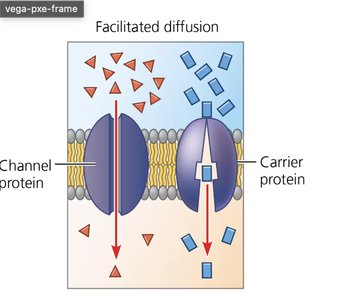
Facilitated diffusion uses transport proteins to move substances down their concentration gradients without energy input.
Channel proteins provide hydrophilic pathways for specific molecules or ions.
Carrier proteins undergo conformational changes to transport bound solutes across the membrane.
Ion channels facilitate the diffusion of ions.
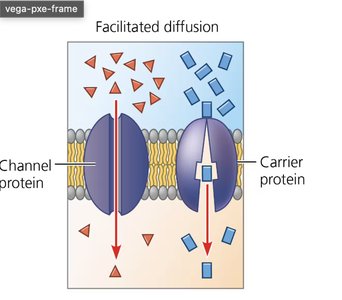
Example: Glucose transporters facilitate the movement of glucose into cells, while aquaporins allow rapid water movement.
What happens to a cell in a hypertonic solution? Water leaves the cell, causing it to shrink; the free water concentration is higher inside the cell than outside.
Active Transport
Mechanisms of Active Transport
Active transport moves solutes against their concentration gradients, requiring energy (usually from ATP).
Specific membrane proteins (pumps) use ATP to transport ions or molecules.
Ions experience both a chemical gradient (concentration difference) and an electrical gradient (voltage), together forming the electrochemical gradient.
Cotransport involves the coupled transport of two solutes: the downhill movement of one drives the uphill transport of another.
Although ATP is not directly used by cotransporters, the gradient driving cotransport is established by ATP-dependent pumps, making cotransport a form of active transport.
Bulk Transport Across the Plasma Membrane
Exocytosis and Endocytosis
Bulk transport moves large molecules or particles across the membrane via vesicles, requiring energy.
Exocytosis: Transport vesicles fuse with the plasma membrane, releasing their contents outside the cell.
Endocytosis: The plasma membrane engulfs external materials, forming vesicles that bring substances into the cell.
Three types of endocytosis:
Phagocytosis: "Cell eating"—engulfment of large particles.
Pinocytosis: "Cell drinking"—uptake of extracellular fluid and dissolved solutes.
Receptor-mediated endocytosis: Specific molecules bind to receptors, triggering vesicle formation. This enables cells to acquire bulk quantities of specific substances.
Example: Cholesterol uptake by animal cells occurs via receptor-mediated endocytosis.
