 Indietro
Cell Organization: Multicellularity, Differentiation, and Cytoskeleton
Guida di studio - Note intelligenti
 Appunti personalizzati basati sui tuoi materiali, ampliati con definizioni chiave, esempi e contesto.
Cell Organization: Single Cells & Multicellularity
Overview
Cell organization is a fundamental concept in biology, encompassing the structure and function of single cells and the complex arrangements found in multicellular organisms. This topic covers the transition from individual cells to multicellular assemblies, including cell division, differentiation, and the cytoskeleton.
Multicellularity: Cell Division & Growth
Binary Fission
Binary fission is the primary method of cell division in prokaryotes, such as bacteria and archaea. It involves the replication of the cell's genome followed by the division of the cytoplasm, resulting in two genetically identical daughter cells.
Key Steps: DNA replication, cell elongation, septum formation, and cell separation.
Example: Bacterial reproduction in nutrient-rich environments.
Mitosis and Cytokinesis
Mitosis is the process by which eukaryotic cells divide their nucleus, followed by cytokinesis, the division of the cytoplasm. This ensures that each daughter cell receives a complete set of chromosomes.
Phases of Mitosis: Prophase, Metaphase, Anaphase, Telophase.
Cytokinesis: Animal cells form a cleavage furrow; plant cells form a cell plate.
Eukaryotic Cell Cycle: The cell cycle is tightly regulated, with checkpoints ensuring proper division and growth.
What Does It Mean to Be Multicellular?
Definition and Types
Multicellular organisms consist of more than one cell, which may be identical or specialized. True multicellularity involves cell adherence, specialization, and tissue formation.
Cell Adherence: Cells stick together via protein-protein interactions.
Cell Specialization: Cells develop specific functions or "fates."
Tissue Formation: Specialized cells organize into tissues.
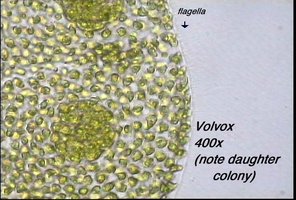
Examples: Colonial organisms like Volvox demonstrate intermediate forms of multicellularity, where cells form colonies but may not be fully specialized.
Tissues
A tissue is a group of cells with similar function. Most animals (except sponges) and plants (with some exceptions) possess tissues.
Animal Tissues: Epithelial, connective, muscle, and nervous tissues.
Plant Tissues: Vascular (xylem and phloem), ground, and dermal tissues.
Exceptions: Sponges lack true tissues; non-vascular plants have simpler tissue structures.
Cell Recognition and Adherence
Mechanisms
Multicellular organisms require cells to recognize and adhere to each other, forming organized structures such as sheets, tubes, and layers. This is mediated by signaling molecules and protein-protein interactions.
Cell Signaling: Communication via chemical signals.
Adherence: Formation of junctions and extracellular matrix.
Loss of Adherence: Can lead to disease, such as cancer or infection by viruses.
Differentiation
Cell Genome vs Proteome
Differentiation is the process by which cells become specialized. Although all cells share the same genome, their proteome (the set of proteins expressed) varies depending on environmental signals and developmental cues.
Stem Cells: Undifferentiated cells that can become specialized cell types.
Environmental Influence: Signals can activate or deactivate genes, leading to permanent or reversible changes in cell function.
Plant Cells: Can return to an undifferentiated state with specific chemical signals.
Differentiation in Bacteria: Biofilm Formation
Bacteria can differentiate by forming biofilms, which are communities of cells with specialized functions, such as protection and nutrient acquisition.
Cytoskeleton
Structure and Function
The cytoskeleton is an internal network of protein filaments that provides structural support, enables movement, and organizes cellular components. It is dynamic and essential for cell shape, division, and motility.
Microtubules: Hollow tubes involved in cell division and transport.
Microfilaments: Actin filaments important for cell movement and shape.
Intermediate Filaments: Provide mechanical strength.
Prokaryotes vs Eukaryotes: Both have cytoskeletons, but eukaryotic cytoskeletons are more complex.
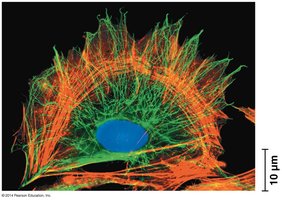
All cytoskeletal elements are composed of proteins, which assemble into filaments and networks.
Summary Table: Cell Organization Concepts
Concept | Definition | Example |
|---|---|---|
Binary Fission | Prokaryotic cell division | Bacteria |
Mitosis & Cytokinesis | Eukaryotic cell division | Animal and plant cells |
Multicellularity | Organisms with multiple cells | Animals, plants, colonial algae |
Differentiation | Specialization of cells | Stem cells becoming neurons |
Cytoskeleton | Internal protein network | Microtubules, actin filaments |
Additional info: The images included are directly relevant to the explanation of multicellularity (Volvox colony) and cytoskeleton structure (fluorescent micrograph). Other images were not included as they do not directly reinforce the specific concepts discussed in the paragraphs.
