 Indietro
Cell Size and Surface Area-to-Volume Ratio
Guida di studio - Note intelligenti
 Appunti personalizzati basati sui tuoi materiali, ampliati con definizioni chiave, esempi e contesto.
Cell Size and Its Biological Importance
Introduction to Cell Size
Cell size is a critical factor in cellular function and efficiency. The ability of a cell to exchange materials with its environment is largely determined by its surface area-to-volume (SA:V) ratio. As cells grow, their volume increases faster than their surface area, which can limit the rate at which materials enter or exit the cell.
Cellular Metabolism and Size Constraints
Cellular metabolism depends on the efficient exchange of nutrients, gases, and waste products across the plasma membrane.
As a cell increases in size, it becomes more difficult to regulate what enters and exits due to a relatively smaller surface area compared to its volume.
Cells must dissipate thermal energy and maintain homeostasis, which is more challenging as size increases.
Surface Area-to-Volume Ratio
Definition and Importance
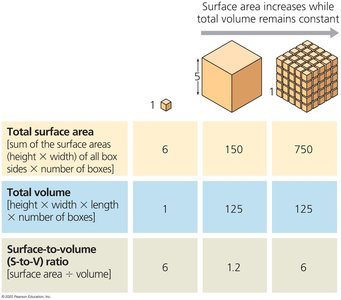
The surface area-to-volume ratio (SA:V) is a key concept in understanding why cells are small. A high SA:V ratio allows for more efficient exchange of materials through the plasma membrane, supporting cellular function and survival.
Formula: SA:V ratio = Surface Area / Volume
Cells with a higher SA:V ratio can exchange materials more efficiently.
Formulas for Common Cell Shapes
Cuboidal cells:
Total Surface Area (SA):
Total Volume (V):
SA:V Ratio:
Spherical cells:
Surface Area:
Volume:
SA:V Ratio:
Practice Problems and Examples
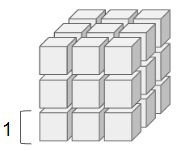
Consider two cuboidal cells:
Cell #1: units2, units3,
Cell #2: units2, units3,
Cell #2, with the higher SA:V ratio, will have more efficient material exchange.
SA:V Ratio in Spherical Cells
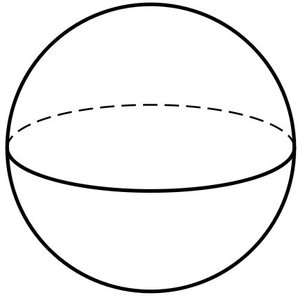
For a sphere with radius :
units2
units3
For a sphere with radius :
units2
units3
The smaller sphere (r=5) has a higher SA:V ratio and thus a more efficient exchange of materials.
Relationship Between Cell Size and SA:V Ratio
As cell size (radius or length) increases, the SA:V ratio decreases.
This decrease limits the rate of material exchange and can constrain cell size.
Biological Implications of Cell Size
Why Are Cells Small?
Small cells have a high SA:V ratio, optimizing the exchange of materials at the plasma membrane.
Larger cells have a lower SA:V ratio, leading to decreased efficiency in exchanging materials and dissipating heat.
As cells grow, their demand for resources increases, but their ability to exchange those resources does not keep pace.
Conclusion: The need for efficient exchange of materials and energy constrains cell size, explaining why most cells are microscopic.
