 Indietro
Cell Structure and Function: A Mini-Textbook Study Guide
Guida di studio - Note intelligenti
 Appunti personalizzati basati sui tuoi materiali, ampliati con definizioni chiave, esempi e contesto.
Cell Theory and Types of Cells
Cell Theory
Cell theory is a foundational concept in biology, stating that all living things are composed of cells and that all cells arise from pre-existing cells. This principle underscores the continuity of life and the importance of cellular division in growth and reproduction.
Cells are the basic unit of structure and function in living organisms.
All cells originate from the division of other cells.
Organisms may be single-celled (e.g., most prokaryotes and protists) or multicellular (e.g., plants, animals, fungi).
Classification of Cells
Biologists classify all life into three domains: Bacteria, Archaea, and Eukarya. The first two domains consist of prokaryotic cells, while Eukarya includes eukaryotic cells.
Prokaryotic cells: Found in Bacteria and Archaea; lack a nucleus and membrane-bound organelles.
Eukaryotic cells: Found in Eukarya (protists, plants, fungi, animals); possess a nucleus and membrane-bound organelles.
Comparing Prokaryotic and Eukaryotic Cells
Prokaryotic cells have a nucleoid region instead of a nucleus, while eukaryotic cells have a true nucleus surrounded by a nuclear envelope.
Nucleoid region: Area in prokaryotes where DNA is located, not enclosed by a membrane.
Nucleus: Membrane-bound organelle in eukaryotes containing DNA.
Cell Components and Membranes
The Plasma Membrane
The plasma membrane is a selectively permeable barrier composed of a phospholipid bilayer and proteins, described by the fluid mosaic model.
Phospholipid bilayer: Provides structural foundation.
Fluid mosaic model: Membrane is flexible, with proteins embedded or attached to the bilayer.
Cell Surfaces
Plant cells: Have a cell wall made of cellulose, providing protection, shape, and preventing excessive water uptake.
Animal cells: Lack cell walls; secrete an extracellular matrix and have cell junctions for tissue formation and coordination.
The Nucleus and Ribosomes: Genetic Control
The Nucleus
The nucleus is the control center of the cell, housing DNA and directing protein synthesis.
Chromatin: DNA and associated proteins, forming chromosomes.
Nucleolus: Site of ribosome component synthesis.
Nuclear envelope: Double membrane with pores for material exchange.
Ribosomes
Ribosomes are responsible for protein synthesis, either free in the cytosol or bound to the endoplasmic reticulum.
Free ribosomes: Synthesize proteins for use within the cytosol.
ER-bound ribosomes: Synthesize proteins for membranes or secretion.
How DNA Directs Protein Production
DNA transfers information to messenger RNA (mRNA), which exits the nucleus and is translated by ribosomes into proteins.
Process: DNA → mRNA → Protein
The Endomembrane System: Manufacturing and Distribution
Overview
The endomembrane system includes the nuclear envelope, endoplasmic reticulum (ER), Golgi apparatus, lysosomes, and vacuoles. These organelles are connected physically or by vesicles.
Vesicles: Membrane sacs for transport between organelles.
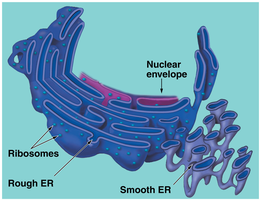
The Endoplasmic Reticulum (ER)
The ER is a major manufacturing site, consisting of rough and smooth regions with distinct functions.
Rough ER: Studded with ribosomes; synthesizes proteins for membranes and secretion.
Smooth ER: Lacks ribosomes; synthesizes lipids and detoxifies drugs.
The Golgi Apparatus
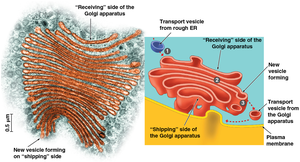
The Golgi apparatus receives, refines, stores, and distributes cellular products, working closely with the ER.
Receives vesicles from the ER.
Modifies and sorts proteins and lipids.
Ships products to their final destinations.
Lysosomes
Lysosomes are membrane-bound sacs of digestive enzymes found in animal cells, responsible for breaking down macromolecules and recycling cellular components.
Digest proteins, polysaccharides, fats, and nucleic acids.
Destroy harmful bacteria and recycle damaged organelles.
Important in embryonic development and disease prevention.
Vacuoles
Vacuoles are large vesicles with diverse functions, including storage, water regulation, and defense.
Food vacuoles: Formed by endocytosis.
Contractile vacuoles: Expel excess water in protists.
Central vacuole (plants): Stores nutrients, water, pigments, and toxins.
Chloroplasts and Mitochondria: Cellular Energy
Chloroplasts
Chloroplasts are organelles unique to plants and algae, responsible for photosynthesis—the conversion of solar energy to chemical energy.
Contain their own DNA and ribosomes.
Site of photosynthesis.
Mitochondria
Mitochondria are found in almost all eukaryotic cells and are the site of cellular respiration, producing ATP from food molecules.
Contain their own DNA and ribosomes.
Site of ATP production.
Endosymbiotic Theory
Chloroplasts and mitochondria likely evolved from ancient prokaryotes that entered into symbiotic relationships with host cells, eventually becoming organelles.
Both organelles have circular DNA similar to prokaryotes.
Can reproduce independently within the cell.
The Cytoskeleton: Cell Shape and Movement
Cytoskeleton Structure
The cytoskeleton is a network of protein fibers that provides structural support, maintains cell shape, and enables movement.
Microtubules: Hollow tubes; provide support and tracks for organelle movement.
Intermediate filaments: Solid, provide reinforcement.
Microfilaments: Solid, thin fibers; involved in cell movement.
Cilia and Flagella
Cilia and flagella are extensions of the cytoskeleton that aid in cell movement.
Flagella: Long, whip-like; propel cells (e.g., sperm).
Cilia: Short, numerous; move in coordinated waves (e.g., lining respiratory tract).
Evolution Connection: Bacterial Resistance
Natural Selection and Disease Resistance
Persistent diseases, such as cholera, can drive natural selection in human populations, favoring individuals with genetic resistance.
Mutations in certain genes confer resistance to cholera.
Understanding these mutations may lead to new antibiotic development.
Table: Comparison of Prokaryotic and Eukaryotic Cells
Feature | Prokaryotic Cells | Eukaryotic Cells |
|---|---|---|
Nucleus | No (nucleoid region) | Yes (membrane-bound) |
Membrane-bound organelles | No | Yes |
Cell size | Generally smaller | Generally larger |
Domains | Bacteria, Archaea | Eukarya |
Table: Functions of Endomembrane System Components
Organelle | Main Function |
|---|---|
Nuclear Envelope | Separates nucleus from cytoplasm |
Rough ER | Protein synthesis and membrane production |
Smooth ER | Lipid synthesis and detoxification |
Golgi Apparatus | Modification, sorting, and shipping of cellular products |
Lysosomes | Digestion and recycling of cellular materials |
Vacuoles | Storage, water regulation, and defense |
Key Equations
Central Dogma of Molecular Biology:
ATP Production (Cellular Respiration):
Additional info: Academic context was added to clarify the functions and relationships of cell organelles, the endomembrane system, and the evolutionary significance of mitochondria and chloroplasts.
