Indietro
Cell Structure and Function: Foundations of Eukaryotic and Prokaryotic Cells
Guida di studio - Note intelligenti
 Appunti personalizzati basati sui tuoi materiali, ampliati con definizioni chiave, esempi e contesto.
Cell Structure and Function
Cell Theory and Its Significance
The Cell Theory is a fundamental concept in biology that unifies our understanding of living systems. It states:
All living organisms are composed of one or more cells.
The cell is the basic unit of structure and organization in organisms.
Cells arise only from pre-existing cells (Omnis cellula e cellula).
This theory highlights that the properties of life emerge from cellular organization and that continuity of life depends on cell division, not spontaneous generation.
Basic Features of All Cells
Despite their diversity, all cells share four essential features:
Plasma membrane – Encloses the cell and regulates exchange with the environment.
Cytosol – Semifluid substance where metabolic reactions occur.
Chromosomes – Carry genetic information (DNA).
Ribosomes – Synthesize proteins from genetic instructions.
Comparing Prokaryotic and Eukaryotic Cells
Key Differences
Feature | Prokaryotic Cells | Eukaryotic Cells |
|---|---|---|
Nucleus | Absent (DNA in nucleoid) | Present (DNA in nucleus) |
Membrane-bound organelles | None | Present (ER, Golgi, mitochondria, etc.) |
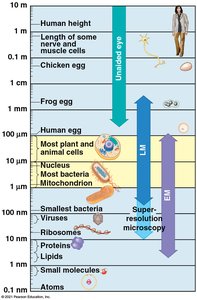
Size | Smaller (~1–5 µm) | Larger (~10–100 µm) |
Domains | Bacteria, Archaea | Protists, Fungi, Plants, Animals |
Prokaryotic cells lack internal compartmentalization, while eukaryotic cells possess complex organelles that enable specialized functions.
Structures in Bacterial, Plant, and Animal Cells
Structure | Bacterial Cell | Plant Cell | Animal Cell |
|---|---|---|---|
Plasma membrane | Yes | Yes | Yes |
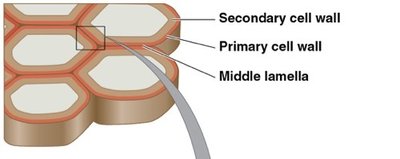
Cell wall | Yes (peptidoglycan) | Yes (cellulose) | No |
Nucleus | No | Yes | Yes |
Chloroplasts | No | Yes | No |
Central vacuole | No | Yes (large) | No / small vesicles |
Mitochondria | No | Yes | Yes |
Endomembrane system | No | Yes | Yes |
Cytoskeleton | Simple analogs | Yes | Yes |
ECM / cell junctions | No | Plasmodesmata | ECM, tight/gap/desmosomes |
Cell Size and Surface Area Constraints
Cells are limited in size by the surface-area-to-volume ratio. As a cell grows, its volume increases faster than its surface area, restricting the rate of exchange of materials with the environment. This constraint explains why cells remain small and why larger organisms are multicellular.
Cellular Organelles and Compartmentalization
Adaptive Significance of Organelles
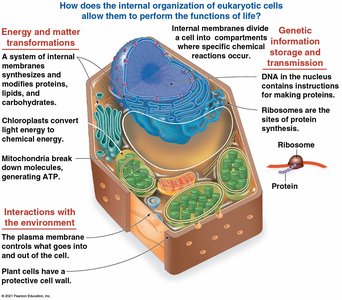
Membrane-bound organelles allow eukaryotic cells to compartmentalize incompatible reactions, concentrate enzymes, and increase membrane surface area for metabolic processes. This compartmentalization is especially important in large cells, enabling efficient division of labor and specialization.
The Endomembrane System
The endomembrane system is a network of membranes that regulates protein traffic and performs metabolic functions. It includes the nuclear envelope, endoplasmic reticulum (ER), Golgi apparatus, lysosomes, vacuoles, and the plasma membrane. Components are connected directly or via vesicle transfer.
Endoplasmic Reticulum (ER)
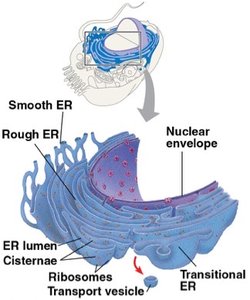
Smooth ER: Synthesizes lipids, detoxifies drugs, and stores calcium ions.
Rough ER: Studded with ribosomes; synthesizes secretory and membrane proteins, which are packaged into vesicles for transport.
Golgi Apparatus
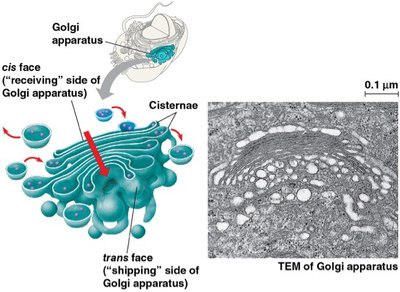
The Golgi apparatus consists of flattened sacs (cisternae) and functions as the cell's shipping and receiving center. It modifies, sorts, and packages proteins and lipids for delivery to their destinations.
Lysosomes and Vacuoles
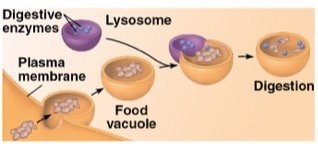
Lysosomes: Membranous sacs containing hydrolytic enzymes for digesting macromolecules, recycling organelles (autophagy), and breaking down engulfed material (phagocytosis).
Vacuoles: Large vesicles with diverse functions, including storage, waste disposal, and maintaining cell turgor in plants.
Organelle Diversity and Cellular Specialization
The abundance and arrangement of organelles vary among cell types, reflecting their specialized functions. For example, muscle cells have many mitochondria for energy, while liver cells have abundant smooth ER for detoxification.
Endosymbiont Theory: Origin of Mitochondria and Chloroplasts
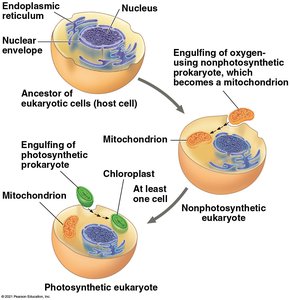
The endosymbiont theory proposes that mitochondria and chloroplasts originated as free-living prokaryotes engulfed by ancestral eukaryotic cells. Evidence includes their double membranes, own DNA, ribosomes, and independent replication.
Mitochondria
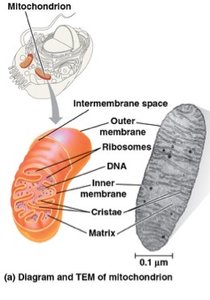
Mitochondria are the sites of cellular respiration, converting chemical energy in food to ATP. They have an outer membrane, a highly folded inner membrane (cristae), and their own DNA and ribosomes.
Chloroplasts
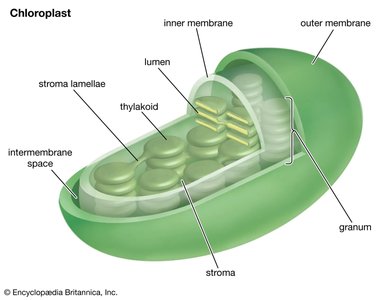
Chloroplasts are found in plants and algae and are the sites of photosynthesis. They contain thylakoids (stacked into grana), stroma, and their own DNA and ribosomes.
Peroxisomes
Peroxisomes are single-membrane organelles containing enzymes that transfer hydrogen to oxygen, producing hydrogen peroxide (H2O2). They break down fatty acids and detoxify harmful substances.
Predicting the Effects of Organelle Loss or Alteration
Nucleus lost: Cell cannot direct protein synthesis; dies.
Mitochondria lost: ATP production fails; cell cannot meet energy demands.
Lysosomes lost: Debris accumulates; cell cannot degrade waste.
Rough ER lost: Secretory/membrane proteins not made; secretion halts.
Golgi lost: Proteins not modified/sorted; mislocalization occurs.
Chloroplasts lost (plants): Photosynthesis stops; plant cannot make sugars.
The Cytoskeleton and Cell Movement
Types of Cytoskeletal Fibers
Type | Structure | Function |
|---|---|---|
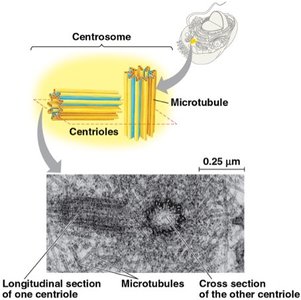
Microtubules | Hollow rods of tubulin | Organelle movement, chromosome separation |
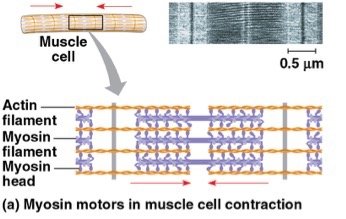
Microfilaments (Actin) | Twisted double chains of actin | Cell shape, muscle contraction, motility |
Intermediate filaments | Fibrous proteins coiled into cables | Cell shape, anchoring organelles |
Cytoskeleton and Extracellular Matrix (ECM)
The cytoskeleton interacts with the ECM to support cell shape, stability, and movement. ECM glycoproteins (e.g., collagen, fibronectin) bind integrins on the cell surface, which connect to the cytoskeleton, linking external signals to internal responses.
Cell Junctions and Communication
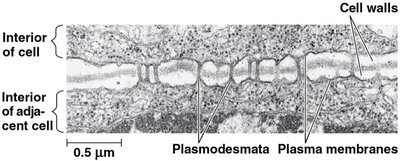
Plant Cell Junctions: Plasmodesmata
Plasmodesmata are channels between plant cells that allow the passage of water, small solutes, and sometimes proteins and RNA, facilitating communication and transport.
Animal Cell Junctions
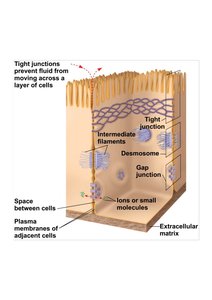
Tight junctions: Seal neighboring cells to prevent leakage.
Desmosomes: Anchor cells together into strong sheets.
Gap junctions: Provide cytoplasmic channels for communication.
Practice: Labeling and Application
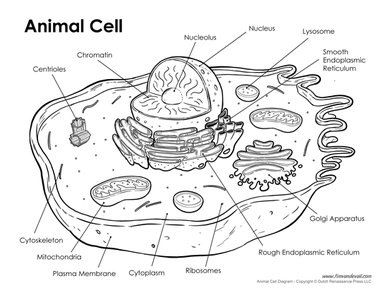
Practice labeling the animal cell and predicting the effects of changes in cell structure or function. Consider how the loss or alteration of specific organelles would impact overall cell physiology.