 Indietro
Cell Structure and Function: Practice Worksheet Guidance
Guida di studio - Note intelligenti
 Appunti personalizzati basati sui tuoi materiali, ampliati con definizioni chiave, esempi e contesto.
Q1. Name the cell structure or organelle based on its structure or function.
Background
Topic: Cell Structure and Function
This question tests your knowledge of the major organelles and structures found in eukaryotic cells, as well as their specific functions. Understanding these is fundamental in General Biology, as each organelle plays a unique role in the life of the cell.
Key Terms and Concepts:
Organelle: Specialized structure within a cell that performs a specific function.
Examples: Nucleus, mitochondria, ribosome, Golgi apparatus, endoplasmic reticulum, lysosome, vacuole, etc.
Step-by-Step Guidance
Read each description carefully and identify the key function or structural feature mentioned.
Recall which organelle or cell structure is associated with that function. For example, if the description mentions 'makes protein,' think about which organelle is responsible for protein synthesis.
Use process of elimination for similar-sounding organelles (e.g., rough vs. smooth endoplasmic reticulum).
For plant-specific structures (like those involved in photosynthesis or storage), consider which organelles are unique to plant cells.
Write the name of the organelle or structure that best matches each description in the table.
Try solving on your own before revealing the answer!
Final Answers:
Vacuole
Chloroplast
Ribosome
Flagellum (Flagella)
Cytoplasm
Nucleus
Lysosome
Plasma membrane (Cell membrane)
Cilium (Cilia)
Mitochondrion (Mitochondria)
Golgi apparatus (Golgi body)
Cytoskeleton (Microtubules)
Smooth endoplasmic reticulum (Smooth ER)
Rough endoplasmic reticulum (Rough ER)
Smooth endoplasmic reticulum (Smooth ER)
Each answer matches the function or structure described in the left column. Review the definitions and functions of each organelle to reinforce your understanding.
Q2. Match each cell surface characteristic or structure with its description.
Background
Topic: Cell Surface Structures and Junctions
This question focuses on the different types of cell junctions and surface structures found in plant and animal cells. These structures are important for cell communication, adhesion, and maintaining the integrity of tissues.
Key Terms:
Tight Junctions: Seal neighboring cells together to prevent leakage.
Plasmodesmata: Channels between plant cells for communication.
Desmosomes (Anchoring Junctions): Fasten cells together into strong sheets.
Cell Wall: Rigid outer layer in plant cells.
Gap Junctions: Channels between animal cells for communication.
Extracellular Matrix: Network outside animal cells for support and adhesion.
Step-by-Step Guidance
Read each description and identify if it refers to plant or animal cells.
Recall which junction or structure is unique to plants (e.g., plasmodesmata, cell wall) or animals (e.g., tight junctions, desmosomes, gap junctions, extracellular matrix).
Match the function described (e.g., channels, rigid covering, leak-proof layer) to the correct structure.
Write the corresponding letter (A–F) next to each description.
Try solving on your own before revealing the answer!
Final Answers:
E) Gap Junctions
B) Plasmodesmata
A) Tight Junctions
D) Cell Wall
C) Desmosomes (Anchoring Junctions)
F) Extracellular Matrix
These answers match the descriptions of each cell surface structure or junction. Review the functions and locations of each to reinforce your understanding.
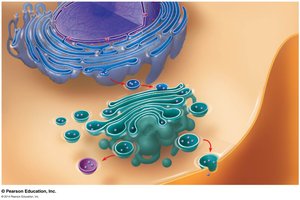
Q3. Label the components of the endomembrane system shown in the diagram.
Background
Topic: Endomembrane System
This question asks you to identify and label the major components of the endomembrane system in a eukaryotic cell. The endomembrane system is a group of organelles that work together to modify, package, and transport lipids and proteins.
Key Terms:
Endoplasmic Reticulum (ER): Network of membranes involved in protein and lipid synthesis. Includes rough ER (with ribosomes) and smooth ER (without ribosomes).
Golgi Apparatus: Modifies, sorts, and packages proteins and lipids for storage or transport out of the cell.
Vesicles: Small membrane-bound sacs that transport materials between organelles.
Plasma Membrane: The cell's outer boundary, involved in exporting materials.
Step-by-Step Guidance
Examine the diagram and identify the structures based on their shape and position. The rough ER is usually shown with ribosomes attached, while the smooth ER lacks ribosomes.
Locate the Golgi apparatus, which typically appears as a stack of flattened, membrane-bound sacs.
Identify vesicles as small, round structures that bud off from the ER or Golgi apparatus.
Find the plasma membrane, which is the outermost boundary in the diagram.
Label each structure accordingly, using the correct biological terms.
Try solving on your own before revealing the answer!
Final Answer:
Top left: Rough Endoplasmic Reticulum (with ribosomes)
Center: Golgi Apparatus
Small circles: Vesicles
Bottom right: Plasma Membrane
These are the main components of the endomembrane system shown in the diagram. Understanding their roles helps explain how proteins and lipids are processed and transported in the cell.
