 Indietro
Cell Structure and Membrane Function: Study Guide
Guida di studio - Note intelligenti
 Appunti personalizzati basati sui tuoi materiali, ampliati con definizioni chiave, esempi e contesto.
Cell Structure and Function
Prokaryotic vs. Eukaryotic Cells
Cells are classified as either prokaryotic or eukaryotic based on their structural features. Understanding their similarities and differences is fundamental to cell biology.
Prokaryotic Cells: No nucleus (DNA in nucleoid), no membrane-bound organelles, smaller and simpler structure. Found in Bacteria and Archaea.
Eukaryotic Cells: Nucleus with DNA inside, membrane-bound organelles, larger and more complex. Includes Plant and Animal cells.
Both: Have plasma membrane, cytoplasm, ribosomes, and DNA. Perform basic life functions (metabolism, growth, reproduction).
Plasma Membrane Structure and Function
The plasma membrane is a universal feature of all cells, providing a boundary and regulating transport.
Structure: Phospholipid bilayer with embedded proteins, cholesterol, and carbohydrates.
Function: Selective permeability, cell communication, anchoring cytoskeleton, signal transduction.
Present in: Both prokaryotic and eukaryotic cells.
Eukaryotic Cell Organelles
Eukaryotic cells contain specialized organelles, each with distinct structure and function.
Nucleus: Double membrane with pores, contains chromatin, regulates gene expression, nucleolus produces rRNA.
Ribosomes: Complexes of rRNA and proteins, site of protein synthesis.
Endomembrane System: Includes vesicles (transport/storage), Golgi apparatus (modifies/packages proteins/lipids), lysosomes (digestive enzymes), vacuoles (storage, especially large in plants), endoplasmic reticulum (rough ER synthesizes proteins, smooth ER synthesizes lipids and detoxifies).
Energy Organelles:
Mitochondria: Double membrane, inner membrane forms cristae, site of cellular respiration (converts glucose to ATP).
Chloroplasts (plants): Double membrane, thylakoids stacked into grana, stroma, site of photosynthesis (converts light energy to glucose).
Peroxisomes: Break down fatty acids, detoxify compounds, produce hydrogen peroxide.
Cytoskeleton: Maintains cell shape, aids movement, organizes organelles.
Microtubules: Hollow tubes, tracks for movement, spindle formation.
Microfilaments: Thin fibers, support shape, enable cell crawling and muscle contraction.
Intermediate Filaments: Structural support, anchor organelles.
Motor Proteins: Move vesicles and organelles along cytoskeleton.
Extracellular Components:
Cell Wall (plants, fungi, bacteria): Rigid layer for support and protection.
Extracellular Matrix (ECM, animals): Network of glycoproteins for support, communication, adhesion.
Cell Junctions: Plasmodesmata (plants), tight junctions, desmosomes, gap junctions (animals).
Membrane Structure and Function
Phospholipid Structure and Bilayer Formation
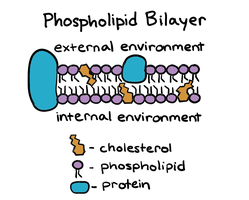
The cell membrane is primarily composed of phospholipids, which self-assemble into a bilayer due to their amphipathic nature.
Phospholipid: Glycerol backbone, two fatty acid tails (hydrophobic), phosphate head (hydrophilic).
Bilayer Formation: Hydrophilic heads face outward toward water; hydrophobic tails face inward, away from water.
Fluid Mosaic Model
The fluid mosaic model describes the dynamic and diverse nature of the cell membrane.
Phospholipids move laterally, proteins and cholesterol are embedded throughout.
Membrane is flexible and composed of many molecules.
Membrane Fluidity: Fatty Acids and Cholesterol
Membrane fluidity is influenced by the types of fatty acids and cholesterol present.
Saturated Fatty Acids: No double bonds, pack tightly, less fluid, more viscous.
Unsaturated Fatty Acids: Double bonds, prevent tight packing, more fluid.
Environmental Adaptation: Cold climates favor unsaturated tails for flexibility; hot climates favor saturated tails for stability.
Cholesterol: At high temperatures, reduces fluidity; at low temperatures, prevents packing and maintains flexibility. Cold environments require more cholesterol to prevent freezing; hot environments require less to avoid stiffness.
Membrane Proteins and Carbohydrates
Proteins and carbohydrates embedded in the membrane serve various functions.
Integral/Transmembrane Proteins: Span the bilayer, involved in transport, receptors, anchoring.
Transport Proteins: Move molecules across membrane (channels/carriers).
Aquaporins: Specialized for water transport.
Peripheral Proteins: Attached to surface, involved in signaling, shape, anchoring.
Functions: Transport, enzymatic activity, signal transduction, cell-cell recognition, intercellular joining, attachment to cytoskeleton and ECM.
Membrane Carbohydrates: Glycolipids (carbohydrate + lipid), glycoproteins (carbohydrate + protein), important for cell recognition and signaling.
Synthesis of Membrane Components
Membrane proteins and lipids are synthesized in the ER and modified in the Golgi apparatus.
Proteins and lipids made in ER.
Modified in Golgi; carbohydrates added to form glycoproteins and glycolipids.
Transported to plasma membrane in vesicles.
Selective Permeability of the Cell Membrane
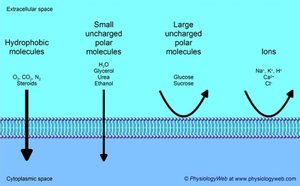
The cell membrane allows certain molecules to pass while restricting others, based on size and polarity.
Moves Through Easily: Small, nonpolar molecules (O2, CO2), small uncharged polar molecules (H2O, ethanol).
Does Not Move Through Easily: Large molecules (glucose, proteins), charged ions (Na+, K+, Cl-).
Transport Across Membranes
Passive Transport
Passive transport involves movement of molecules down their concentration gradient without energy input.
Diffusion: Movement from high to low concentration.
Osmosis: Diffusion of water across a selectively permeable membrane.
Concentration Gradient: Difference in concentration across a membrane.
Osmosis and Water Balance
Cells respond differently to osmotic environments:
Isotonic: Equal solute inside and outside; water moves evenly; cell stays same size.
Hypertonic: More solute outside; water exits; cell shrinks (animal cell shrivels, plant cell plasmolyzes).
Hypotonic: More solute inside; water enters; cell swells (animal cell lyses, plant cell turgid).
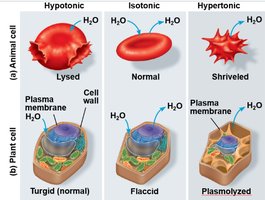
Animal Cells: Isotonic = normal, hypotonic = lysed, hypertonic = shriveled.
Plant Cells: Isotonic = flaccid, hypotonic = turgid, hypertonic = plasmolyzed.
Facilitated Diffusion
Facilitated diffusion uses transport proteins to move molecules across membranes without energy.
Channel Proteins: Provide hydrophilic passageways.
Carrier Proteins: Bind and change shape to move molecules.
Active Transport
Active transport moves molecules against their concentration gradient, requiring energy (usually ATP).
Maintains concentration gradients essential for nutrient uptake, nerve impulses, muscle contractions.
Proton Pumps: Use ATP to pump H+ ions out, creating electrochemical gradients.
Cotransport: Movement of one substance down its gradient drives another against its gradient (e.g., sucrose-H+ cotransporter in plants).
Bulk Transport
Bulk transport moves large molecules via vesicles.
Exocytosis: Exporting large molecules out of the cell; vesicle fuses with plasma membrane.
Endocytosis: Importing large molecules into the cell; includes phagocytosis (engulfing particles) and pinocytosis (taking in fluid and solutes).
Summary Table: Prokaryotic vs. Eukaryotic Cells
Feature | Prokaryotic | Eukaryotic |
|---|---|---|
Nucleus | No | Yes |
Membrane-bound Organelles | No | Yes |
Size | Smaller | Larger |
Complexity | Simple | Complex |
Examples | Bacteria, Archaea | Plants, Animals |
Summary Table: Membrane Transport Types
Transport Type | Energy Required? | Direction | Example |
|---|---|---|---|
Diffusion | No | High to Low | O2, CO2 |
Osmosis | No | High to Low (water) | Water movement |
Facilitated Diffusion | No | High to Low | Glucose via channel |
Active Transport | Yes (ATP) | Low to High | Na+/K+ pump |
Bulk Transport | Yes (vesicles) | Varies | Exocytosis, Endocytosis |
