 Indietro
Cell Structure and Membrane Transport: Study Guide for General Biology
Guida di studio - Note intelligenti
 Appunti personalizzati basati sui tuoi materiali, ampliati con definizioni chiave, esempi e contesto.
Cells: The Basic Unit of Life
Cell Theory
All living organisms are composed of cells, which are the fundamental units of structure and function in life. Cells arise only from preexisting cells, and they carry out all activities necessary for life.
Specialization: Multicellular organisms have specialized cells for different functions.
Surface Area-to-Volume Ratio: Cells must maintain a high surface area relative to volume to efficiently exchange materials with their environment.
Types of Cells
Prokaryotic vs. Eukaryotic Cells
Cells are classified as prokaryotic or eukaryotic based on their structural features.
Prokaryotes: Domains Bacteria and Archaea; lack a nucleus and membrane-bound organelles; DNA is circular and located in the nucleoid region; cell wall contains peptidoglycan; may have flagella and capsules.
Eukaryotes: Have a true nucleus enclosed by a nuclear envelope; contain membrane-bound organelles; more complex internal structure.
Structural Comparison Table
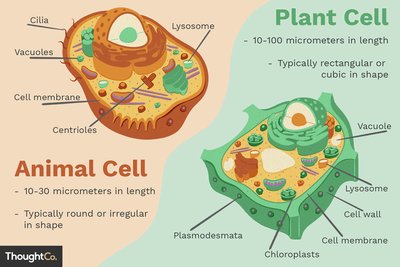
Structure | Prokaryote | Plant Cell | Animal Cell |
|---|---|---|---|
Cell Wall | Yes | Yes | No |
Plasma Membrane | Yes | Yes | Yes |
Organelles | No | Yes | Yes |
Nucleus | No | Yes | Yes |
Centrioles | No | No | Yes |
Ribosomes | Yes | Yes | Yes |
Cell Organelles and Their Functions
Nucleus
The nucleus is the largest organelle in animal cells, containing genetic material (DNA) organized into chromosomes. The nucleolus within the nucleus synthesizes rRNA and assembles ribosomes.
Ribosomes
Ribosomes are the sites of protein synthesis, composed of RNA and proteins. They can be free in the cytoplasm or bound to the rough endoplasmic reticulum (ER).
Endoplasmic Reticulum (ER)
Rough ER: Studded with ribosomes; synthesizes and transports proteins.
Smooth ER: Lacks ribosomes; synthesizes lipids, hormones, and steroids; detoxifies chemicals.
Golgi Bodies
Golgi bodies modify, process, and sort proteins and lipids received from the ER, packaging them into vesicles for transport.
Mitochondria
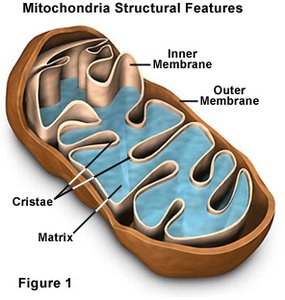
Mitochondria are double-membraned organelles responsible for cellular respiration and ATP production. The inner membrane forms cristae, increasing surface area for energy production.
Lysosomes
Lysosomes are membrane-bound sacs containing hydrolytic enzymes for digesting macromolecules, cellular debris, and foreign particles. They function optimally at acidic pH.
Centrioles
Centrioles are cylindrical structures involved in organizing microtubules during cell division, present in animal cells but not in plant cells.
Vacuoles
Vacuoles are fluid-filled sacs for storage of water, nutrients, and waste. Plant cells have a large central vacuole that maintains turgor pressure.
Peroxisomes
Peroxisomes break down long-chain fatty acids and detoxify harmful substances via oxidation reactions.
Cytoskeleton
Microtubules: Tubulin polymers involved in cell shape, division, and movement.
Microfilaments: Actin filaments important for cell movement and muscle contraction.
Cilia and Flagella
Cilia and flagella are extensions of the cytoskeleton that enable cell movement or movement of substances across cell surfaces.
Extracellular Matrix
The extracellular matrix is composed mainly of glycoproteins (e.g., collagen) and provides structural and biochemical support to cells.
Cell Membrane Structure and Function
Fluid Mosaic Model
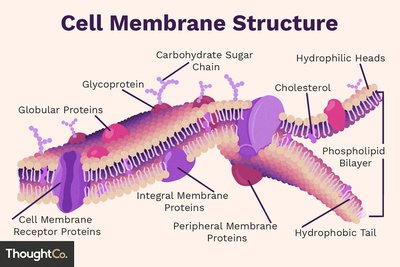
The plasma membrane is a dynamic structure composed of a phospholipid bilayer with embedded proteins, cholesterol, and carbohydrates. It is selectively permeable, allowing certain substances to cross while restricting others.
Phospholipids: Amphipathic molecules with hydrophilic heads and hydrophobic tails.
Proteins: Integral (transmembrane) and peripheral proteins serve as channels, carriers, receptors, and enzymes.
Carbohydrates: Attached to proteins or lipids on the extracellular surface, involved in cell recognition.
Cholesterol: Maintains membrane fluidity and stability.
Transport Across the Plasma Membrane
Passive Transport
Simple Diffusion: Movement of small, nonpolar molecules (e.g., O2, CO2) directly through the lipid bilayer down their concentration gradient.
Facilitated Diffusion: Movement of ions or polar molecules via specific channel or carrier proteins, down their concentration gradient; no energy required.
Osmosis: Diffusion of water across a selectively permeable membrane from high to low water potential (low to high solute concentration).
Tonicity describes the ability of a solution to cause a cell to gain or lose water:
Isotonic: Equal solute concentration; no net water movement.
Hypertonic: Higher solute concentration outside; cell loses water (crenation in animal cells, plasmolysis in plant cells).
Hypotonic: Lower solute concentration outside; cell gains water (cytolysis in animal cells, turgor in plant cells).
Water Potential ()
Water potential predicts the direction of water movement and is affected by solute potential () and pressure potential ():
Water moves from regions of higher to lower water potential.
Solutes lower water potential; pressure can increase or decrease it.
Active Transport
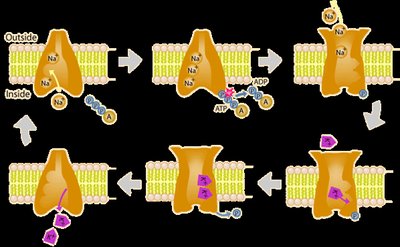
Active transport moves substances against their concentration gradient using energy (usually ATP) and specific transport proteins.
Ion Pumps: Create membrane potential by moving ions (e.g., sodium-potassium pump moves 3 Na+ out and 2 K+ in).
Electrogenic Pumps: Generate voltage across membranes.
Cotransport: Active transport of one solute drives passive transport of another.
Bulk Transport
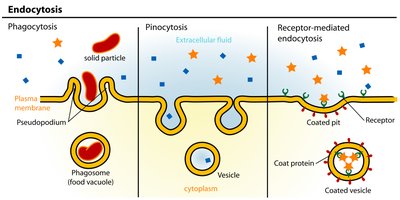
Endocytosis: Uptake of large particles or fluids via vesicle formation. Types include:
Phagocytosis: "Cell eating" of solids.
Pinocytosis: "Cell drinking" of fluids.
Receptor-mediated endocytosis: Specific uptake via receptor-ligand binding.
Exocytosis: Export of large molecules by vesicle fusion with the plasma membrane.
Cell Junctions
Cell junctions connect neighboring cells and facilitate communication and adhesion.
Desmosomes: Anchor adjacent animal cells together.
Gap Junctions: Allow passage of ions and small molecules between animal cells.
Tight Junctions: Seal spaces between animal cells, preventing leakage.
Plasmodesmata: Channels between plant cells for communication and transport.
Key Terms and Concepts
Amphipathic: Molecules with both hydrophilic and hydrophobic regions (e.g., phospholipids).
Selective Permeability: Membrane property allowing selective passage of substances.
Transport Proteins: Facilitate movement of ions and polar molecules across membranes.
Osmoregulation: Regulation of water and solute balance by cells and organisms.
