 Indietro
Cell Structure, Function, and Membrane Transport: AP Biology Unit 2 Study Guide
Guida di studio - Note intelligenti
 Appunti personalizzati basati sui tuoi materiali, ampliati con definizioni chiave, esempi e contesto.
Cell Structure: Subcellular Components
Ribosome
Ribosomes are small, non-membranous organelles responsible for protein synthesis. They can be found free in the cytosol or bound to the endoplasmic reticulum.
Structure: Composed of ribosomal RNA and proteins, forming two subunits (large and small).
Function: Translate messenger RNA (mRNA) into polypeptide chains.
Example: Ribosomes in the cytosol synthesize proteins for use within the cell, while those on the rough ER produce proteins for export.
Rough Endoplasmic Reticulum (RER)
The rough ER is a membranous organelle studded with ribosomes, giving it a 'rough' appearance.
Structure: Network of flattened sacs with ribosomes attached.
Function: Synthesis and modification of proteins destined for secretion or membrane insertion.
Example: Secretory cells have extensive rough ER for producing hormones or enzymes.
Smooth Endoplasmic Reticulum (SER)
The smooth ER lacks ribosomes and is involved in lipid synthesis and detoxification.
Structure: Tubular network without ribosomes.
Function: Synthesis of lipids, metabolism of carbohydrates, detoxification of drugs and poisons.
Example: Liver cells have abundant smooth ER for detoxification.
Golgi Bodies/Apparatus/Complex
The Golgi apparatus is a stack of flattened, membrane-bound sacs involved in modifying, sorting, and packaging proteins and lipids.
Structure: Series of cisternae (flattened sacs).
Function: Modifies proteins and lipids from the ER, packages them into vesicles for transport.
Example: Secretory vesicles bud from the Golgi to deliver hormones outside the cell.
Mitochondria
Mitochondria are double-membraned organelles responsible for cellular respiration and energy production.
Structure: Outer membrane, highly folded inner membrane (cristae), matrix.
Function: Generate ATP through oxidative phosphorylation.
How structure aids function: The inner membrane's folds (cristae) increase surface area for enzymes involved in ATP production.
Example: Muscle cells have many mitochondria to meet high energy demands.
Lysosome
Lysosomes are membrane-bound organelles containing hydrolytic enzymes for digestion.
Structure: Spherical vesicles with acidic interior.
Function: Breakdown of macromolecules, cellular debris, and apoptosis (programmed cell death).
Example: White blood cells use lysosomes to digest pathogens.
Vacuoles
Vacuoles are membrane-bound sacs for storage and maintaining cell structure.
Structure: Large central vacuole in plant cells; smaller vacuoles in animal cells.
Function: Store nutrients, waste products, and provide turgor pressure in plants.
Example: Plant vacuoles store water and maintain rigidity.
Chloroplast
Chloroplasts are double-membraned organelles found in plants and algae, responsible for photosynthesis.
Structure: Outer and inner membranes, thylakoid membranes, stroma.
Function: Convert light energy into chemical energy (glucose).
Example: Leaf cells contain chloroplasts for photosynthesis.
Nucleus
The nucleus is the control center of the cell, housing genetic material.
Structure: Nuclear envelope, nucleolus, chromatin.
Function: Stores DNA, coordinates cell activities (growth, metabolism, reproduction).
Example: Eukaryotic cells have a prominent nucleus.
Cytosol
Cytosol is the fluid component of the cytoplasm where metabolic reactions occur.
Structure: Gel-like substance.
Function: Site of metabolic pathways and molecular transport.
Example: Glycolysis occurs in the cytosol.
Cell Structure and Function
Endoplasmic Reticulum in Protein Synthesis and Transport
The ER plays a critical role in synthesizing and transporting proteins within the cell.
Protein Synthesis: Ribosomes on the rough ER synthesize proteins, which are then modified and transported.
Intracellular Transport: Proteins and lipids are moved through the ER and sent to the Golgi for further processing.
Lysosome in Digestion and Apoptosis
Lysosomes digest cellular waste and play a role in programmed cell death.
Intracellular Digestion: Lysosomes break down macromolecules and damaged organelles.
Apoptosis: Release of enzymes triggers cell death when necessary.
Vacuole in Storage and Turgor Pressure
Vacuoles store macromolecules and maintain cell rigidity in plants.
Storage: Vacuoles store nutrients, waste, and water.
Turgor Pressure: Water-filled vacuoles exert pressure against the cell wall, keeping plants upright.
Cell Size
Surface Area to Volume Ratio
The surface area to volume (SA:V) ratio is a key factor in determining cell efficiency and size.
Effect on Cell Size: Higher SA:V ratios allow for more efficient exchange of materials.
Favorable Ratio: Cells prefer a high SA:V ratio for optimal diffusion and transport.
Example: Small cells or cells with extensions (microvilli) maximize SA:V ratio.
Surface Area and Volume Formulas
Shape | Surface Area Formula | Volume Formula |
|---|---|---|
Sphere | ||
Rectangular Solid | ||
Cylinder | ||
Cube |
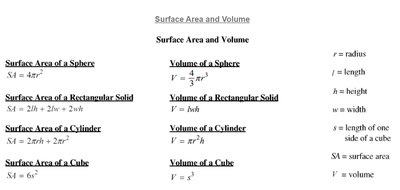
Diffusion Efficiency: The cell with the highest SA:V ratio will have the most efficient diffusion.
Increasing Surface Area: Cells can increase surface area with extensions (e.g., microvilli) without greatly increasing volume.
Heat Exchange: Greater surface area increases heat exchange with the environment.
Specialized Surfaces: Examples include alveoli in lungs and villi in intestines for material exchange.
Nutrient/Waste Strategies: Examples include contractile vacuoles in protists and kidneys in animals.
Plasma Membranes
Components and Functions
The plasma membrane is a selectively permeable barrier composed of various molecules.
Components: Phospholipids, proteins, cholesterol, glycoproteins, glycolipids.
Phospholipid Orientation: Hydrophilic heads face outward; hydrophobic tails face inward.
Bilayer Function: Maintains internal environment by controlling entry and exit of substances.
Membrane Proteins: Include transport, receptor, enzymatic, and structural proteins.
Fluid Mosaic Model: Describes the dynamic arrangement of lipids and proteins.
Cholesterol: Stabilizes membrane fluidity.
Glycoproteins: Cell recognition and signaling.
Glycolipids: Cell recognition and protection.
Membrane Permeability
Transport Across Membranes
Different materials cross the membrane by different mechanisms.
Easy Passage: Small, nonpolar molecules (e.g., O2, CO2).
Protein Required: Large or charged molecules (e.g., glucose, ions).
Vesicle Required: Bulk transport (e.g., proteins, polysaccharides).
Cell Wall: Found in plants, fungi, prokaryotes; composed of cellulose, chitin, or peptidoglycan.
Cell Wall Function: Maintains structure, protects from hypotonic solutions, allows material passage.
Membrane Transport
Passive and Active Transport
Cells use passive and active mechanisms to move substances across membranes.
Passive Transport: No energy required; includes diffusion and osmosis.
Active Transport: Requires energy (ATP); moves substances against concentration gradient.
Concentration Gradient: Difference in concentration across a membrane.
Endocytosis: Bulk import; includes phagocytosis, pinocytosis, receptor-mediated endocytosis.
Exocytosis: Bulk export; e.g., neurotransmitter release.
Facilitated Diffusion
Transport of Charged and Large Molecules
Facilitated diffusion uses proteins to move substances across membranes.
Charged Molecules/Ions: Use channel or carrier proteins.
Large Polar Molecules: Use carrier proteins.
Water Transport: Small amounts by simple diffusion; large amounts via aquaporins.
Tonicity and Osmoregulation
Osmosis and Water Potential
Tonicity describes the relative solute concentration of solutions, affecting water movement.
Hypotonic: Solution has lower solute concentration than cell; water enters cell.
Hypertonic: Solution has higher solute concentration than cell; water leaves cell.
Isotonic: Equal solute concentration; no net water movement.
Water Potential (): Determines direction of water movement; calculated as .
Homeostasis: Maintenance of stable internal conditions.
Osmoregulation: Regulation of water and solute balance.
Mechanisms of Transport
Diffusion and Plant Water Movement
Simple and facilitated diffusion are both passive, but differ in the need for proteins.
Simple Diffusion: Direct movement across membrane.
Facilitated Diffusion: Requires transport proteins.
Plant Water Movement: Water moves from soil to roots (root hairs), through xylem (cohesion, adhesion), and out stomata (transpiration).
Transpiration Rate: Higher in warm, dry, windy environments.
Guard Cells: Regulate stomata opening/closing via turgor pressure.
Xylem Structure: Allows water movement against gravity via cohesion, adhesion, and transpiration pull.
Cell Compartmentalization
Membrane-Bound Organelles
Membranes allow for specialized processes and compartmentalization in eukaryotic cells.
Examples: ATP synthesis in mitochondria, protein modification in ER.
Inner Membrane Folding: Increases surface area for reactions (mitochondria, ER, thylakoids).
Golgi Membranes: Multiple sacs allow sorting and packaging.
Origins of Cell Compartmentalization
Prokaryotic vs. Eukaryotic Cells and Endosymbiotic Theory
Cell compartmentalization evolved through endosymbiosis and membrane infolding.
Similarities: Both have DNA, ribosomes, plasma membrane.
Differences: Eukaryotes have membrane-bound organelles, larger size, complex structure.
Prokaryotic Compartmentalization: Limited; no membrane-bound organelles.
Eukaryotic Compartmentalization: Extensive; organelles perform specialized functions.
Endosymbiotic Theory: Mitochondria and chloroplasts originated from engulfed prokaryotes.
Evidence: Mitochondria and chloroplasts have their own DNA, double membranes, and similarities to ancestral species.
Order of Acquisition: Mitochondria were obtained first, followed by chloroplasts.
