Indietro
Cells and Metabolism: Study Guide (Chapters 6-8, Enzyme Activity, Osmosis & Diffusion)
Guida di studio - Note intelligenti
 Appunti personalizzati basati sui tuoi materiali, ampliati con definizioni chiave, esempi e contesto.
Cells and Metabolism: Study Guide
Overview
This study guide covers essential concepts from General Biology chapters 6-8, focusing on cell structure, membrane function, and metabolism. It includes key questions and explanations relevant to cellular processes, enzyme activity, and transport mechanisms.
Chapter 8: An Introduction to Metabolism
Thermodynamics in Biology
The laws of thermodynamics govern energy transformations in living organisms:
First Law of Thermodynamics: Energy cannot be created or destroyed, only transformed. In cells, chemical energy from food is converted to ATP and heat.
Second Law of Thermodynamics: Every energy transfer increases the entropy (disorder) of the universe. Biological systems maintain order by releasing heat.
Maximum Stability: When a reaction reaches equilibrium, it cannot do work; cells avoid equilibrium to remain functional.
Endergonic vs. Exergonic Reactions
Endergonic Reaction: Requires energy input; products have more free energy than reactants. Example: Photosynthesis.
Exergonic Reaction: Releases energy; products have less free energy than reactants. Example: Cellular respiration.
Gibbs Free Energy Equation:
Energy Coupling
Cells couple exergonic and endergonic reactions to drive essential processes. For example, ATP hydrolysis (exergonic) powers muscle contraction (endergonic).
ATP and Cellular Work
ATP (Adenosine Triphosphate): Main energy currency of the cell.
Phosphorylated Intermediate: A molecule with a phosphate group attached, increasing its energy and reactivity.
Enzyme Activity and Regulation
Enzymes: Biological catalysts that speed up reactions by lowering activation energy.
Environmental Effects: Changes in pH, salinity, and temperature can denature enzymes or alter their activity.
Regulation: Activators, inhibitors, and cofactors modulate enzyme activity. Cooperativity occurs when substrate binding increases enzyme activity.
Vmax: Maximum rate of enzyme activity; cannot be exceeded due to enzyme saturation.
Negative Feedback: End product inhibits an earlier step, preventing overproduction.
Chapter 6: A Tour of the Cell
Cellular Organelles and Functions
Ribosomes: Free ribosomes synthesize proteins for the cytoplasm; ribosomes on the rough ER produce proteins for secretion or membrane insertion.
Beta Cells (Pancreas): Structures involved in insulin secretion include the nucleus (gene expression), ribosomes (protein synthesis), ER (folding), Golgi apparatus (packaging), and vesicles (exocytosis).
Lysosomes vs. Peroxisomes: Lysosomes digest cellular waste; peroxisomes break down fatty acids and detoxify. Smooth ER synthesizes lipids and detoxifies, but does not degrade like peroxisomes.
Organelle Interactions
Nucleus and Ribosome: Nucleus provides mRNA for ribosome protein synthesis.
SER and Cell Membrane: SER produces lipids for membrane maintenance.
Cell Size and Division
Cell Division: Cells divide to maintain efficient transport and communication; large cells (e.g., neurons) use specialized structures for transport.
Organelle Distribution
Prokaryotes: Only have ribosomes, cell membrane, and cell wall.
Eukaryotes: Have nucleus, ER, Golgi, mitochondria, etc.
Plants: Chloroplasts, cell wall, central vacuole.
Animals: Lysosomes, centrioles.
Chloroplasts and Mitochondria in Plants
Plants need mitochondria to generate ATP for cellular processes, even though they produce glucose via photosynthesis in chloroplasts.
Chapter 7: Membrane Structure and Function
Fluid Mosaic Model
The cell membrane is a dynamic structure composed of a phospholipid bilayer with embedded proteins, cholesterol, and carbohydrates.
Phospholipids: Form the bilayer, providing a semi-permeable barrier.
Proteins: Transport, signaling, and structural support.
Cholesterol: Maintains membrane fluidity.
Carbohydrates: Cell recognition and signaling.
Phospholipid Bilayers in Other Structures
Other cell structures with phospholipid bilayers include the nuclear envelope, ER, Golgi apparatus, mitochondria, and vesicles.
Membrane Proteins
Transport Proteins: Facilitate movement of substances.
Receptor Proteins: Receive and transmit signals.
Enzymatic Proteins: Catalyze reactions.
Structural Proteins: Maintain cell shape.
Osmosis and Tonicity
Isotonic: Equal solute concentration; no net water movement.
Hypertonic: Higher solute concentration outside; cell loses water.
Hypotonic: Lower solute concentration outside; cell gains water.
1M sucrose vs. 1M glucose: Not isotonic due to different membrane permeability.
Transport Mechanisms
Diffusion: Small, nonpolar molecules (e.g., O2, CO2) move freely.
Facilitated Diffusion: Larger or polar molecules use protein channels.
Passive Transport: No energy required; moves down concentration gradient.
Active Transport: Requires energy (ATP); moves against gradient.
Endocytosis vs. Exocytosis
Endocytosis: Cell takes in substances by engulfing them.
Exocytosis: Cell expels substances by vesicle fusion with membrane.
Study Resources and Practice
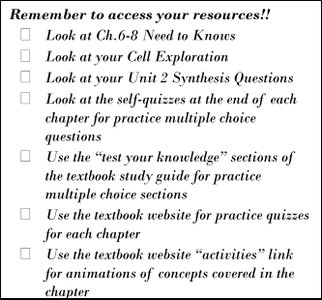
Recommended Study Tools
Review "Need to Know" sections for chapters 6-8.
Explore cell structure and function through Cell Exploration activities.
Practice synthesis questions and self-quizzes at the end of each chapter.
Utilize textbook study guide and online quizzes for additional practice.
Use animations and activities from the textbook website to reinforce concepts.