 Indietro
Cellular Basis of Reproduction and Inheritance: Study Notes
Guida di studio - Note intelligenti
 Appunti personalizzati basati sui tuoi materiali, ampliati con definizioni chiave, esempi e contesto.
Cell Division and Reproduction
Asexual vs. Sexual Reproduction
Organisms reproduce either asexually or sexually, each method affecting the genetic relationship between parent and offspring.
Asexual reproduction: Offspring are genetic clones of the parent, produced without the fusion of gametes.
Sexual reproduction: Offspring inherit a mix of genetic material from two parents, resulting in genetic diversity.
Example: Bacteria reproduce asexually by binary fission, while humans reproduce sexually.
Importance of Cell Division
Cell division is essential for the growth, repair, and reproduction of all living organisms.
Prokaryotes: Cell division enables reproduction and population growth.
Eukaryotes: Cell division is necessary for development, tissue repair, and reproduction.
Prokaryotic Cell Division: Binary Fission
Binary Fission Process
Prokaryotes reproduce by binary fission, a simple process that results in two genetically identical daughter cells.
Single circular DNA molecule is replicated.
Chromosome copies move apart as the cell elongates.
Plasma membrane pinches inward, and new cell wall forms, dividing the cell.
Eukaryotic Cell Cycle and Mitosis
Structure of Eukaryotic Chromosomes
Eukaryotic chromosomes are complex structures composed of DNA and proteins, organized within the nucleus.
Each chromosome contains one long DNA molecule.
Chromatin fibers are loosely packed during most of the cell cycle, condensing during cell division.
Chromosome Duplication and Sister Chromatids
Before cell division, chromosomes duplicate, forming sister chromatids joined together.
Sister chromatids contain identical DNA.
Separation of sister chromatids during cell division ensures each daughter cell receives a complete set of chromosomes.
The Cell Cycle: Growth and Division Phases
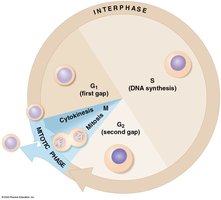
The cell cycle is an ordered sequence of events that includes growth, DNA replication, and cell division.
Interphase: Consists of three phases:
G1 (first gap): Cell grows and prepares for DNA replication.
S (DNA synthesis): DNA is replicated.
G2 (second gap): Cell prepares for mitosis.
Mitotic phase: Includes mitosis (division of the nucleus) and cytokinesis (division of the cytoplasm).
Mitosis and Cytokinesis
Phases of Mitosis
Mitosis is the process by which a eukaryotic cell divides its nucleus and distributes duplicated chromosomes to two daughter cells.
Prophase: Chromosomes condense, spindle forms.
Metaphase: Chromosomes align at the cell's equator.
Anaphase: Sister chromatids separate and move to opposite poles.
Telophase: Nuclear envelopes reform, chromosomes decondense.
Cytokinesis in Animal vs. Plant Cells
Cytokinesis is the division of the cytoplasm, differing between animal and plant cells.
Animal cells: Cytokinesis occurs via a cleavage furrow that pinches the cell in two.
Plant cells: A cell plate forms, eventually dividing the cell.
Cell Cycle Regulation and Cancer
Cell Cycle Control System
The cell cycle is regulated by a set of proteins and checkpoints that ensure proper division.
Growth factors stimulate cell division.
Checkpoints determine if the cell is ready to proceed to the next phase.
Cancer Cells vs. Healthy Cells
Cancer cells divide uncontrollably, forming tumors that can invade other tissues.
Malignant tumors: Can spread to other parts of the body.
Treatments: Radiation and chemotherapy target rapidly dividing cells.
Meiosis and Genetic Variation
Homologous Chromosomes and Chromosome Number
Somatic cells contain pairs of homologous chromosomes, while gametes have a single set.
Diploid (2n): Two sets of chromosomes (somatic cells).
Haploid (n): One set of chromosomes (gametes).
Meiosis: Reduction Division
Meiosis reduces chromosome number by half, producing four genetically unique haploid cells.
Meiosis I: Homologous chromosomes separate.
Meiosis II: Sister chromatids separate.
Crossing over: Homologous chromosomes exchange segments, increasing genetic variation.
Genetic Variation in Sexual Reproduction
Genetic variation arises from independent assortment, crossing over, and random fertilization.
Each gamete is genetically unique.
Random fertilization further increases variation among offspring.
Alterations of Chromosome Number and Structure
Nondisjunction and Chromosomal Disorders
Nondisjunction is the failure of chromosomes to separate properly during meiosis, leading to abnormal chromosome numbers.
Can result in disorders such as Down syndrome (trisomy 21).
Abnormal numbers of sex chromosomes can lead to syndromes (e.g., XXY, XXX).
Karyotyping
Karyotyping is the process of photographing and arranging chromosomes to detect abnormalities.
Cells are arrested at metaphase and chromosomes are visualized under a microscope.
Chromosomes are arranged in pairs for analysis.
Chromosomal Changes and Their Consequences
Chromosome breakage and rearrangements can cause genetic disorders or cancer.
Types: Deletions, duplications, inversions, translocations.
Changes in somatic cells can lead to cancer; changes in gametes can cause inherited disorders.
Summary Table: Comparison of Mitosis and Meiosis
Feature | Mitosis | Meiosis |
|---|---|---|
Number of divisions | 1 | 2 |
Number of daughter cells | 2 | 4 |
Chromosome number in daughter cells | Diploid (2n) | Haploid (n) |
Genetic similarity | Identical | Unique |
Function | Growth, repair | Sexual reproduction |
