 Indietro
Cellular Basis of Reproduction and Inheritance: Mitosis
Guida di studio - Note intelligenti
 Appunti personalizzati basati sui tuoi materiali, ampliati con definizioni chiave, esempi e contesto.
Cell Division and Reproduction
Cell Division Overview
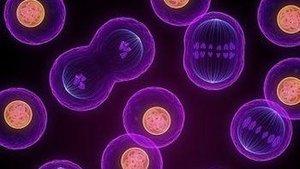
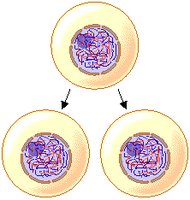
Cell division is a fundamental process by which cells reproduce, enabling growth, maintenance, and repair in multicellular organisms. It results in the formation of two daughter cells that are genetically identical to each other and to the parent cell.
Chromosome Duplication: Before division, chromosomes (DNA) are duplicated to ensure each daughter cell receives a complete set.
Asexual Reproduction: Involves a single parent and produces genetically identical offspring, known as clones.
Examples of Asexual Reproduction
Asexual reproduction occurs in various organisms through different mechanisms.
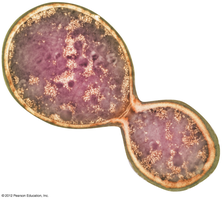
Budding: Yeast reproduces asexually by budding, where a new cell forms from the parent.
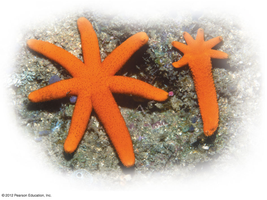
Fragmentation: Sea stars can regenerate from fragments, producing new individuals.
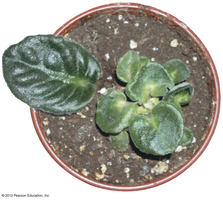
Cuttings: African violets can grow new plants from cuttings.
Sexual Reproduction
Sexual reproduction involves the fusion of gametes (sperm and egg), resulting in offspring with unique genetic combinations.
Gametes: Produced in reproductive organs (ovaries and testes), each gamete contains half the chromosome number of the parent cell.
Variation: Offspring inherit a unique combination of genes, promoting genetic diversity.
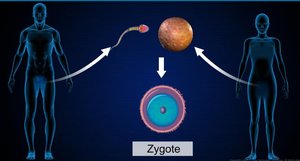
Mitosis
Definition and Purpose
Mitosis is the process of nuclear division that maintains the chromosome number in daughter cells. It is essential for growth, tissue repair, and asexual reproduction in multicellular organisms.
Produces: Two descendant cells with the same number and type of chromosomes as the parent cell.
Functions: Growth, tissue remodeling, and replacement of dead or damaged cells.
Prokaryotic Cell Division
Binary Fission
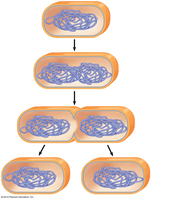
Prokaryotes reproduce by binary fission, a simpler process than mitosis.
Process: The single circular DNA molecule is duplicated, and the cell divides into two identical daughter cells.
Steps: Chromosome duplication, cell elongation, separation of chromosome copies, and division.
Eukaryotic Chromosomes
Structure and Composition
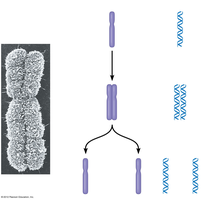
Eukaryotic chromosomes are composed of a single DNA molecule associated with proteins, forming chromatin. Each species has a characteristic number of chromosomes.
Chromatin: DNA and proteins together form chromatin.
Chromosome Numbers: Humans have 46, dogs 78, hedgehogs 90.
Chromosome Duplication: Before cell division, chromosomes duplicate, forming sister chromatids joined at the centromere.
The Cell Cycle
Phases of the Cell Cycle
The cell cycle describes the life of a cell, including growth, DNA replication, and division.
Interphase: Consists of G1 (growth), S (DNA synthesis), and G2 (preparation for division).
Mitosis: Nuclear division.
Cytokinesis: Division of cytoplasm.
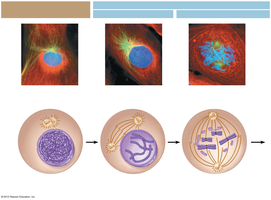
Interphase
During interphase, the cell grows, duplicates its chromosomes, and prepares for division.
G2: Cell has doubled its contents and cytoplasm; two centrosomes are present.
Chromatin: Chromosomes are duplicated but not yet visible.
Stages of Mitosis
Prophase
Nucleus: Chromosomes become visible.
Cytoplasm: Mitotic spindle forms as microtubules grow from centrosomes, which move apart.
Prometaphase
Nuclear Envelope: Breaks up.
Microtubules: Attach to kinetochores on sister chromatids and move chromosomes toward the cell center.
Metaphase
Spindle: Fully formed, with poles at opposite ends.
Chromosomes: Aligned on the metaphase plate (cell equator).
Anaphase
Centromeres: Separate, allowing sister chromatids to move apart.
Motor Proteins: Move chromosomes along microtubules; cell elongates.
Telophase
Nuclear Envelope: Reforms around chromosomes.
Chromatin: Uncoils; mitotic spindle disappears.
Cytokinesis: Begins, dividing the cytoplasm.
Cytokinesis
Animal Cell Cytokinesis
Process: Cytoplasm divides, often overlapping with telophase.
Mechanism: Actin and myosin form a contractile ring, creating a cleavage furrow that deepens until the cell splits.
Plant Cell Cytokinesis
Challenge: Stiff cell wall requires a different mechanism.
Mechanism: Microtubules guide vesicles to form a cell plate, which becomes the new cell wall.
Cell Cycle Control System
Regulation and Checkpoints
The cell cycle is regulated by a set of molecules that coordinate events and ensure proper division.
Checkpoints: G1, G2, and M checkpoints regulate progression; cells may enter a non-dividing state (G0) if signals are absent.
Growth Factors: Proteins that stimulate cell division by binding to receptors and triggering signal transduction pathways.
Pathological Mitosis and Cancer
Loss of Control
Mutations in checkpoint genes can disrupt cell cycle regulation, leading to uncontrolled cell division.
Neoplasm: Accumulation of abnormal cells forms a tumor.
Benign Tumors: Do not invade neighboring tissues; often removable.
Malignant Tumors: Invade tissues and can spread (metastasis), posing health risks.
Cancer
Cancer cells divide abnormally, disrupt tissues, and can metastasize.
HeLa Cells: Immortal cancer cells used in research since 1951.
Treatment: Early removal, radiation (damages DNA), and chemotherapy (targets metastatic tumors).
Summary Table: Comparison of Asexual and Sexual Reproduction
Feature | Asexual Reproduction | Sexual Reproduction |
|---|---|---|
Number of Parents | One | Two |
Genetic Variation | None (clones) | High (unique offspring) |
Examples | Yeast, sea star, African violet | Humans, most animals |
Chromosome Number in Offspring | Same as parent | Half from each parent |
