 Indietro
Cellular Components and Membrane Transport: Structure, Function, and Mechanisms
Guida di studio - Note intelligenti
 Appunti personalizzati basati sui tuoi materiali, ampliati con definizioni chiave, esempi e contesto.
Endomembrane System
Nucleus, Endoplasmic Reticulum, Golgi Apparatus, and Vesicles
The endomembrane system is a group of organelles in eukaryotic cells that work together to modify, package, and transport lipids and proteins. It includes the nucleus, endoplasmic reticulum (ER), Golgi apparatus, and vesicles.
Nucleus: Contains genetic material and directs cellular activities.
Endoplasmic Reticulum: Rough ER synthesizes proteins; smooth ER synthesizes lipids.
Golgi Apparatus: Modifies, sorts, and packages proteins and lipids for delivery.
Vesicles: Small membrane-bound sacs that transport substances within the cell.
Example: Proteins synthesized in the rough ER are sent to the Golgi apparatus for modification and then transported in vesicles to their destination.
Energy-Producing Organelles
Mitochondria and Chloroplasts
Mitochondria and chloroplasts are specialized organelles responsible for energy conversion in eukaryotic cells. Mitochondria generate ATP through cellular respiration, while chloroplasts perform photosynthesis in plant cells.
Mitochondria: Site of aerobic respiration; converts glucose and oxygen into ATP.
Chloroplasts: Site of photosynthesis; converts sunlight, water, and CO2 into glucose and oxygen.
Endosymbiont Theory: Suggests mitochondria and chloroplasts originated from prokaryotic cells engulfed by ancestral eukaryotes.
Lysosomes, Vacuoles, and Central Vacuole
Lysosomes: Structure and Function
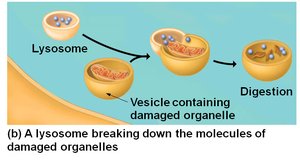
Lysosomes are membrane-enclosed sacs containing digestive enzymes found in animal cells. They break down large molecules, old organelles, and foreign substances.
Digestive Enzymes: Break down proteins, polysaccharides, fats, nucleic acids, and damaged organelles.
Developmental Role: Lysosomes participate in developmental processes, such as digesting webbing between fingers and toes.
Lysosomal Storage Disease: Disorders caused by malfunctioning lysosomes, leading to accumulation of undigested substances.
Vacuoles: Structure and Function
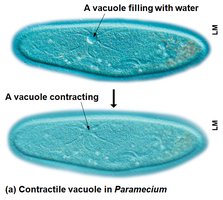
Vacuoles are large sacs that bud off from membranes such as the ER, Golgi apparatus, or cell membrane. They serve various functions depending on cell type.
Food Vacuoles: Formed by endocytosis, containing ingested food.
Contractile Vacuoles: Found in protists like Paramecium, pump out excess water to maintain osmotic balance.
Lysosomes and Food Vacuoles: Cooperation
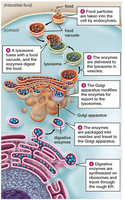
Animal cells and protists often "eat" by endocytosis, engulfing food into food vacuoles. Lysosomes merge with these vacuoles to digest the contents.
Endocytosis: Process by which cells engulf external substances.
Digestion: Lysosomal enzymes break down food within the vacuole.
Central Vacuole in Plant Cells
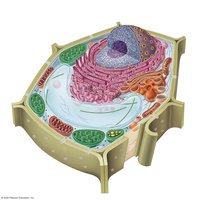
The central vacuole is a large, versatile organelle specific to plant cells, often occupying more than half the cell's volume.
Storage: Stores organic nutrients and water.
Pigments: Contains pigments that attract pollinators or toxins that deter herbivores.
Structural Support: Maintains cell turgor pressure for structural integrity.
Cell Membrane Structure and Function
Membrane Structure
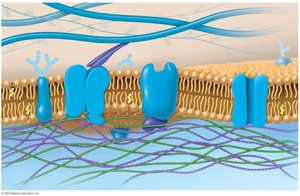
The cell membrane is a selectively permeable barrier composed of a phospholipid bilayer with embedded proteins. It regulates the movement of substances in and out of the cell.
Phospholipid Bilayer: Amphipathic molecules with hydrophilic heads and hydrophobic tails.
Embedded Proteins: Perform various functions including transport, signaling, and cell recognition.
Classes of Membrane Proteins
Membrane proteins are classified based on their function:
Transport Proteins: Form channels or carriers for specific molecules.
Receptor Proteins: Bind messenger molecules and trigger cellular responses.
Membrane Enzymes: Catalyze chemical reactions at the membrane.
Connection Proteins: Anchor cells to each other and to the extracellular matrix.
Recognition Proteins: Serve as identification tags for immune recognition.
Transport Proteins
Transport proteins facilitate the movement of molecules across the membrane. They include channel proteins, carrier proteins, and aquaporins.
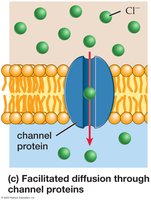
Channel Proteins: Provide passageways for ions and small molecules.
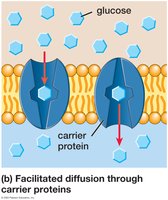
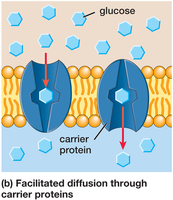
Carrier Proteins: Change shape to transport specific molecules.
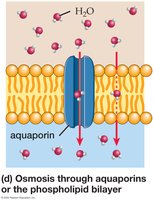
Aquaporins: Specialized channels for water transport.
Receptor Proteins
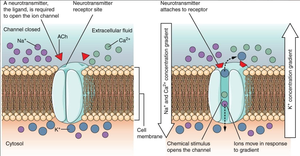
Receptor proteins have binding sites for messenger molecules. When a messenger binds, the receptor changes shape and initiates a cellular response.
Signal Transduction: Receptors can trigger the production of proteins or open transport channels.
Cell Communication: Essential for hormone and neurotransmitter signaling.
Membrane Enzymes
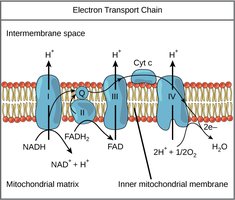
Membrane enzymes catalyze reactions at the cell membrane, such as those involved in cellular respiration and photosynthesis.
Respiratory Complexes: Located in mitochondrial cristae.
Photosystems: Located in chloroplast thylakoid membranes.
Connection Proteins
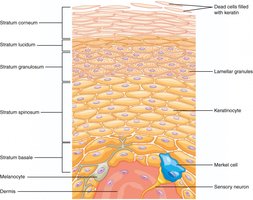
Connection proteins anchor cells to each other and to the extracellular matrix, maintaining tissue structure and integrity.
Collagen: Provides strength and support.
Keratin: Forms protective layers in skin.
Hyaluronidase: Enzyme that breaks down connection proteins, used by some parasites.
Recognition Proteins
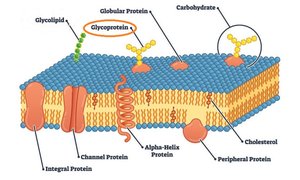
Recognition proteins are glycoproteins that serve as identification tags, allowing the immune system to distinguish self from non-self.
Glycoproteins: Proteins with carbohydrate chains.
Immune Function: White blood cells scan for familiar glycoproteins.
Bacterial Recognition: Bacteria lack human recognition proteins.
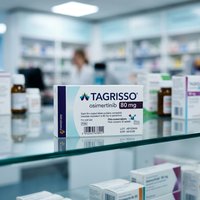
Recognition Protein Example: Tagrisso®
Tagrisso® is a cancer immunotherapy drug that helps the immune system target lung cancer cells by identifying unique glycoprotein shapes.
Mechanism: Teaches immune cells to recognize and destroy cancer cells anywhere in the body.
Membrane Transport: Diffusion and Osmosis
Phospholipid Bilayer and Water World
The cell membrane's phospholipid bilayer is amphipathic, creating a selectively permeable barrier. Cells exist in aqueous environments, and their membranes regulate water and solute movement.
Cytosol: Aqueous, polar interior.
Extracellular Environment: Moist surroundings for all cell types.
Key Terms: Equilibrium, Autopoiesis, Homeostasis
Equilibrium: Equal concentrations on both sides of a membrane.
Autopoiesis: Self-maintenance through component production.
Homeostasis: Maintenance of a constant internal environment.
Molecule Movement and Brownian Motion
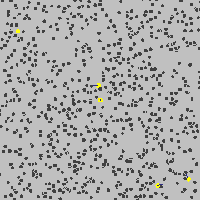
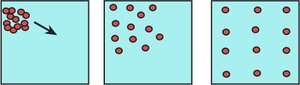
Molecules are in constant motion due to Brownian motion, which is the random movement of particles. This movement drives diffusion and increases entropy.
Diffusion: Net movement of molecules from high to low concentration.
Entropy: Tendency toward disorder.
Diffusion and Concentration Gradients
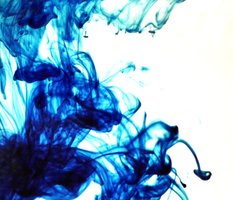
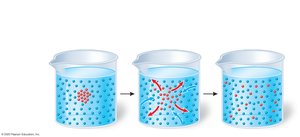
Diffusion is the process by which molecules spread out evenly in available space, moving down their concentration gradient until equilibrium is reached.
Gradient: Difference in concentration between two areas.
Net Movement: Primary direction of molecule movement.
Selective Permeability and Passive Transport
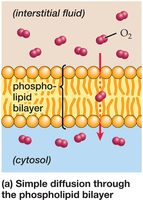
Cell membranes are selectively permeable, allowing only certain molecules to pass. Passive transport occurs without energy input (ATP).
Simple Diffusion: Small, nonpolar molecules pass directly through the bilayer.
Facilitated Diffusion: Transport proteins help larger or polar molecules cross the membrane.
Osmosis and Dialysis
Osmosis is the movement of water across a membrane toward solutes, while dialysis is the movement of solutes toward water. Both are types of passive transport.
Osmosis: Water moves down its concentration gradient.
Dialysis: Solutes move down their concentration gradient.
Concentration Terminology
Hypertonic: Higher solute concentration.
Hypotonic: Lower solute concentration.
Isotonic: Equal solute concentration.
Key Equations
Diffusion Rate:
Osmosis: (Osmotic pressure equation)
