 Indietro
Cellular Energetics and Metabolism: Study Guide for General Biology
Guida di studio - Note intelligenti
 Appunti personalizzati basati sui tuoi materiali, ampliati con definizioni chiave, esempi e contesto.
Metabolism: An Overview
Definition and Pathways
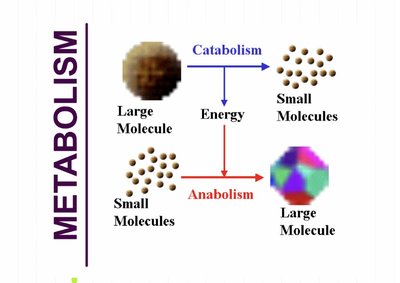
Metabolism refers to the totality of an organism's chemical reactions, arising from orderly interactions between molecules. These reactions are organized into metabolic pathways, which begin with a specific molecule and end with a product, with each step catalyzed by a specific enzyme.
Catabolic pathways: Release energy by breaking down complex molecules into simpler compounds (e.g., cellular respiration).
Anabolic pathways: Consume energy to build complex molecules from simpler ones (e.g., protein synthesis from amino acids).
Example: Cellular respiration is catabolic; protein synthesis is anabolic.
Cellular Energy and the Laws of Thermodynamics
Energy Transformations and Entropy
The study of energy transformations in matter is governed by the laws of thermodynamics:
First Law (Conservation of Energy): Energy cannot be created or destroyed, only transferred or transformed. Example: Solar energy is converted to carbohydrates by autotrophs.
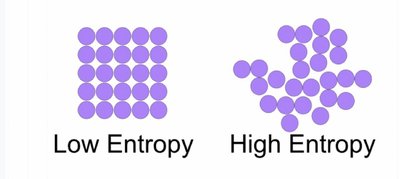
Second Law: Every energy transfer increases the entropy (disorder/randomness) of the universe. No energy transfer is 100% efficient; some energy dissipates as heat.
Maintaining order in living cells requires constant energy input. Loss of order or energy flow results in cell death.
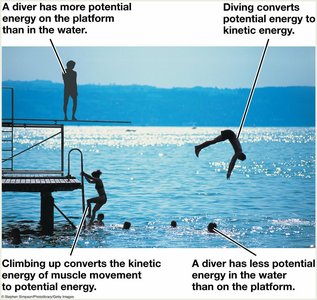
Example: Cleaning a messy kitchen increases order locally but increases disorder elsewhere as energy dissipates as heat.
Entropy and Stability
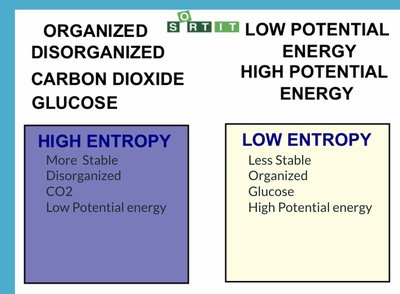
High entropy: More stable, disorganized, low potential energy (e.g., CO2).
Low entropy: Less stable, organized, high potential energy (e.g., glucose).
Free Energy: Exergonic and Endergonic Reactions
Free Energy and Spontaneity
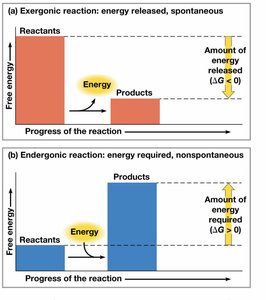
Free energy (G) is the portion of a system’s energy that can do work under uniform temperature and pressure. Changes in free energy (ΔG) determine whether a reaction is spontaneous:
Exergonic reaction: Net release of free energy, spontaneous, ΔG < 0 (e.g., cellular respiration).
Endergonic reaction: Absorbs free energy, nonspontaneous, ΔG > 0 (e.g., photosynthesis).
Systems naturally move toward lower free energy and greater stability.
Equation: Gibbs Free Energy Equation Where: = change in free energy = change in enthalpy (total energy) = temperature in Kelvin = change in entropy
ATP Powers Cellular Work by Coupling Exergonic and Endergonic Reactions
Structure and Function of ATP
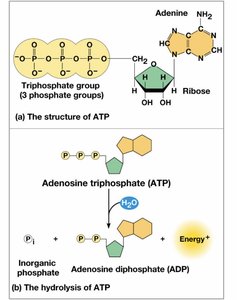
ATP (adenosine triphosphate) consists of ribose (a sugar), adenine (a nitrogenous base), and three phosphate groups. The bonds between phosphate groups can be broken by hydrolysis, releasing energy and producing ADP and inorganic phosphate.
ATP mediates energy coupling in cells, transferring a phosphate group to another molecule (phosphorylation).
ATP hydrolysis can be coupled with endergonic reactions to minimize energy loss.
ATP is used for chemical, transport, and mechanical work in cells.
Equation: ATP Hydrolysis
Enzyme Structure and Substrate Specificity
Enzyme Function and Induced Fit Model
An enzyme is a protein that acts as a catalyst, speeding up reactions without being consumed. Enzymes are specific for their substrates, which bind to the enzyme's active site. The induced fit model describes how enzymes change shape slightly to fit the substrate, enhancing catalysis.
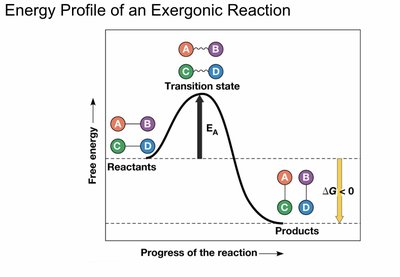
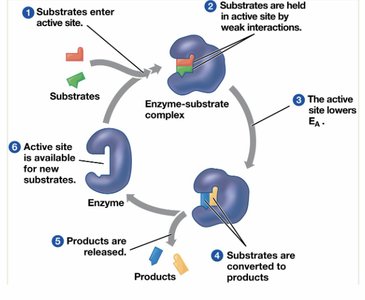
Enzymes lower the activation energy barrier, speeding up reactions.
Substrates are held by weak interactions; after conversion to products, the enzyme is available for more substrate.
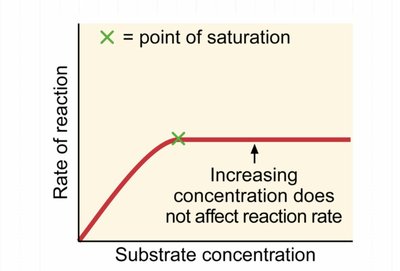
Increasing substrate concentration increases reaction rate until the enzyme is saturated.
Equation: Activation Energy = Activation energy required to start a reaction
Environmental Impacts on Enzyme Function
Factors Affecting Enzyme Activity
Enzyme activity is influenced by temperature, pH, and chemicals. Higher temperatures increase reaction rates up to a point, after which enzymes become denatured and lose function. Each enzyme has an optimal pH. Enzyme activity can be regulated by inhibitors:
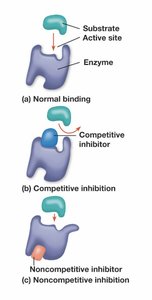
Competitive inhibitors: Bind to the active site, preventing substrate binding.
Noncompetitive inhibitors: Bind to an allosteric site, changing the enzyme's shape and reducing effectiveness.
Cofactors are nonprotein molecules that assist enzymes; coenzymes are organic cofactors (often vitamins).
Regulation of Enzyme Activity: Allosteric Regulation and Feedback Inhibition
Allosteric Regulation and Feedback
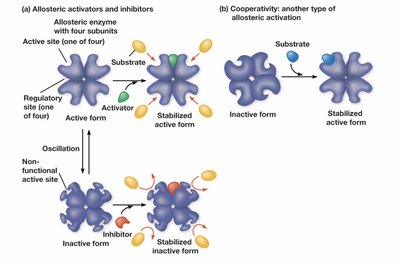
Cells regulate metabolic pathways by controlling enzyme activity. Allosteric regulation occurs when a regulatory molecule binds to a site other than the active site, inhibiting or stimulating enzyme activity. Feedback inhibition is when the end product of a pathway inhibits an enzyme early in the pathway, preventing overproduction.
Oxidation-Reduction Reactions and Metabolism
Redox Reactions
Oxidation-reduction (redox) reactions involve the transfer of electrons between molecules:
Oxidation: Loss of electrons (or hydrogen), gain of oxygen.
Reduction: Gain of electrons (or hydrogen), loss of oxygen.
OIL RIG: Oxidation Is Loss, Reduction Is Gain.
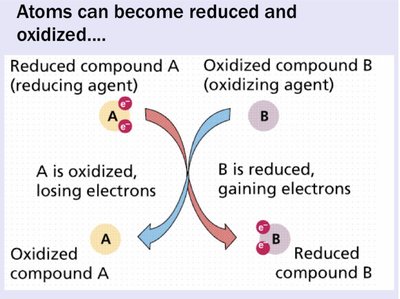
Example: Na + Cl → NaCl (sodium is oxidized, chlorine is reduced).
Energy Coupling in Cellular Respiration and Photosynthesis
Coupled Reactions and Electron Transport
Cells drive endergonic reactions by coupling them with exergonic reactions. In cellular respiration, glucose is oxidized to CO2, producing ATP. In photosynthesis, solar energy is used to reduce CO2 to glucose. Electron carriers (NAD, NADP) facilitate these processes.
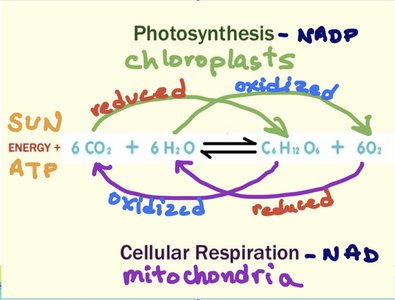
Electron Transport Chain: High-energy electrons are transferred through a series of redox reactions, releasing energy to pump hydrogen ions and synthesize ATP.
Chloroplasts: Capture solar energy, form ATP and NADPH, reduce CO2 to glucose.
Mitochondria: Oxidize glucose, produce ATP, use NAD as electron carrier.
Equation: Cellular Respiration
Equation: Photosynthesis
