 Indietro
Cellular Energetics: Metabolism, Enzymes, and Cellular Respiration
Guida di studio - Note intelligenti
 Appunti personalizzati basati sui tuoi materiali, ampliati con definizioni chiave, esempi e contesto.
Cellular Energetics
Introduction to Metabolism
Metabolism encompasses all the chemical reactions that occur within living organisms to transform matter and energy. These reactions are essential for organization, growth, and reproduction. Metabolic pathways are sequences of reactions, each catalyzed by a specific enzyme, that convert substrates into final products.
Metabolic Pathway: A series of chemical reactions in a cell, each step catalyzed by an enzyme.
Anabolic Pathways: Build complex molecules from simpler ones; require energy (e.g., photosynthesis).
Catabolic Pathways: Break down complex molecules into simpler ones; release energy (e.g., cellular respiration).
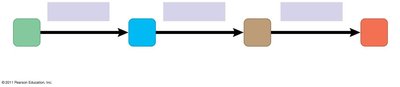
Additional info: Metabolic pathways are fundamental to all life and support the concept of common ancestry.
Energy and Free Energy in Biological Systems
Energy is required for cellular work and is captured, stored, and used through metabolic processes. Free energy (G) is the energy available to do work in a system. The change in free energy (ΔG) determines whether a reaction is spontaneous.
Exergonic Reactions: Release energy; ΔG is negative; occur spontaneously (e.g., cellular respiration).
Endergonic Reactions: Require energy input; ΔG is positive; not spontaneous (e.g., photosynthesis).
ATP: The main energy currency of the cell, couples exergonic and endergonic reactions.
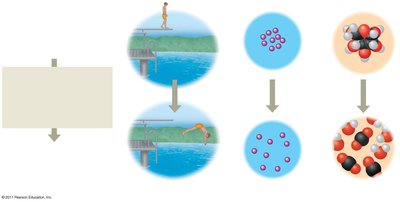
Additional info: The relationship between free energy, stability, and work capacity is central to understanding cellular energetics.
ATP: Structure and Function
ATP (adenosine triphosphate) powers cellular work by coupling energy-releasing reactions to energy-requiring ones. The hydrolysis of ATP releases energy by breaking the terminal phosphate bond.
Structure of ATP: Consists of adenine (a nitrogenous base), ribose (a sugar), and three phosphate groups.
ATP Hydrolysis: ; ΔG is negative (exergonic).
Phosphorylation: Transfer of a phosphate group from ATP to another molecule, making it less stable and more reactive.
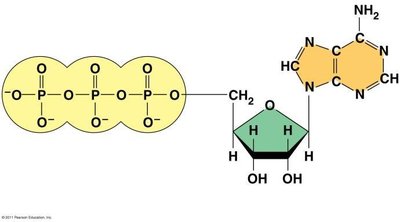
Additional info: ATP regeneration is vital; cells recycle ATP rapidly to meet energy demands.
Enzymes and Activation Energy
Enzymes are biological catalysts that speed up metabolic reactions by lowering the activation energy (EA) required for a reaction to proceed. They are highly specific due to their unique protein structure and active site.
Catalyst: A substance that increases the rate of a reaction without being consumed.
Activation Energy (EA): The energy barrier that must be overcome for a reaction to occur.
Enzyme Specificity: Determined by the shape and charge of the active site.
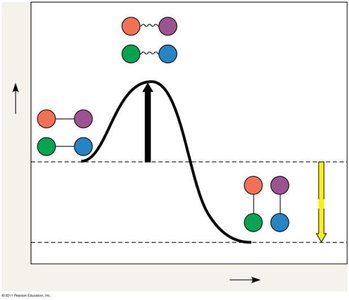
Additional info: Enzymes do not affect ΔG; they only lower EA, making reactions faster.
Mechanisms of Enzyme Action
Enzymes use several mechanisms to lower activation energy, including orienting substrates, straining substrate bonds, providing a favorable microenvironment, and covalently bonding to substrates.
Substrate: The reactant on which an enzyme acts.
Active Site: The region of the enzyme where substrate binding and catalysis occur.
Product: The final molecule(s) produced by the enzyme-catalyzed reaction.
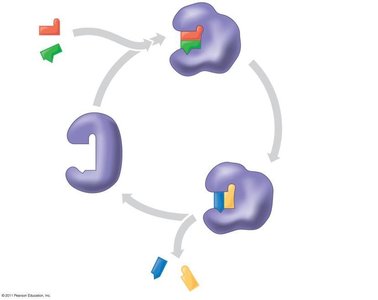
Additional info: Protein structure is crucial for enzyme specificity; changes in pH or temperature can denature enzymes.
Factors Affecting Enzyme Activity
Enzyme activity is influenced by substrate concentration, pH, temperature, and the presence of inhibitors.
Competitive Inhibitors: Bind to the active site, blocking substrate access.
Noncompetitive Inhibitors: Bind elsewhere, changing enzyme shape and reducing activity.
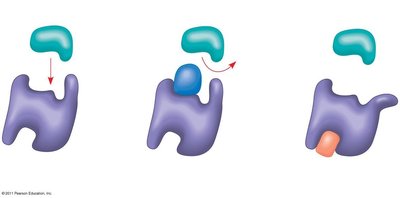
Additional info: Enzyme regulation is essential for controlling metabolic pathways and maintaining homeostasis.
Cellular Respiration and Fermentation
Overview of Cellular Respiration
Cellular respiration is a catabolic pathway that breaks down glucose to produce ATP. It involves glycolysis, pyruvate oxidation, the citric acid cycle, and oxidative phosphorylation.
Summary Equation:
Glycolysis: Occurs in the cytosol; splits glucose into two pyruvate molecules.
Citric Acid Cycle: Completes glucose oxidation; occurs in the mitochondria.
Oxidative Phosphorylation: Uses electron transport chain and chemiosmosis to generate ATP.

Additional info: Both cellular respiration and photosynthesis are redox reactions, involving electron transfer.
Redox Reactions in Cellular Respiration
Redox reactions involve the transfer of electrons. Oxidation is the loss of electrons, while reduction is the gain of electrons. Electron carriers like NAD+ and FAD are essential for transferring electrons during cellular respiration.
Oxidation: Loss of electrons; molecule becomes more positive.
Reduction: Gain of electrons; molecule becomes more negative.
NAD+: Electron carrier; reduced to NADH by dehydrogenase enzymes.
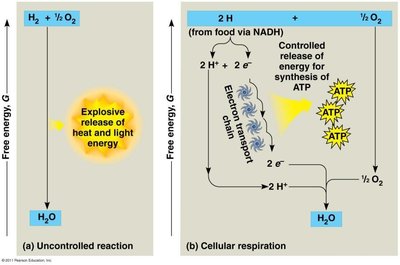
Additional info: NADH holds higher potential energy than NAD+.
Glycolysis: Energy Harvesting
Glycolysis is the first step in cellular respiration, occurring in the cytosol. It converts glucose into two pyruvate molecules, producing ATP and NADH.
Energy Investment Phase: Uses 2 ATP to phosphorylate glucose.
Energy Payoff Phase: Produces 4 ATP and 2 NADH.
Net Yield: 2 ATP, 2 NADH, 2 pyruvate per glucose.
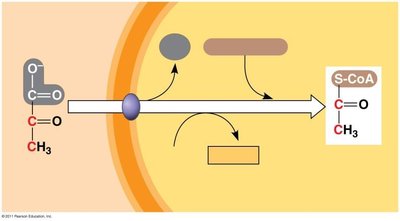
Additional info: Glycolysis does not require oxygen and is shared by all life forms.
Citric Acid Cycle and Pyruvate Oxidation
Pyruvate is transported into the mitochondria and converted to acetyl CoA, which enters the citric acid cycle. The cycle completes the oxidation of glucose, producing NADH, FADH2, ATP, and CO2.
Pyruvate Oxidation: Produces acetyl CoA, NADH, and CO2.
Citric Acid Cycle: Each turn produces 3 NADH, 1 FADH2, 1 ATP, and 2 CO2.
Location: Mitochondrial matrix.
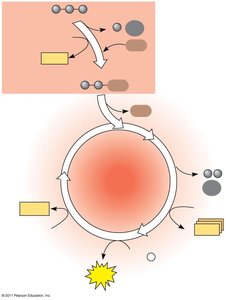
Additional info: The cycle occurs twice per glucose molecule.
Oxidative Phosphorylation and Chemiosmosis
Oxidative phosphorylation involves the electron transport chain and chemiosmosis. Electrons from NADH and FADH2 are passed through protein complexes, creating a proton gradient that drives ATP synthesis via ATP synthase.
Electron Transport Chain: Located in the inner mitochondrial membrane.
ATP Synthase: Uses the flow of H+ ions to produce ATP.
Oxygen: Final electron acceptor, forming water.
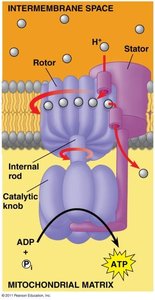
Additional info: Most ATP is produced during oxidative phosphorylation.
Fermentation
Fermentation allows cells to produce ATP without oxygen. It regenerates NAD+ by transferring electrons to organic molecules, enabling glycolysis to continue.
Alcohol Fermentation: Converts glucose to ethanol, recycling NAD+.
Lactic Acid Fermentation: Converts glucose to lactate, recycling NAD+.
Additional info: Fermentation is less efficient than cellular respiration but is essential in anaerobic conditions.
Photosynthesis Overview
Photosynthesis: Energy Capture and Storage
Photosynthesis is the process by which photoautotrophs convert solar energy into chemical energy, producing glucose and oxygen. It consists of light reactions and the Calvin cycle.
Summary Equation:
Light Reactions: Occur in the thylakoid membranes; produce ATP, NADPH, and O2.
Calvin Cycle: Occurs in the stroma; uses ATP and NADPH to fix CO2 and produce G3P.
Additional info: Both plants and other photosynthetic organisms undergo cellular respiration and photosynthesis.
