 Indietro
Cellular Energy Harvesting, DNA Replication, Gene Expression, and Genetic Modification: Study Guide for General Biology
Guida di studio - Note intelligenti
 Appunti personalizzati basati sui tuoi materiali, ampliati con definizioni chiave, esempi e contesto.
Cellular Energy Harvesting
Anaerobic Energy Harvesting
Cells harvest energy from organic molecules in anaerobic conditions (low or no oxygen) primarily through glycolysis and fermentation. Glycolysis occurs in the cytosol and produces ATP by substrate-level phosphorylation. Fermentation regenerates NAD+ to allow glycolysis to continue.
Glycolysis: Glucose is broken into 2 pyruvate, yielding 2 net ATP and 2 NADH.
Fermentation: Regenerates NAD+ by transferring electrons from NADH to organic molecules. Types include lactic acid fermentation (pyruvate → lactate) and alcohol fermentation (pyruvate → acetaldehyde → ethanol + CO2).
Anaerobic Respiration: Some microbes use electron transport chains with alternative final electron acceptors (e.g., nitrate, sulfate).
Products: Glycolysis produces 2 pyruvate, 2 ATP, 2 NADH. Fermentation produces either lactate or ethanol + CO2, and regenerates NAD+.
Reactant Recovery: NAD+ is recycled via fermentation, allowing glycolysis to continue.
Energy Storage: Energy is stored as ATP, NADH, FADH2, and in larger molecules like glycogen, starch, and fats.
Aerobic Energy Harvesting
In aerobic conditions, cells perform cellular respiration using oxygen as the final electron acceptor, resulting in greater ATP yield.
Glycolysis: Glucose → 2 pyruvate (cytosol), small ATP yield.
Pyruvate Oxidation: Pyruvate → acetyl-CoA + CO2 (mitochondrial matrix).
Krebs/Citric Acid Cycle: Acetyl-CoA → CO2, NADH, FADH2, ATP (matrix).
Electron Transport Chain & Chemiosmosis: NADH/FADH2 donate electrons, H+ gradient powers ATP synthase, O2 becomes water (inner mitochondrial membrane).
Products: ATP, CO2, H2O. Most ATP is produced during oxidative phosphorylation.
Energy Storage: ATP (phosphoanhydride bonds), NADH/FADH2 (high-energy electrons), H+ gradient.
Key Stage: Oxidative phosphorylation harvests the most energy; oxygen acts as the final electron acceptor, forming water.
Organelle Responsible & Evolutionary History
Mitochondrion: Responsible for aerobic respiration in eukaryotes.
Endosymbiotic Theory: Mitochondria evolved from engulfed aerobic bacteria; evidence includes circular DNA, bacterial ribosomes, binary fission, double membrane.
Photosynthesis in Photoautotrophs
Process Overview
Photoautotrophs synthesize organic molecules via photosynthesis, using sunlight to convert CO2 and H2O into sugars.
Light-dependent Reactions: Occur in thylakoid membranes; produce ATP, NADPH, release O2.
Calvin Cycle: Occurs in stroma; uses ATP/NADPH to fix CO2 into G3P (precursor to glucose).
Organisms: Plants, algae, cyanobacteria.
Organelle: Chloroplast (contains chlorophyll, site of photosynthesis).
Evolutionary History: Chloroplasts evolved via endosymbiosis of photosynthetic bacteria; evidence includes circular DNA, bacterial ribosomes, binary fission, double membrane.
Photosynthesis Reactants & Products
Reactants: H2O (light reactions), CO2 (Calvin cycle), NADP+, ADP + Pi.
Products: ATP, NADPH, O2 (light reactions); G3P, glucose (Calvin cycle).
Ultimate Energy Source: Sunlight.
Pigments: Chlorophyll a, chlorophyll b, carotenoids (absorb blue-violet and red light).
Cell Division and DNA Replication
Asexual Reproduction: Mitosis
Mitosis allows eukaryotic cells to reproduce asexually, producing two genetically identical daughter cells. Regulation is crucial to prevent uncontrolled growth (cancer) or insufficient division (impaired growth/repair).
Regulation: Cyclins, CDKs, checkpoints ensure proper timing and DNA integrity.
DNA Copying: Semi-conservative replication ensures each daughter cell receives a full genome.
DNA Replication Mechanism
DNA replication is a highly regulated process involving several key enzymes:
Helicase: Unwinds and unzips the DNA double helix.
DNA Polymerase: Synthesizes new DNA strands (reads 3'→5', builds 5'→3').
DNA Ligase: Joins Okazaki fragments on the lagging strand.
Okazaki fragments form because DNA polymerase can only synthesize in the 5'→3' direction, requiring discontinuous synthesis on the lagging strand.
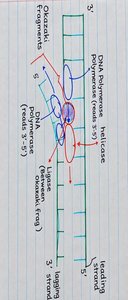
Outcome: Two identical daughter cells, each with a complete genome.
Sexual Reproduction: Meiosis
Meiosis produces four haploid gametes, each with one set of chromosomes and unique genetic combinations due to crossing over, independent assortment, and random fertilization.
Homologous Chromosomes: Pairs with same genes at same loci, one from each parent.
Genetic Diversity: Crossing over, independent assortment, random fertilization.
Gene Expression and Regulation
Transcription and Translation
Gene expression involves transcribing DNA into mRNA and translating mRNA into protein. Transcription occurs in the nucleus (eukaryotes) or cytoplasm (prokaryotes); translation occurs in the cytoplasm on ribosomes.
Transcription: RNA polymerase binds to promoter, reads template strand, synthesizes mRNA.
Translation: Ribosome reads mRNA codons, tRNA delivers amino acids, protein is synthesized.
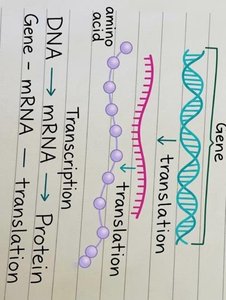
Enzymes: RNA polymerase (transcription), helicase, DNA polymerase, DNA ligase (replication).
Gene Regulation
Gene regulation is essential for cell specialization, energy conservation, and environmental response.
Prokaryotes: Operons (promoter, operator, genes) regulate transcription.
Eukaryotes: DNA accessibility (chromatin packing), transcription factors, alternative splicing.
These mechanisms control which proteins are produced and when.
Inheritance and Genetic Variation
Genotype, Phenotype, and Alleles
Genotype: Genetic makeup (DNA instructions). Phenotype: Observable traits (result of genotype and environment).
Allele: Variant of a gene; inherited from each parent.
Dominance: Complete dominance (dominant allele masks recessive), incomplete dominance (traits blend), codominance (both traits expressed).
Heterozygous: Two different alleles (Bb). Homozygous: Two identical alleles (BB or bb).
Population Genetics and Evolution
A population is evolving if allele frequencies change across generations. Hardy-Weinberg equilibrium provides expected genotype frequencies:
Equation:
Homozygous dominant:
Homozygous recessive:
Heterozygotes:
Genetic Modification and Gene Therapy
Genetically Modified and Transgenic Organisms
GMO: Organism with altered genetic material via biotechnology. Transgenic: GMO with DNA from another species.
Examples: Bt corn, Golden Rice, oil-eating bacteria, insulin-producing bacteria, genetically modified salmon.
Benefits: Increased crop yield, improved nutrition, environmental protection, medical advances.
Drawbacks: Environmental harm, health concerns, loss of biodiversity, ethical issues.
Gene Therapy
Gene therapy modifies DNA to treat genetic disorders. Benefits include treating root causes and improving quality of life; drawbacks include technical challenges, unintended effects, and ethical concerns.
Alternatives: Genetic testing, fetal testing, newborn screening, supportive treatments.
Summary: Modern biology integrates cellular energy harvesting, DNA replication, gene expression, inheritance, and genetic modification to explain how life functions, adapts, and evolves.
