 Indietro
MODULE 4 - CELLULAR MEMBRANES
Guida di studio - Note intelligenti
 Appunti personalizzati basati sui tuoi materiali, ampliati con definizioni chiave, esempi e contesto.
Cellular Membrane Structure & Physiology
Phospholipid Structure and Arrangement
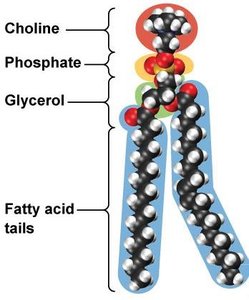
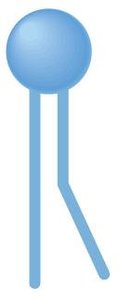
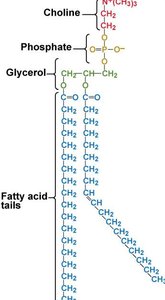
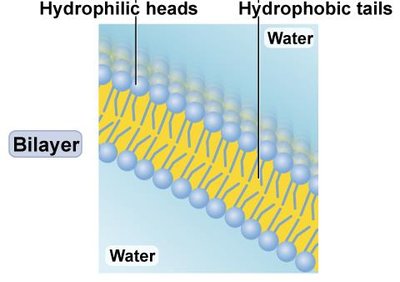
The cell membrane is primarily composed of phospholipids, which form a bilayer that acts as a barrier between the cell's internal and external environments. Each phospholipid molecule consists of a hydrophilic (water-loving) head and two hydrophobic (water-fearing) fatty acid tails. This amphipathic nature drives the self-assembly of the bilayer in aqueous environments.
Hydrophilic head: Contains a polar or charged group, phosphate, and glycerol.
Hydrophobic tails: Comprised of long hydrocarbon chains (fatty acids).
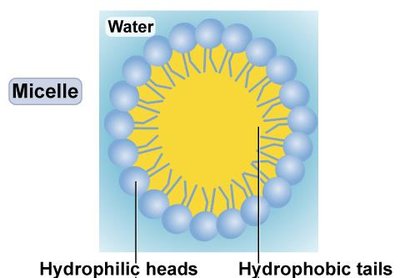
Bilayer formation: Hydrophilic heads face outward toward water, while hydrophobic tails face inward, away from water.
Phospholipid Arrangements in Water
Phospholipids can organize into different structures depending on their environment:
Micelles: Spherical structures with hydrophilic heads facing outward and hydrophobic tails inward.
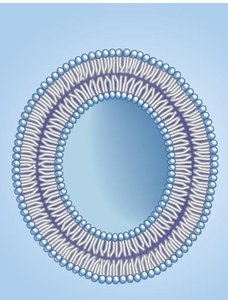
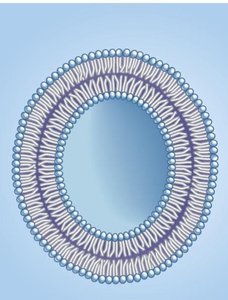
Liposomes: Double-layered vesicles with an aqueous core, mimicking cell membranes.
Fluid Mosaic Model of Membrane Structure
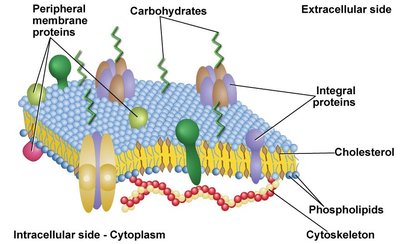
The cell membrane is described by the fluid mosaic model, which highlights its dynamic nature and diverse components. The membrane is a mosaic of proteins, lipids, and carbohydrates, all capable of lateral movement within the bilayer.
Integral proteins: Span the membrane and facilitate transport.
Peripheral proteins: Attach to the membrane surface.
Carbohydrates: Often attached to proteins or lipids, important for cell recognition.
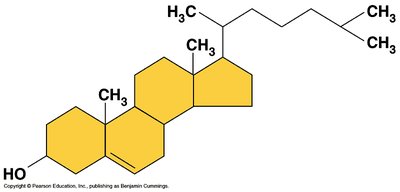
Cholesterol: Interspersed among phospholipids, modulates fluidity.
Membrane Fluidity and Permeability
Saturated vs. Unsaturated Fatty Acids
The degree of saturation in phospholipid tails affects membrane fluidity and permeability:
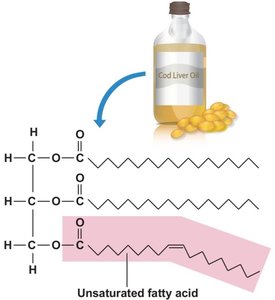
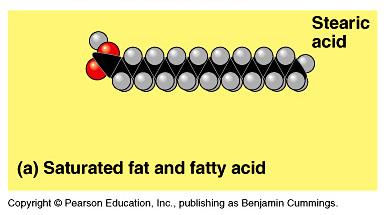
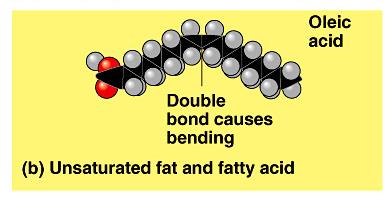
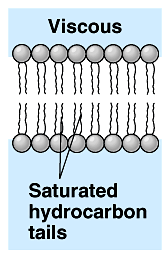
Saturated fatty acids: No double bonds, straight chains, pack tightly, resulting in less fluid, less permeable membranes.
Unsaturated fatty acids: Contain double bonds, causing kinks, prevent tight packing, resulting in more fluid, more permeable membranes.


Role of Temperature and Cholesterol
Temperature and cholesterol content further influence membrane properties:
Increasing temperature: Increases membrane fluidity and permeability.
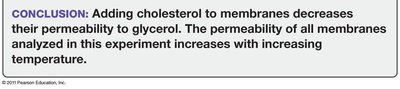
Cholesterol: Acts as a buffer, stabilizing membrane fluidity across temperature changes. At high temperatures, cholesterol reduces fluidity; at low temperatures, it prevents the membrane from becoming too rigid.
Membrane Transport
Types of Membrane Permeability
Cell membranes are selectively permeable, allowing certain molecules to pass while restricting others. The permeability depends on molecule size, polarity, and charge.
Freely permeable: Small, nonpolar molecules (e.g., O2, CO2, N2).
Semi-permeable: Small, uncharged polar molecules (e.g., H2O, glycerol).
Impermeable: Ions and large, uncharged polar molecules (e.g., glucose, sucrose, Cl-, K+, Na+).
Diffusion and Brownian Motion
Diffusion is the passive movement of molecules from areas of high concentration to low concentration, driven by Brownian motion. This process continues until equilibrium is reached.
Brownian motion: Random movement of particles suspended in a fluid.
Diffusion: Movement along a concentration gradient.
Equilibrium: Equal concentration on both sides; net movement stops, but random movement persists.
Osmosis and Tonicity
Osmosis is the diffusion of water across a selectively permeable membrane. Tonicity describes the relative solute concentration of two solutions separated by a membrane.
Hypertonic: Higher solute concentration outside the cell; water flows out, cell shrinks.
Hypotonic: Lower solute concentration outside the cell; water flows in, cell swells or bursts.
Isotonic: Equal solute concentration; no net water movement.
Facilitated Diffusion
Facilitated diffusion uses integral membrane proteins (channels or carriers) to transport molecules that cannot diffuse directly through the lipid bilayer. This process does not require energy and moves substances down their concentration gradient.
Channel proteins: Provide passageways for specific molecules.
Gated channels: Open or close in response to signals.
Active Transport
Active transport moves molecules against their concentration gradient using energy, typically from ATP. This process is essential for maintaining cellular homeostasis.
Pumps: Proteins such as Na+/K+ ATPase actively transport ions.
Co-transport: Uses the gradient established by one pump to drive the transport of another molecule (e.g., proton-sucrose co-transport).
Summary Table: Membrane Transport Mechanisms
Transport Type | Energy Required | Direction | Example |
|---|---|---|---|
Simple Diffusion | No | Down gradient | O2, CO2 |
Facilitated Diffusion | No | Down gradient | Glucose via channel protein |
Active Transport | Yes (ATP) | Against gradient | Na+/K+ pump |
Key Equations
Diffusion Rate (Fick's Law)
The rate of diffusion across a membrane can be described by Fick's Law:
J: Flux (rate of diffusion)
D: Diffusion coefficient
\frac{dC}{dx}: Concentration gradient
Osmosis
Osmotic pressure can be calculated using:
\Pi: Osmotic pressure
i: van 't Hoff factor (number of particles)
M: Molarity
R: Gas constant
T: Temperature (Kelvin)
Study Strategies
Review learning objectives and self-assess understanding.
Practice with clicker questions and quizzes.
Seek help from instructors or teaching assistants as needed.
Additional info: Academic context was added to clarify the structure and function of membrane components, transport mechanisms, and the impact of lipid composition and cholesterol on membrane properties.
