 Indietro
Cellular Metabolism, Enzyme Function, and Photosynthesis: Study Guide
Guida di studio - Note intelligenti
 Appunti personalizzati basati sui tuoi materiali, ampliati con definizioni chiave, esempi e contesto.
Cellular Metabolism and Energy
Kinetic Energy
Kinetic energy is the energy associated with motion. In biological systems, moving objects such as molecules perform work by imparting motion to matter, which is essential for cellular processes.
Kinetic energy: Energy of moving objects.
Example: Movement of molecules during diffusion.
Efficiency of Energy Transformations
Energy transformations in cells are not 100% efficient. During metabolic processes, only about 30–40% of the energy from fuel molecules (like glucose) is captured in usable forms such as ATP; the rest is lost as heat.
Efficiency: Most energy is dissipated as heat.
Example: Cellular respiration releases heat.
ATP Structure and Function
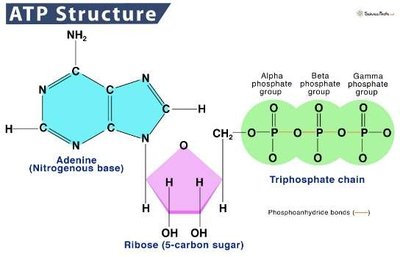
ATP (adenosine triphosphate) is the primary energy carrier in cells. It consists of adenine (a nitrogenous base), ribose (a 5-carbon sugar), and three phosphate groups. ATP stores energy in its phosphate bonds, which is released during hydrolysis to power cellular activities.
Structure: Adenine, ribose, and three phosphate groups.
Function: Energy storage and transfer.
Catabolic and Anabolic Reactions
Metabolic reactions are classified as catabolic or anabolic. Catabolic reactions break down complex molecules, releasing energy (e.g., cellular respiration). Anabolic reactions build complex molecules from simpler ones, requiring energy (e.g., photosynthesis).
Catabolic: "Downhill" reactions; energy released.
Anabolic: "Uphill" reactions; energy required.
Example: Cellular respiration (catabolic), photosynthesis (anabolic).
Enzyme Function and Regulation
Enzyme Catalysis
Enzymes are biological catalysts that speed up reactions by lowering the activation energy (EA) barrier. This enables reactant molecules to reach the transition state at moderate temperatures.
Activation energy: Minimum energy required for a reaction.
Enzyme action: Lowers activation energy.
Competitive and Noncompetitive Inhibition
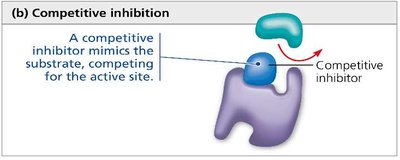
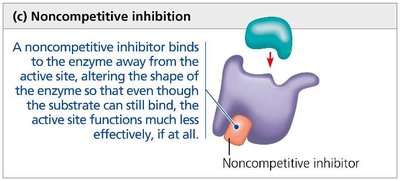
Enzyme activity can be regulated by inhibitors. Competitive inhibitors mimic the substrate and compete for the active site, reducing enzyme productivity. Noncompetitive inhibitors bind elsewhere, changing the enzyme's shape and reducing its effectiveness.
Competitive inhibition: Inhibitor competes for active site.
Noncompetitive inhibition: Inhibitor binds away from active site, alters enzyme shape.
Feedback Inhibition
Feedback inhibition occurs when the end product of a metabolic pathway shuts down the pathway, preventing excess production and conserving resources. For example, cholesterol synthesis is regulated by feedback inhibition to prevent harmful accumulation.
Purpose: Prevents wasteful overproduction.
Example: Cholesterol synthesis regulation.
Energy in Chemical Reactions
Endergonic and Exergonic Reactions
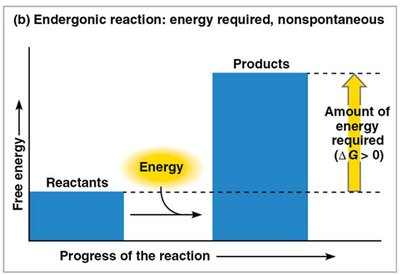
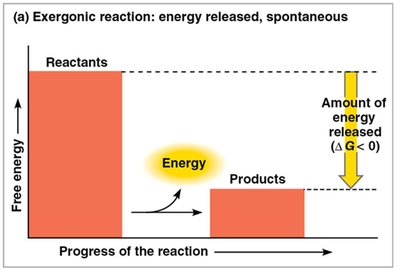
Endergonic reactions absorb free energy from the surroundings and are nonspontaneous (ΔG > 0). Exergonic reactions release free energy and are spontaneous (ΔG < 0).
Endergonic: Energy required; products have more free energy than reactants.
Exergonic: Energy released; products have less free energy than reactants.
Activation Energy on Reaction Graphs
On reaction graphs, activation energy is the energy barrier between reactants and products. It is shown as the peak between the starting and ending points.
Cellular Respiration
Overview and Reaction
Cellular respiration is a catabolic process that occurs in the mitochondria. The overall reaction is:
Equation:
Type: Catabolic
Location: Mitochondria
Redox Reactions
Redox reactions involve the transfer of electrons. Oxidation is the loss of electrons, and reduction is the gain of electrons. These reactions are central to cellular respiration.
Oxidation: Loss of electrons.
Reduction: Gain of electrons.
Glycolysis
Glycolysis occurs in the cytoplasm and consists of two phases: energy investment and energy payoff. It produces a net gain of 2 ATP, 2 NADH, and 2 pyruvate molecules.
Location: Cytoplasm
ATP produced: Net 2 ATP
Key steps: Glucose split, ATP used and produced, NADH formed.
Krebs Cycle (Citric Acid Cycle)
The Krebs cycle occurs in the mitochondrial matrix. Each turn generates 1 ATP, NADH, and FADH2, and releases CO2 as a waste product. The cycle runs twice per glucose molecule.
Location: Mitochondrial matrix
ATP produced: 2 ATP per glucose
Electron carriers: NADH and FADH2
Electron Transport Chain (ETC)
The ETC occurs in the inner mitochondrial membrane. Electrons from NADH and FADH2 are passed through protein complexes, creating a proton gradient. ATP synthase uses this gradient to produce ATP. Oxygen is the final electron acceptor.
Location: Inner mitochondrial membrane
ATP produced: About 26–28 ATP
Final electron acceptor: Oxygen
Fermentation
When oxygen is unavailable, cells undergo fermentation. Lactic acid fermentation converts pyruvate to lactic acid. Alcoholic fermentation converts pyruvate to ethanol and CO2.
Lactic acid fermentation: Pyruvate → lactic acid
Alcoholic fermentation: Pyruvate → acetaldehyde → ethanol + CO2
Photosynthesis
Overview and Reaction
Photosynthesis is an anabolic process that occurs in the chloroplast. The overall reaction is:
Equation:
Type: Anabolic
Location: Chloroplast (thylakoid membranes and stroma)
Gas Exchange in Leaves
Gases move in and out of leaves through stomata, which are surrounded by guard cells. Stomata allow CO2 intake, O2 release, and water vapor loss.
Stomata: Tiny openings for gas exchange.
Guard cells: Regulate opening and closing.
Photosynthetic Pigments
Photosynthetic pigments such as chlorophyll a, chlorophyll b, and carotenoids are located in the thylakoid membranes. These pigments absorb light energy for photosynthesis.
Location: Thylakoid membranes
Function: Capture light energy
Light-Dependent Reactions
Light-dependent reactions occur in the thylakoid membranes. Light energy excites electrons, water is split, ATP and NADPH are produced, and oxygen is released.
Products: ATP, NADPH, O2
Light-Independent Reactions (Calvin Cycle)
These reactions occur in the stroma and use ATP and NADPH to build glucose from CO2. They do not require light directly.
Main goal: Synthesize glucose
Inputs: ATP, NADPH, CO2
Electron Flow in Photosynthesis
Electrons flow through photosystems in the thylakoid membranes, powering the production of ATP and NADPH for the Calvin cycle.
Colors Used in Photosynthesis
Photosynthesis primarily uses red and blue light, as chlorophyll absorbs these wavelengths. Green light is reflected, which is why plants appear green.
Absorbed: Red and blue
Reflected: Green
Additional info: Academic context was added to clarify enzyme inhibition, feedback inhibition, and the details of cellular respiration and photosynthesis steps.
