 Indietro
Cellular Organization: Integration of Structure and Function
Guida di studio - Note intelligenti
 Appunti personalizzati basati sui tuoi materiali, ampliati con definizioni chiave, esempi e contesto.
Cell Components and Their Integration
Overview: The Cell as a Coordinated Unit
The cell is a highly organized structure where various organelles and molecular machines work together to sustain life. The integration of cellular components enables complex functions, such as movement, energy production, and defense against pathogens. Understanding how these parts interact is essential for grasping the fundamentals of cell biology.
Cellular Order: The cell's architecture is designed to maximize efficiency and coordination among its parts.
Structure-Function Relationship: Each organelle's structure is closely related to its specific function within the cell.
Integration: Cellular processes are interconnected, with products and signals moving between organelles.
Tour of Animal and Plant Cells
Animal and plant cells contain specialized organelles that perform distinct functions. The compartmentalization within cells allows for the separation and regulation of biochemical processes.
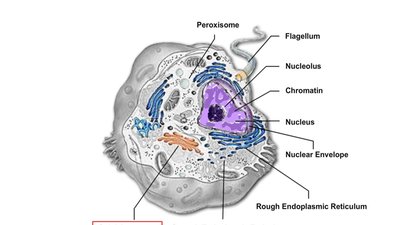
Animal Cell: Contains organelles such as the nucleus, mitochondria, lysosomes, and cytoskeleton.
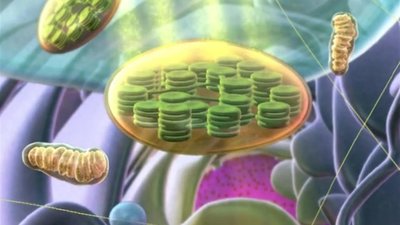
Plant Cell: Contains unique structures like chloroplasts and a central vacuole, in addition to common organelles.
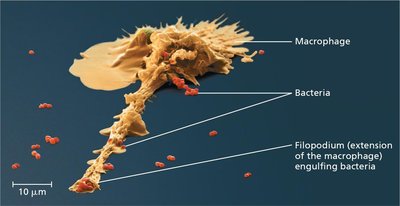
Example: The macrophage, an animal cell, uses its cytoskeleton and lysosomes to engulf and destroy bacteria.
Coordination of Cellular Activities
Cellular functions depend on the coordination between organelles and molecular components. For example, the destruction of bacteria by a macrophage involves the cytoskeleton, lysosomes, ribosomes, and mitochondria.
Cytoskeleton: Provides structural support and enables movement through actin filaments and microtubules.
Lysosomes: Contain digestive enzymes that break down engulfed particles.
Ribosomes: Synthesize proteins required for cellular functions.
Mitochondria: Supply energy in the form of ATP for cellular processes.
Nucleus: Directs protein synthesis through genetic instructions.
Visualizing the Scale and Organization of Cellular Machinery
Relative Sizes and Organization of Cellular Components
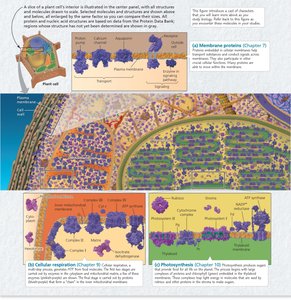
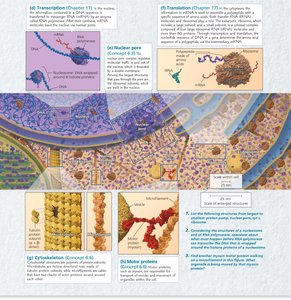
Cellular components range from large organelles to small molecules. Visualizing their scale helps understand their interactions and spatial relationships within the cell.
Organelles: Structures such as the nucleus, mitochondria, and chloroplasts are visible under a microscope.
Molecular Machinery: Includes proteins, enzymes, and complexes involved in processes like transcription, translation, and energy production.
Example: ATP synthase is oriented differently in cellular respiration (mitochondria) and photosynthesis (chloroplasts).
Integration of Cellular Processes
Cellular processes such as enzyme production, energy conversion, and genetic regulation require the interaction of multiple organelles and molecular machines.
Enzyme Production: Involves transcription in the nucleus, translation by ribosomes, and transport via the endomembrane system.
Energy Conversion: Mitochondria and chloroplasts convert energy through cellular respiration and photosynthesis, respectively.
Genetic Regulation: Nuclear pores allow the exchange of genetic material and regulatory molecules between the nucleus and cytoplasm.
Concept Check: Integration in Unicellular Protists
Example: Colpidium colpoda
Colpidium colpoda is a unicellular protist that demonstrates the integration of cellular structures for movement, feeding, and energy production.
Cilia: Enable movement and help capture bacteria.
Food Vacuoles: Digest engulfed bacteria.
Nucleus: Controls cellular activities and protein synthesis.
Mitochondria: Provide energy for movement and digestion.
Endomembrane System: Facilitates transport and processing of molecules.
Summary Table: Major Cell Organelles and Their Functions
Organelle | Main Function | Example Process |
|---|---|---|
Nucleus | Genetic information storage and regulation | Transcription of DNA to RNA |
Ribosome | Protein synthesis | Translation of mRNA |
Mitochondria | ATP production | Cellular respiration |
Chloroplast | Photosynthesis | Conversion of light energy to chemical energy |
Lysosome | Digestion of macromolecules | Breakdown of engulfed bacteria |
Cytoskeleton | Structural support and movement | Formation of filopodia |
Key Equations
ATP Production in Cellular Respiration
The overall equation for cellular respiration is:
Photosynthesis Equation
The overall equation for photosynthesis is:
Conclusion
The cell is a dynamic and integrated unit, with each component contributing to the overall function. Understanding the interplay between organelles and molecular machines is fundamental to studying biology at the cellular level.
Additional info: Academic context was added to clarify the integration of cell components and provide examples relevant to General Biology.
