 Indietro
Cellular Reproduction and DNA Structure: Study Notes for General Biology
Guida di studio - Note intelligenti
 Appunti personalizzati basati sui tuoi materiali, ampliati con definizioni chiave, esempi e contesto.
Cellular Reproduction
Overview of Cellular Reproduction
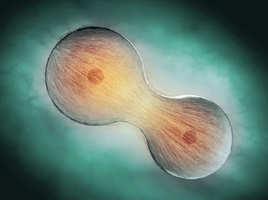
Cellular reproduction is the process by which cells divide to produce new cells, essential for growth, repair, and maintenance in living organisms. This process ensures genetic continuity and is fundamental to all life forms.
Cell Division: The process by which a parent cell divides into two daughter cells.
Types: Includes mitosis (for somatic cells) and meiosis (for gametes).
Importance: Enables organismal growth, tissue repair, and reproduction.
Genetic Material: DNA is replicated and distributed to daughter cells during division.
Structure of DNA
Nucleic Acids
Nucleic acids are macromolecules that store genetic information and direct protein synthesis. They are essential for cellular function and heredity.
Types: DNA (Deoxyribonucleic acid) and RNA (Ribonucleic acid).
Function: DNA stores genetic instructions; RNA carries out these instructions.
Proteins: Synthesized based on instructions from nucleic acids; perform most cellular activities.
Building Blocks of DNA: Nucleotides
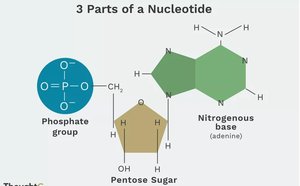
Nucleotides are the monomers of nucleic acids, forming the backbone and functional units of DNA and RNA.
Three Parts:
Phosphate group (PO4)
Pentose sugar: Deoxyribose (DNA) or Ribose (RNA)
Nitrogenous base: Adenine (A), Thymine (T), Cytosine (C), Guanine (G), Uracil (U)
Polymerization: Nucleotides link via phosphodiester bonds to form nucleic acid chains.
Types of Nucleotides: Purines and Pyrimidines
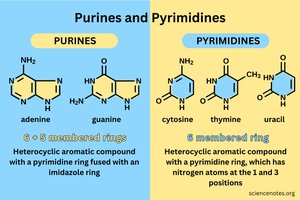
Nitrogenous bases are classified into two groups based on their structure.
Purines: Double-ring structure; includes Adenine (A) and Guanine (G).
Pyrimidines: Single-ring structure; includes Cytosine (C), Thymine (T) (DNA only), and Uracil (U) (RNA only).
History of DNA Structure Discovery
The discovery of DNA's structure was a pivotal moment in biology, involving several key scientists.
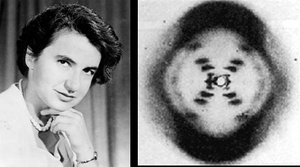
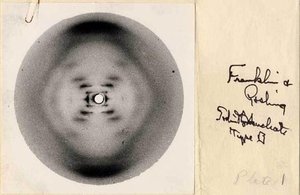
Rosalind Franklin: Used X-ray diffraction to photograph DNA crystals, revealing its helical structure.
Watson and Crick: Built the first model of DNA, proposing the double helix structure based on Franklin's data.
Double Helix: DNA consists of two nucleotide chains twisted into a helix.
DNA Structure
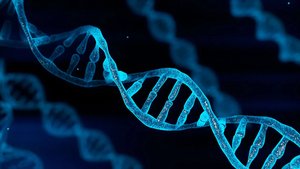
DNA is a double-stranded molecule with a unique structure that allows it to store and transmit genetic information.
Double Helix: Two strands twisted together, resembling a ladder.
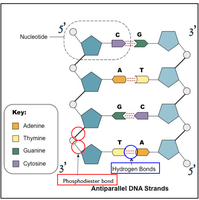
Antiparallel: Strands run in opposite directions (5' to 3' and 3' to 5').
Sugar-Phosphate Backbone: Sides of the ladder formed by alternating sugars and phosphates, connected by phosphodiester bonds.
Base Pairs: Rungs of the ladder formed by nitrogenous bases paired via hydrogen bonds.
Base Pairing and Chargaff's Rule
Base pairing is fundamental to DNA's structure and function, governed by specific rules.
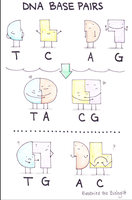
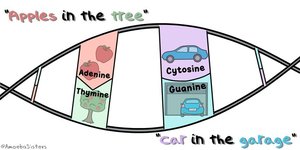
Base Pairing: Adenine (A) pairs with Thymine (T) via 2 hydrogen bonds; Guanine (G) pairs with Cytosine (C) via 3 hydrogen bonds.
Chargaff's Rule: In any DNA strand, %A = %T and %G = %C.
Complementarity: Nitrogenous bases can only bond to their specific complementary base.
RNA Structure and Function
RNA: Ribonucleic Acid
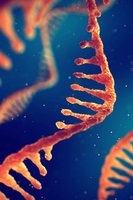
RNA is a nucleic acid that plays a crucial role in translating genetic instructions from DNA into proteins.
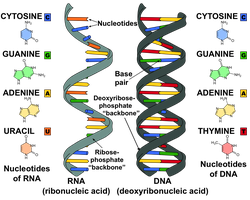
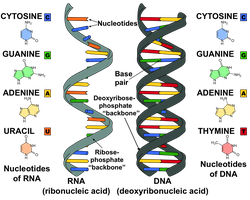
Sugar: Ribose instead of deoxyribose.
Structure: Single-stranded, not a double helix.
Bases: Uracil (U) replaces Thymine (T); Uracil pairs with Adenine (A).
Function: Carries genetic instructions from DNA out of the nucleus for protein synthesis.
Chromosomes and Chromatin
Chromosomes
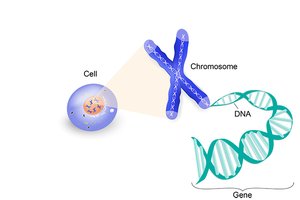
Chromosomes are condensed structures of DNA that ensure accurate distribution of genetic material during cell division.
Structure: Long, tightly coiled strands of DNA.
Gene: A segment of DNA that codes for a specific protein.
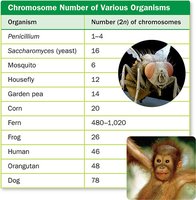
Variation: Different organisms have different numbers of chromosomes.
Chromosome Number in Various Organisms
The number of chromosomes varies widely among species and does not correlate with organismal complexity.
Organism | Number (2n) of Chromosomes |
|---|---|
Penicillium | 1–4 |
Saccharomyces (yeast) | 16 |
Mosquito | 6 |
Housefly | 12 |
Garden pea | 14 |
Corn | 20 |
Fern | 480–1,020 |
Frog | 26 |
Human | 46 |
Orangutan | 48 |
Dog | 78 |
Chromatin
Chromatin is the relaxed form of DNA found in the nucleus when the cell is not dividing. It allows for DNA replication and repair.
Structure: DNA is loosely packed, enabling access for replication and transcription.
Cell Division: Chromatin condenses into chromosomes during cell division for efficient segregation.
Parts of a Eukaryotic Chromosome
Eukaryotic chromosomes have specialized regions that play key roles during cell division.
Centromere: Central region where spindle fibers attach; contains repeating sequences.
Telomeres: Repetitive sequences at chromosome ends; protect genetic information and shorten with each division.
Additional Resources
Journey into Human DNA Interactive: PBS Nova
What is DNA? (YouTube): Video
DNA Structure and Replication: Crash Course (YouTube): Video
3D Replication of DNA (YouTube): Video
DNA Workshop: Interactive
Bacterial Transformation (Griffith’s experiment): Video
Oswald Avery and the identification of the transforming principle: Video
Hershey and Chase Experiment: Video
Picturing the Molecules of Life Interactive: PBS Nova
Before Watson and Crick article: Article
Franklin’s X-ray diffraction, explanation of X-ray pattern: Video
Additional info: Academic context was added to clarify the structure and function of nucleic acids, chromosomes, and chromatin, as well as to explain the historical significance of DNA structure discovery. Equations and chemical structures were referenced where appropriate for completeness.
