 Indietro
Cellular Respiration and Fermentation: A Comprehensive Study Guide
Guida di studio - Note intelligenti
 Appunti personalizzati basati sui tuoi materiali, ampliati con definizioni chiave, esempi e contesto.
Cellular Respiration and Fermentation
Overview of Cellular Respiration
Cellular respiration is a fundamental metabolic process in which cells convert energy stored in food molecules into adenosine triphosphate (ATP), the cell's primary energy currency. This process is essential for sustaining life and occurs in both prokaryotic and eukaryotic cells. - Cellular respiration transfers energy from organic molecules (such as sugars, fats, and proteins) into ATP. - Aerobic respiration uses oxygen (O2) and produces carbon dioxide (CO2) and water (H2O) as waste products. - Fermentation is an alternative pathway used when oxygen is unavailable. 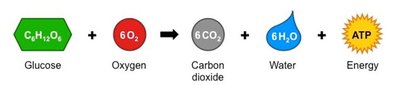
Organic Molecules as Fuels
Organic molecules, especially carbohydrates and fats, are excellent fuels because they contain many high-energy electrons, particularly in C–H bonds. Cells harvest energy stepwise by transferring electrons to carriers and eventually making ATP. - Carbohydrates and fats are rich in high-energy electrons. - Energy is harvested gradually to maximize ATP production and minimize energy loss as heat.
Stages of Cellular Respiration
Cellular respiration consists of three interconnected stages: 1. Glycolysis: Breaks glucose into two pyruvate molecules; occurs in the cytosol. 2. Pyruvate Oxidation and Citric Acid Cycle: Completes the breakdown of pyruvate; occurs in the mitochondrial matrix (eukaryotes). 3. Oxidative Phosphorylation: Uses electrons to make most of the ATP; occurs in the inner mitochondrial membrane.
Redox Reactions in Cellular Respiration
Energy transfer in cellular respiration occurs through redox reactions (reduction-oxidation). - Oxidation: Loss of electrons. - Reduction: Gain of electrons. - Electron transfer releases usable energy. - OIL RIG: Oxidation Is Loss, Reduction Is Gain.
Role of Electron Carriers
Cells use special coenzymes to move electrons safely. - NAD+ (nicotinamide adenine dinucleotide) and FAD (flavin adenine dinucleotide) are key electron carriers. - NAD+ is reduced to NADH; FAD is reduced to FADH2. - Electrons are passed gradually through carriers, releasing energy in manageable steps. 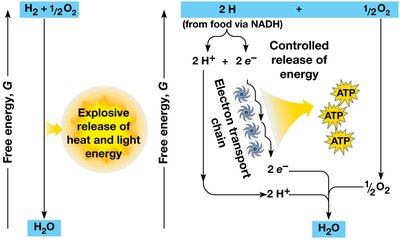
Mitochondria: The Site of Cellular Respiration
In eukaryotes, most stages of cellular respiration occur in the mitochondria. - Outer membrane: Separates mitochondrion from cytosol. - Inner membrane: Folded into cristae, providing a large surface area for electron transport and ATP synthase. - Matrix: Contains enzymes for pyruvate oxidation and the citric acid cycle. 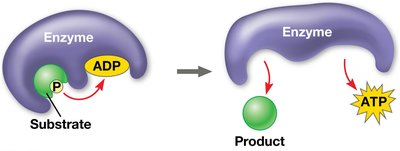
ATP Production Mechanisms
There are two main ways to produce ATP during cellular respiration: - Substrate-level phosphorylation: An enzyme directly transfers a phosphate group from a substrate to ADP, forming ATP. Occurs during glycolysis and the citric acid cycle. - Oxidative phosphorylation: Uses energy from electrons carried by NADH/FADH2. The electron transport chain pumps H+, creating a gradient that drives ATP synthase. 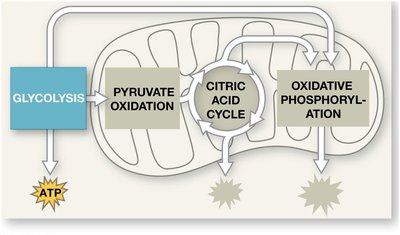
Glycolysis
Glycolysis: Sugar Splitting
Glycolysis is the first stage of cellular respiration and occurs in the cytosol of all cells. It breaks one glucose (6C) into two pyruvate molecules (3C each) and consists of two phases: - Energy investment phase: Uses ATP to phosphorylate glucose. - Energy payoff phase: Produces ATP and NADH. 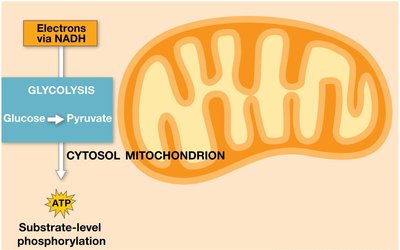
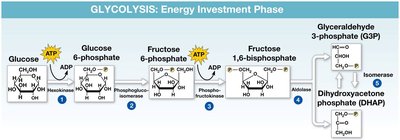
Net Products of Glycolysis (per glucose)
Glycolysis yields: - 2 Pyruvate - 2 NADH + 2 H+ - 2 H2O - Net 2 ATP (4 produced – 2 invested) 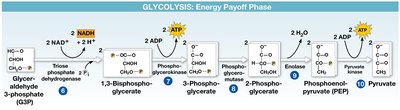
Pyruvate Oxidation
Conversion of Pyruvate to Acetyl CoA
After glycolysis, pyruvate still contains much of glucose’s energy. During aerobic respiration: - Pyruvate enters the mitochondrial matrix (eukaryotes) or remains in the cytosol (prokaryotes). - Each pyruvate (3C) is converted into acetyl CoA (2C): 1 CO2 released, 1 NADH produced, 2C fragment attaches to coenzyme A. - Per glucose: 2 NADH and 2 CO2 from pyruvate oxidation. 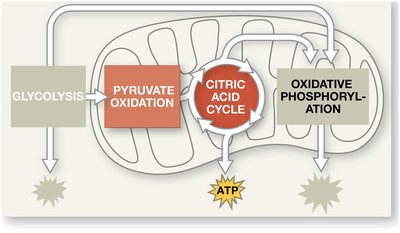
Citric Acid Cycle (Krebs Cycle)
Citric Acid Cycle Overview
The citric acid cycle completes the breakdown of glucose by oxidizing acetyl CoA. - Acetyl CoA combines with oxaloacetate (4C) to form citrate (6C). - Citrate is oxidized through enzyme-catalyzed steps, regenerating oxaloacetate. - Each turn of the cycle (1 acetyl CoA) produces: 3 NADH, 1 FADH2, 1 ATP, 2 CO2. - Since each glucose makes 2 acetyl CoA, the cycle runs twice per glucose. 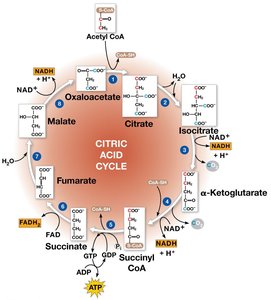
Oxidative Phosphorylation
Electron Transport Chain (ETC)
Most of glucose’s energy is stored in NADH and FADH2. Electrons from these carriers enter the ETC, which is embedded in the inner mitochondrial membrane (eukaryotes) or plasma membrane (prokaryotes). - ETC is composed of multiprotein complexes (I–IV) and mobile carriers. - Electrons are passed stepwise to oxygen, the final electron acceptor. 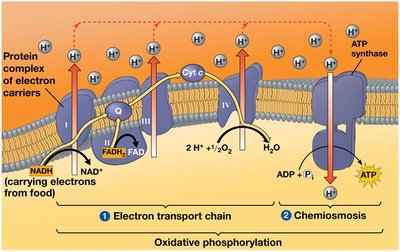
Proton-Motive Force and Chemiosmosis
- Electron transport releases energy, which is used to pump H+ across the membrane. - H+ accumulates in the intermembrane space, creating an electrochemical gradient (proton-motive force). - ATP synthase uses the energy from H+ flow to phosphorylate ADP, producing ATP. - The use of an H+ gradient to power cellular work is called chemiosmosis.
Energy Flow and ATP Yield
- Complete oxidation of one glucose typically produces about 30–32 ATP in a eukaryotic cell. - The exact yield varies because cells use some of the proton-motive force for transport and other cellular processes.
ATP Production without Oxygen
Anaerobic Respiration and Fermentation
When oxygen is unavailable, cells can produce ATP through: - Anaerobic respiration: Uses an ETC with a different final electron acceptor (e.g., sulfate). - Fermentation: No ETC; produces ATP only through substrate-level phosphorylation.
Fermentation Pathways
Fermentation is the combination of glycolysis and reactions that regenerate NAD+. Two commonly studied types: - Alcohol fermentation: Pyruvate is converted to ethanol in two steps; CO2 is released, acetaldehyde is reduced by NADH to produce ethanol. Used by yeast in brewing, winemaking, and baking. - Lactic acid fermentation: Pyruvate is directly reduced by NADH to form lactate; no CO2 is released.
Comparison of Fermentation, Anaerobic, and Aerobic Respiration
Feature | Fermentation | Anaerobic Respiration | Aerobic Respiration |
|---|---|---|---|
Electron Transport Chain | No | Yes | Yes |
Final Electron Acceptor | Organic molecule | Non-oxygen acceptor | Oxygen |
ATP Production | Substrate-level phosphorylation | Mostly oxidative phosphorylation | Mostly oxidative phosphorylation |
Relative ATP Yield | Lowest | Variable | Usually highest |
Example: Yeast cells use alcohol fermentation to produce ethanol and CO2 in bread and alcoholic beverages. Additional info: The study notes cover all major aspects of cellular respiration and fermentation, including the biochemical pathways, energy yield, and comparisons between aerobic and anaerobic processes.
