 Indietro
Chapter 9
Guida di studio - Note intelligenti
 Appunti personalizzati basati sui tuoi materiali, ampliati con definizioni chiave, esempi e contesto.
Cellular Respiration and Fermentation
An Overview of Cellular Respiration
Cellular respiration is a fundamental metabolic process that allows cells to extract energy from glucose and other organic molecules to produce ATP, the cell’s energy currency. This process is essential for maintaining cellular activities and is central to metabolism in all living organisms.
ATP Production: Cells contain only enough ATP for short-term activity and must continuously synthesize it.
Glucose Source: Plants produce glucose via photosynthesis; other organisms obtain it from food.
Storage: Glucose is stored as glycogen (animals) or starch (plants).
Oxidation of Glucose: Redox Reactions
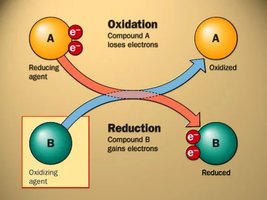
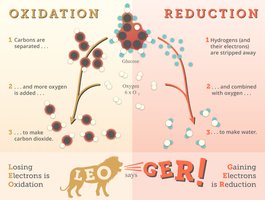
Cellular respiration involves a series of redox reactions, where glucose is oxidized and energy is released. This energy is harnessed to synthesize ATP.
Oxidation: Loss of electrons from a molecule (e.g., glucose).
Reduction: Gain of electrons by another molecule (e.g., NAD+ to NADH).
Redox Reactions: Carefully controlled to maximize energy capture.
Four Main Stages of Cellular Respiration
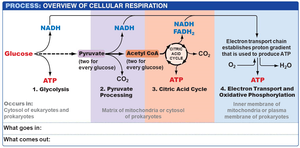
Cellular respiration is divided into four sequential processes, each with distinct inputs, outputs, and locations within the cell.
Glycolysis: Glucose (6C) is split into two pyruvate (3C) in the cytosol.
Pyruvate Processing: Pyruvate is oxidized to acetyl CoA in the mitochondrial matrix (eukaryotes) or cytosol (prokaryotes).
Citric Acid Cycle: Acetyl CoA is oxidized to CO2, generating NADH and FADH2.
Electron Transport and Oxidative Phosphorylation: Electrons from NADH and FADH2 move through the electron transport chain, creating a proton gradient used to produce ATP.
Metabolic Pathways and Regulation
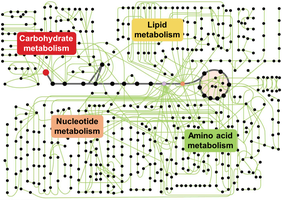
Catabolic and Anabolic Pathways
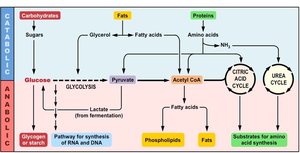
Metabolism includes both catabolic (breakdown) and anabolic (synthesis) pathways. Catabolic pathways degrade molecules to release energy, while anabolic pathways use intermediates to build macromolecules.
Catabolic: Carbohydrates, fats, and proteins can all be used for ATP production.
Anabolic: Intermediates from catabolic pathways are used to synthesize nucleotides, amino acids, and lipids.
Metabolic Regulation and Homeostasis
Metabolic pathways are organized and regulated to maintain homeostasis, ensuring a stable internal environment despite external changes.
Pathway Regulation: Feedback inhibition is a common mechanism.
Homeostasis: Allows cells to adapt to varying conditions.
Glycolysis
Steps and Regulation of Glycolysis
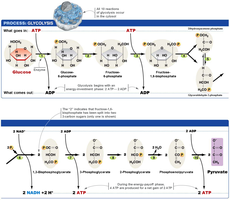
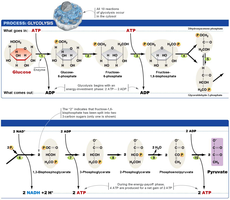
Glycolysis is a ten-step process occurring in the cytosol, where glucose is split into two pyruvate molecules. It consists of an energy investment phase and an energy payoff phase.
Energy Investment: 2 ATP are used in steps 1–5.
Energy Payoff: 4 ATP and 2 NADH are produced in steps 6–10.
Net Yield: 2 ATP, 2 NADH, and 2 pyruvate per glucose.
Regulation: High ATP levels inhibit phosphofructokinase, the third enzyme in glycolysis, via feedback inhibition.
Pyruvate Processing
Conversion to Acetyl CoA
Pyruvate produced in glycolysis is transported into the mitochondria (eukaryotes) and processed by the pyruvate dehydrogenase complex.
Location: Mitochondrial matrix (eukaryotes), cytosol (prokaryotes).
Process: One carbon is released as CO2, NADH is produced, and the remaining two-carbon unit is attached to coenzyme A, forming acetyl CoA.
Regulation: Feedback inhibition by phosphorylation of pyruvate dehydrogenase when products are abundant.
Citric Acid Cycle (Krebs Cycle)
Oxidation of Acetyl CoA
The citric acid cycle completes the oxidation of glucose by converting acetyl CoA into CO2 and capturing energy in NADH, FADH2, and ATP.
Location: Mitochondrial matrix (eukaryotes), cytosol (prokaryotes).
Products per glucose: 6 NADH, 2 FADH2, 2 ATP (or GTP), 4 CO2.
Regulation: Multiple points of feedback inhibition, especially by ATP and NADH.
Electron Transport Chain and Oxidative Phosphorylation
Electron Transport Chain (ETC)
The ETC consists of four protein complexes and other molecules that transfer electrons from NADH and FADH2 to oxygen, forming water. The energy released is used to pump protons across the membrane, creating a proton gradient.
Complexes: I–IV, with ubiquinone (Q) and cytochrome c as electron carriers.
Final Electron Acceptor: Oxygen.
ATP Synthesis via Chemiosmosis
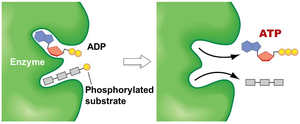
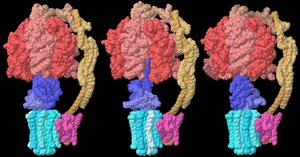
ATP synthase uses the proton-motive force generated by the ETC to synthesize ATP from ADP and inorganic phosphate. This process is called oxidative phosphorylation.
ATP Synthase: Enzyme that couples proton flow to ATP production.
Chemiosmosis: Movement of protons down their gradient drives ATP synthesis.
Yield: Most ATP from cellular respiration is produced by oxidative phosphorylation.
Aerobic vs. Anaerobic Respiration
Fermentation: An Alternative Pathway
When oxygen is unavailable, cells use fermentation to regenerate NAD+ so glycolysis can continue. Fermentation is less efficient than cellular respiration.
Lactic Acid Fermentation: Pyruvate accepts electrons from NADH, forming lactate and NAD+ (occurs in muscle cells).
Alcohol Fermentation: Pyruvate is converted to acetaldehyde and CO2; acetaldehyde accepts electrons from NADH, forming ethanol and NAD+ (occurs in yeast).
Efficiency: Fermentation produces only 2 ATP per glucose, compared to ~29 ATP in aerobic respiration.
Facultative Anaerobes: Organisms that can switch between fermentation and aerobic respiration depending on oxygen availability.
Summary Table: Cellular Respiration Stages
Stage | Location | Main Inputs | Main Outputs |
|---|---|---|---|
Glycolysis | Cytosol | Glucose, 2 ATP, 2 NAD+ | 2 Pyruvate, 2 NADH, 2 ATP |
Pyruvate Processing | Mitochondrial matrix | 2 Pyruvate, 2 NAD+, 2 CoA | 2 Acetyl CoA, 2 NADH, 2 CO2 |
Citric Acid Cycle | Mitochondrial matrix | 2 Acetyl CoA, 6 NAD+, 2 FAD, 2 ADP | 6 NADH, 2 FADH2, 2 ATP, 4 CO2 |
Electron Transport & Oxidative Phosphorylation | Inner mitochondrial membrane | NADH, FADH2, O2, ADP, Pi | ATP, H2O |
Key Equations
Overall Cellular Respiration:
ATP Synthesis (Chemiosmosis):
Additional info:
Metabolic pathways are interconnected, allowing flexibility in energy production and biosynthesis.
Feedback inhibition is a recurring regulatory mechanism in glycolysis, pyruvate processing, and the citric acid cycle.
