 Indietro
Cellular Respiration and Fermentation: Chapter 9 Study Notes
Guida di studio - Note intelligenti
 Appunti personalizzati basati sui tuoi materiali, ampliati con definizioni chiave, esempi e contesto.
Cellular Respiration and Fermentation
Introduction to Cellular Energy Production
Cells require energy to perform essential functions, and this energy is primarily supplied by ATP. Metabolic pathways harvest energy from high-energy molecules, such as glucose, to produce ATP. The process of cellular respiration is central to energy production in most organisms.
ATP fuels cellular work and is constantly produced due to its instability.
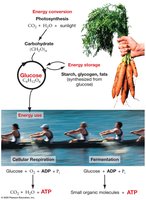
Glucose is obtained from photosynthesis (in plants) or food (in other organisms), and stored as glycogen or starch.
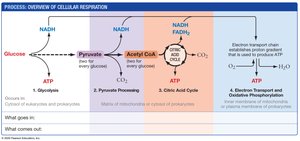
Overview of Cellular Respiration
Cellular respiration is a series of metabolic processes that oxidize glucose to generate ATP. It consists of four main steps, each with distinct inputs, outputs, and locations within the cell.
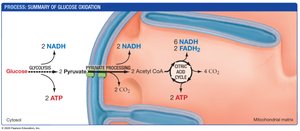
Glycolysis: Glucose is broken down into two pyruvate molecules in the cytosol.
Pyruvate Processing: Pyruvate is oxidized to form acetyl CoA.
Citric Acid Cycle: Acetyl CoA is oxidized to CO2.
Electron Transport and Oxidative Phosphorylation: Electrons are transferred through a chain, creating a proton gradient used to synthesize ATP.
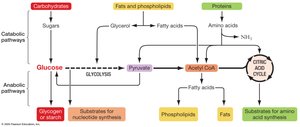
Catabolic and Anabolic Pathways in Metabolism
Cellular respiration interacts with other metabolic pathways, both catabolic (breaking down molecules) and anabolic (building molecules). This integration allows cells to efficiently manage energy and resources.
Catabolic pathways: Break down carbohydrates, fats, and proteins to produce ATP.
Anabolic pathways: Use intermediates from catabolic pathways to synthesize macromolecules.
Fats are broken into glycerol (enters glycolysis) and fatty acids (converted to acetyl CoA).
Proteins are broken into amino acids, which are processed and enter glycolysis or the citric acid cycle.
Four Steps of Cellular Respiration
Each step of cellular respiration is characterized by specific reactants, products, energy transformations, and cellular locations. Regulation of these steps ensures efficient energy production and homeostasis.
Glycolysis: Occurs in the cytosol; net yield is 2 NADH, 2 ATP, and 2 pyruvate.
Pyruvate Processing: Occurs in the mitochondrial matrix (eukaryotes); produces acetyl CoA, CO2, and NADH.
Citric Acid Cycle: Occurs in the mitochondrial matrix; oxidizes acetyl CoA to CO2, produces NADH, FADH2, and ATP.
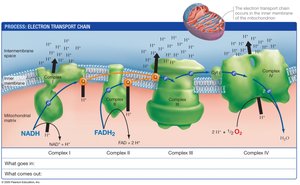
Electron Transport Chain: Located in the inner mitochondrial membrane; uses NADH and FADH2 to create a proton gradient for ATP synthesis.
Electron Transport Chain and ATP Synthesis
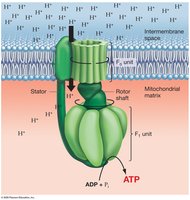
The electron transport chain (ETC) is composed of protein complexes and mobile carriers that transfer electrons from NADH and FADH2 to oxygen, forming water. The energy released is used to pump protons, creating a proton-motive force that drives ATP synthesis.
ETC: Organized into four complexes; electrons are transferred via ubiquinone (Q) and cytochrome c.
Protons are pumped into the intermembrane space, generating an electrochemical gradient.
ATP synthase uses this gradient to phosphorylate ADP, forming ATP.
ATP Yield from Cellular Respiration
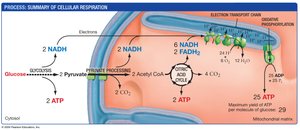
Most ATP is produced during oxidative phosphorylation, which utilizes the proton gradient established by the ETC. The maximum theoretical yield from one glucose molecule is about 29 ATP.
Substrate-level phosphorylation: Occurs during glycolysis and the citric acid cycle.
Oxidative phosphorylation: Occurs during electron transport and chemiosmosis.
ATP yield: Glycolysis (2 ATP), Citric Acid Cycle (2 ATP), Electron Transport Chain (about 25 ATP).
Key Terms and Concepts
ATP (Adenosine Triphosphate): The primary energy currency of the cell.
Glycolysis: The breakdown of glucose into pyruvate.
Pyruvate Processing: Conversion of pyruvate to acetyl CoA.
Citric Acid Cycle: Series of reactions that oxidize acetyl CoA to CO2.
Electron Transport Chain: Sequence of proteins that transfer electrons and pump protons.
Oxidative Phosphorylation: ATP synthesis driven by the proton gradient.
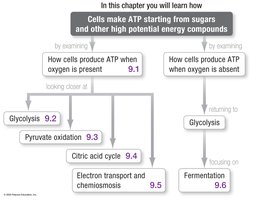
Fermentation: Alternative pathway for ATP production when oxygen is absent.
Summary Table: Steps of Cellular Respiration
Step | Main Reactants | Main Products | Location |
|---|---|---|---|
Glycolysis | Glucose, ATP | Pyruvate, NADH, ATP | Cytosol |
Pyruvate Processing | Pyruvate, NAD+ | Acetyl CoA, CO2, NADH | Mitochondrial matrix |
Citric Acid Cycle | Acetyl CoA, NAD+, FAD | CO2, NADH, FADH2, ATP | Mitochondrial matrix |
Electron Transport Chain | NADH, FADH2, O2 | ATP, H2O | Inner mitochondrial membrane |
Key Equations
Overall cellular respiration equation:
ATP synthesis by ATP synthase:
Additional info:
Homeostasis is maintained by regulating metabolic pathways, ensuring a stable internal environment.
Fermentation is an alternative pathway for ATP production in the absence of oxygen, yielding less ATP than cellular respiration.
