 Indietro
Cellular Respiration and Fermentation: Energy Harvesting in Cells
Guida di studio - Note intelligenti
 Appunti personalizzati basati sui tuoi materiali, ampliati con definizioni chiave, esempi e contesto.
Cellular Respiration and Fermentation
Overview of Cellular Respiration
Cellular respiration is a fundamental metabolic process in which cells convert energy stored in food molecules into ATP, the universal energy currency. This process is essential for powering cellular activities and is carried out in both prokaryotic and eukaryotic cells. - Cellular respiration transfers energy from organic molecules (such as sugars, fats, and proteins) into ATP. - Aerobic respiration uses oxygen as the final electron acceptor and produces carbon dioxide and water as waste products. - Fermentation is an alternative pathway used when oxygen is unavailable.
Organic Molecules as Fuels
Organic molecules, especially carbohydrates and fats, are excellent fuels because they contain many high-energy electrons, particularly in C–H bonds. Cells harvest this energy stepwise, transferring electrons to carriers and eventually making ATP. - Carbohydrates and fats are rich in high-energy electrons. - Energy is harvested gradually to maximize ATP production and minimize energy loss as heat.
Stages of Cellular Respiration
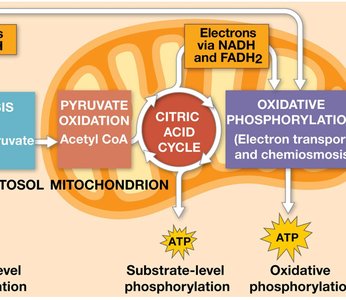
Cellular respiration consists of three interconnected stages, each occurring in specific cellular locations and involving distinct biochemical pathways.
Glycolysis: Breaks glucose into two pyruvate molecules in the cytosol.
Pyruvate Oxidation and Citric Acid Cycle: Completes the breakdown of pyruvate in the mitochondrial matrix (eukaryotes).
Oxidative Phosphorylation: Uses electrons from NADH and FADH2 to generate most of the ATP in the inner mitochondrial membrane.
Redox Reactions in Cellular Respiration
Energy transfer in cellular respiration occurs through redox reactions, where electrons are transferred from one molecule to another. - Oxidation: Loss of electrons (e.g., glucose is oxidized). - Reduction: Gain of electrons (e.g., oxygen is reduced). - OIL RIG: Oxidation Is Loss, Reduction Is Gain. - Electron transfer releases usable energy for ATP synthesis.
Role of Electron Carriers
Cells use coenzymes such as NAD+ and FAD to safely transport high-energy electrons. - NAD+ is reduced to NADH. - FAD is reduced to FADH2. - These carriers deliver electrons to the electron transport chain for ATP production.
Mitochondria: The Site of Respiration
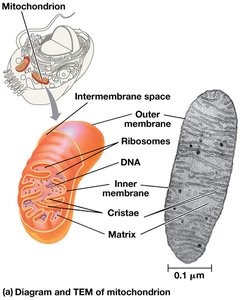
In eukaryotes, mitochondria are the primary site of aerobic respiration. Their structure is specialized for efficient energy conversion. - Outer membrane: Separates mitochondrion from cytosol. - Inner membrane: Folded into cristae, increasing surface area for electron transport and ATP synthesis. - Matrix: Contains enzymes for pyruvate oxidation and the citric acid cycle. 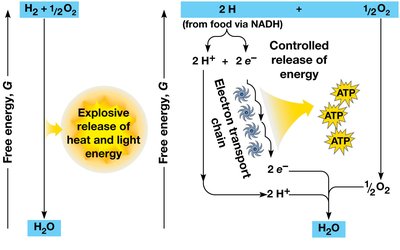
ATP Production Mechanisms
There are two main ways to produce ATP during cellular respiration:
Substrate-level phosphorylation: An enzyme directly transfers a phosphate group from a substrate to ADP, forming ATP. Occurs during glycolysis and the citric acid cycle.
Oxidative phosphorylation: Uses energy from electrons carried by NADH/FADH2 to drive ATP synthase via the electron transport chain and chemiosmosis. Produces the majority of ATP.
Glycolysis
Glycolysis: Sugar Splitting
Glycolysis is the first stage of cellular respiration, breaking down glucose into two pyruvate molecules. It occurs in the cytosol and is present in all living cells. - Glucose (6C) is split into two pyruvate (3C) molecules. - Consists of two phases: energy investment and energy payoff. 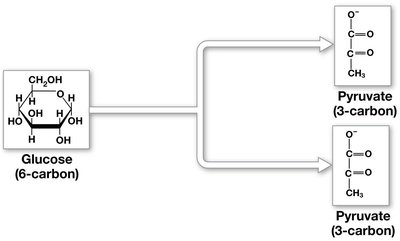
Energy Investment Phase
The cell spends ATP to phosphorylate glucose, priming it for breakdown. - 2 ATP are used to phosphorylate glucose. - The 6-carbon sugar is split into two 3-carbon molecules (G3P). 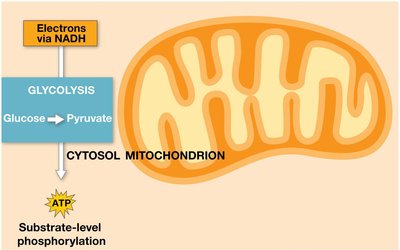
Energy Payoff Phase
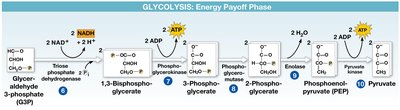
Each G3P is oxidized, transferring electrons to NAD+ and producing ATP by substrate-level phosphorylation. - 4 ATP and 2 NADH are produced. - Two pyruvate molecules are formed. 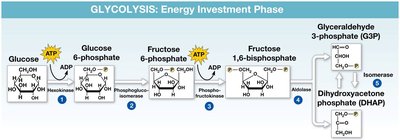
Net Products of Glycolysis
Per glucose molecule, glycolysis yields:
2 Pyruvate
2 NADH + 2 H+
2 H2O
Net 2 ATP (4 produced – 2 invested)
Pyruvate Oxidation
Conversion of Pyruvate to Acetyl CoA
After glycolysis, pyruvate is transported into the mitochondrial matrix (in eukaryotes) and converted to acetyl CoA. - Each pyruvate (3C) is converted into acetyl CoA (2C), releasing 1 CO2 and producing 1 NADH. - Per glucose: 2 NADH and 2 CO2 are generated. 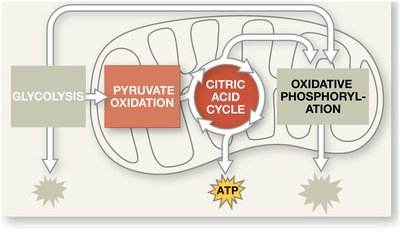
Citric Acid Cycle (Krebs Cycle)
Overview of the Citric Acid Cycle
The citric acid cycle completes the breakdown of glucose by oxidizing acetyl CoA. It occurs in the mitochondrial matrix and regenerates oxaloacetate. - Acetyl CoA (2C) combines with oxaloacetate (4C) to form citrate (6C). - Citrate is oxidized through enzyme-catalyzed steps, regenerating oxaloacetate. - Each turn produces: 3 NADH, 1 FADH2, 1 ATP, 2 CO2. - The cycle runs twice per glucose. 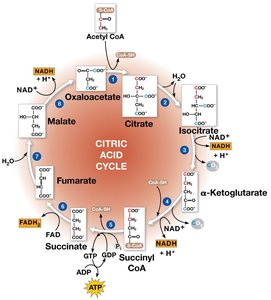
Oxidative Phosphorylation
Electron Transport Chain (ETC)
Most ATP is produced during oxidative phosphorylation, which involves the electron transport chain and chemiosmosis. - Electrons from NADH and FADH2 are passed through a series of multiprotein complexes in the inner mitochondrial membrane. - The final electron acceptor is oxygen, forming water. 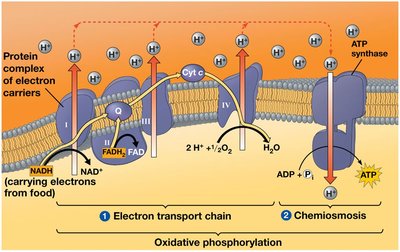
Proton-Motive Force and Chemiosmosis
The ETC releases energy, which is used to pump H+ into the intermembrane space, creating an electrochemical gradient (proton-motive force). - H+ flows back into the matrix through ATP synthase, driving ATP production. - This process is called chemiosmosis.
Energy Yield
Complete oxidation of one glucose typically produces about 30–32 ATP in a eukaryotic cell. - The exact yield varies due to cellular processes that use the proton-motive force.
ATP Production Without Oxygen
Anaerobic Respiration and Fermentation
When oxygen is unavailable, cells can produce ATP through anaerobic respiration or fermentation. - Anaerobic respiration: Uses an ETC with a non-oxygen final electron acceptor (e.g., sulfate). - Fermentation: No ETC; ATP is produced only by substrate-level phosphorylation.
Fermentation Pathways
Fermentation consists of glycolysis and reactions that regenerate NAD+. Two common types are:
Alcohol fermentation: Pyruvate is converted to ethanol, releasing CO2 and regenerating NAD+.
Lactic acid fermentation: Pyruvate is reduced to lactate, regenerating NAD+ without releasing CO2.
Comparison Table: Fermentation, Anaerobic, and Aerobic Respiration
Feature | Fermentation | Anaerobic Respiration | Aerobic Respiration |
|---|---|---|---|
Electron Transport Chain | No | Yes | Yes |
Final Electron Acceptor | Organic molecule | Non-oxygen acceptor | Oxygen |
ATP Production | Substrate-level phosphorylation | Mostly oxidative phosphorylation | Mostly oxidative phosphorylation |
Relative ATP Yield | Lowest | Variable | Usually highest |
Example: Yeast uses alcohol fermentation in brewing, winemaking, and baking. Muscle cells use lactic acid fermentation during intense exercise. Additional info: The notes provide a comprehensive overview of cellular respiration, including glycolysis, pyruvate oxidation, citric acid cycle, oxidative phosphorylation, and fermentation, suitable for General Biology college students.
